
Join Our JEE Preparation Group
Prep with like-minded aspirants; Get access to free daily tests and study material.
Sign in
Please select an account to continue using cracku.in
↓ →
Join Our JEE Preparation Group
Prep with like-minded aspirants; Get access to free daily tests and study material.
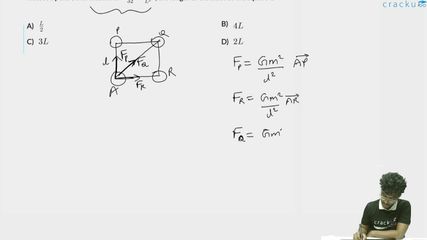
Four identical particles of mass $$m$$ are kept at the four corners of a square. If the gravitational force exerted on one of the masses by the other masses is $$\frac{2\sqrt{2}+1}{32}\frac{Gm^2}{L^2}$$, the length of the sides of the square is
Four identical particles of mass $$m$$ are at the corners of a square of side $$a$$. The net gravitational force on one particle due to the other three is given as $$\frac{(2\sqrt{2}+1)}{32}\frac{Gm^2}{L^2}$$. We need to find $$a$$ in terms of $$L$$.
Consider the particle at one corner. The other three particles are two adjacent particles at distance $$a$$ (along the sides) and one diagonal particle at distance $$a\sqrt{2}$$. Each adjacent particle exerts a force: $$F_{adj} = \frac{Gm^2}{a^2}$$. The two adjacent forces are perpendicular to each other along the two sides of the square, so by the Pythagorean theorem the resultant is $$F_{resultant,adj} = \sqrt{F_{adj}^2 + F_{adj}^2} = F_{adj}\sqrt{2} = \frac{\sqrt{2}\cdot Gm^2}{a^2}$$. This resultant points along the diagonal toward the diagonally opposite corner.
The diagonal particle exerts a force $$F_{diag} = \frac{Gm^2}{(a\sqrt{2})^2} = \frac{Gm^2}{2a^2}$$, which also points along the same diagonal direction. Since all forces are along the diagonal, the total net force is $$F_{net} = \frac{\sqrt{2}\cdot Gm^2}{a^2} + \frac{Gm^2}{2a^2} = \frac{Gm^2}{a^2}\left(\sqrt{2} + \tfrac{1}{2}\right) = \frac{(2\sqrt{2}+1)}{2}\cdot\frac{Gm^2}{a^2}$$. Equating this to the given expression $$\frac{(2\sqrt{2}+1)}{2}\cdot\frac{Gm^2}{a^2} = \frac{(2\sqrt{2}+1)}{32}\cdot\frac{Gm^2}{L^2}$$, the common factor $$(2\sqrt{2}+1)\,Gm^2$$ cancels, giving $$\frac{1}{2a^2} = \frac{1}{32L^2}$$, and hence $$2a^2 = 32L^2$$, $$a^2 = 16L^2$$, $$a = 4L$$.
The correct answer is Option (2): $$4L$$.
Was this solution helpful?
Click on the Email ☝️ to Watch the Video Solution
Create a FREE account and get:
_1.webp)

Educational materials for JEE preparation

Ask our AI anything

AI can make mistakes. Please verify important information.
AI can make mistakes. Please verify important information.
