For the following questions answer them individually
If the percentage errors in measuring the length and the diameter of a wire are $$0.1\%$$ each. The percentage error in measuring its resistance will be:
A force is represented by $$F = ax^2 + bt^{1/2}$$, where $$x$$ = distance and $$t$$ = time. The dimensions of $$\frac{b^2}{a}$$ are :
The relation between time '$$t$$' and distance '$$x$$' is $$t = \alpha x^2 + \beta x$$, where $$\alpha$$ and $$\beta$$ are constants. The relation between acceleration $$a$$ and velocity $$v$$ is:
A small steel ball is dropped into a long cylinder containing glycerine. Which one of the following is the correct representation of the velocity time graph for the transit of the ball?
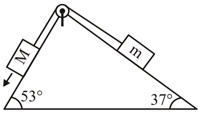
In the given arrangement of a doubly inclined plane two blocks of masses $$M$$ and $$m$$ are placed. The blocks are connected by a light string passing over an ideal pulley as shown. The coefficient of friction between the surface of the plane and the blocks is $$0.25$$. The value of $$m$$, for which $$M = 10$$ kg will move down with an acceleration of $$2 \text{ m s}^{-2}$$, is: (take $$g = 10 \text{ m s}^{-2}$$ and $$\tan 37° = \frac{3}{4}$$)
A coin is placed on a disc. The coefficient of friction between the coin and the disc is $$\mu$$. If the distance of the coin from the center of the disc is $$r$$, the maximum angular velocity which can be given to the disc, so that the coin does not slip away, is :
An artillery piece of mass $$M_1$$ fires a shell of mass $$M_2$$ horizontally. Instantaneously after the firing, the ratio of kinetic energy of the artillery and that of the shell is :
Four identical particles of mass $$m$$ are kept at the four corners of a square. If the gravitational force exerted on one of the masses by the other masses is $$\frac{2\sqrt{2}+1}{32}\frac{Gm^2}{L^2}$$, the length of the sides of the square is
Two conductors have the same resistances at $$0°C$$ but their temperature coefficients of resistance are $$\alpha_1$$ and $$\alpha_2$$. The respective temperature coefficients for their series and parallel combinations are :
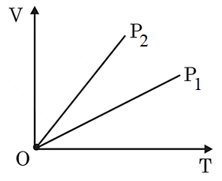
The given figure represents two isobaric processes for the same mass of an ideal gas, then