
Join Our JEE Preparation Group
Prep with like-minded aspirants; Get access to free daily tests and study material.
Sign in
Please select an account to continue using cracku.in
↓ →
Join Our JEE Preparation Group
Prep with like-minded aspirants; Get access to free daily tests and study material.
Two conductors have the same resistances at $$0°C$$ but their temperature coefficients of resistance are $$\alpha_1$$ and $$\alpha_2$$. The respective temperature coefficients for their series and parallel combinations are :
Two conductors have the same resistance $$R_0$$ at $$0°C$$ but different temperature coefficients $$\alpha_1$$ and $$\alpha_2$$. The resistance at temperature $$T$$ can be written as $$R = R_0(1 + \alpha T)$$, so for these conductors: $$R_1 = R_0(1 + \alpha_1 T), \quad R_2 = R_0(1 + \alpha_2 T)$$.
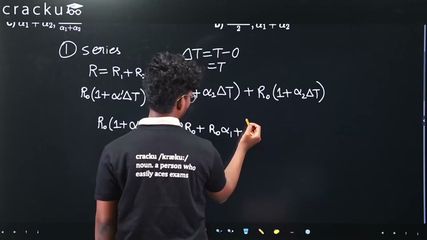
For the series combination the total resistance is $$R_s = R_1 + R_2 = R_0(1 + \alpha_1 T) + R_0(1 + \alpha_2 T) = 2R_0\left(1 + \frac{\alpha_1 + \alpha_2}{2}T\right)$$, so the equivalent resistance at $$0°C$$ is $$R_{s,0} = 2R_0$$ and the effective temperature coefficient becomes $$\alpha_s = \frac{\alpha_1 + \alpha_2}{2}$$.
In the parallel combination one has $$\frac{1}{R_p} = \frac{1}{R_1} + \frac{1}{R_2} = \frac{1}{R_0(1+\alpha_1 T)} + \frac{1}{R_0(1+\alpha_2 T)}$$. Using the linear approximation $$(1 + \alpha T)^{-1} \approx (1 - \alpha T)$$ for small $$\alpha T$$ gives $$\frac{1}{R_p} \approx \frac{1}{R_0}(1 - \alpha_1 T) + \frac{1}{R_0}(1 - \alpha_2 T) = \frac{2}{R_0}\left(1 - \frac{\alpha_1 + \alpha_2}{2}T\right)$$ and hence $$R_p \approx \frac{R_0}{2} \cdot \frac{1}{1 - \frac{\alpha_1+\alpha_2}{2}T} \approx \frac{R_0}{2}\left(1 + \frac{\alpha_1 + \alpha_2}{2}T\right)$$, so the equivalent resistance at $$0°C$$ is $$R_{p,0} = \frac{R_0}{2}$$ and the effective temperature coefficient is $$\alpha_p = \frac{\alpha_1 + \alpha_2}{2}$$.
Key insight: When both conductors have the same initial resistance $$R_0$$, the effective temperature coefficient is $$\frac{\alpha_1 + \alpha_2}{2}$$ for both series and parallel combinations.
The correct answer is Option (2): $$\frac{\alpha_1+\alpha_2}{2}, \frac{\alpha_1+\alpha_2}{2}$$.
Was this solution helpful?
Click on the Email ☝️ to Watch the Video Solution
Create a FREE account and get:
_1.webp)

Educational materials for JEE preparation

Ask our AI anything

AI can make mistakes. Please verify important information.
AI can make mistakes. Please verify important information.
