
Join Our JEE Preparation Group
Prep with like-minded aspirants; Get access to free daily tests and study material.
Sign in
Please select an account to continue using cracku.in
↓ →
Join Our JEE Preparation Group
Prep with like-minded aspirants; Get access to free daily tests and study material.
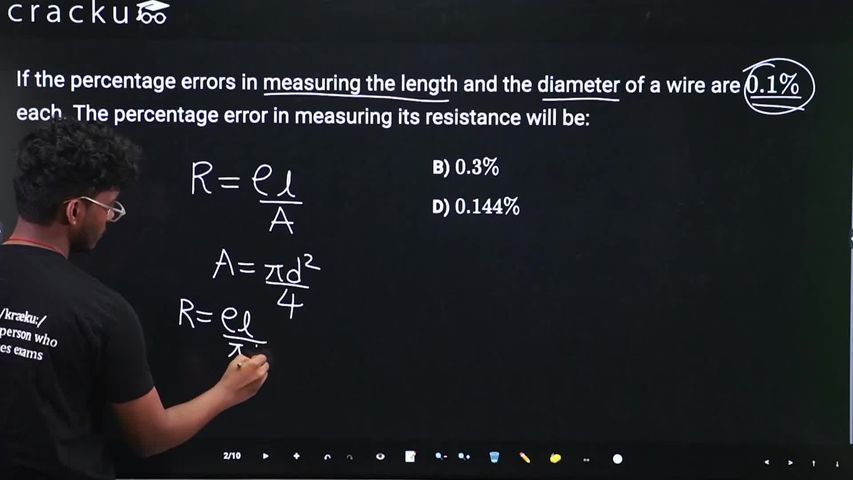
If the percentage errors in measuring the length and the diameter of a wire are $$0.1\%$$ each. The percentage error in measuring its resistance will be:
We need to find the percentage error in measuring the resistance of a wire, given percentage errors in length and diameter measurements.
The resistance of a wire is given by $$R = \frac{\rho L}{A}$$, where $$\rho$$ is the resistivity, $$L$$ is the length, and $$A$$ is the cross-sectional area. For a circular wire with diameter $$d$$, $$A = \frac{\pi d^2}{4}$$. Therefore, $$R = \frac{\rho L}{\frac{\pi d^2}{4}} = \frac{4\rho L}{\pi d^2}$$.
To determine the propagation of error for $$R = \frac{4\rho L}{\pi d^2}$$ (with $$\rho$$ treated as a constant), we take the natural logarithm: $$\ln R = \ln(4\rho/\pi) + \ln L - 2\ln d$$. Differentiating yields $$\frac{\Delta R}{R} = \frac{\Delta L}{L} + 2\frac{\Delta d}{d}$$, where absolute values are taken to represent maximum error.
Given that $$\frac{\Delta L}{L}\times100 = 0.1\%$$ and $$\frac{\Delta d}{d}\times100 = 0.1\%$$, it follows that $$\frac{\Delta R}{R}\times100 = 0.1\% + 2\times0.1\% = 0.3\%$$.
The percentage error in measuring the resistance is 0.3%. Hence the correct answer is Option (2): 0.3%.
Was this solution helpful?
Click on the Email ☝️ to Watch the Video Solution
Create a FREE account and get:
_1.webp)

Educational materials for JEE preparation

Ask our AI anything

AI can make mistakes. Please verify important information.
AI can make mistakes. Please verify important information.
