
Join Our JEE Preparation Group
Prep with like-minded aspirants; Get access to free daily tests and study material.
Sign in
Please select an account to continue using cracku.in
↓ →
Join Our JEE Preparation Group
Prep with like-minded aspirants; Get access to free daily tests and study material.
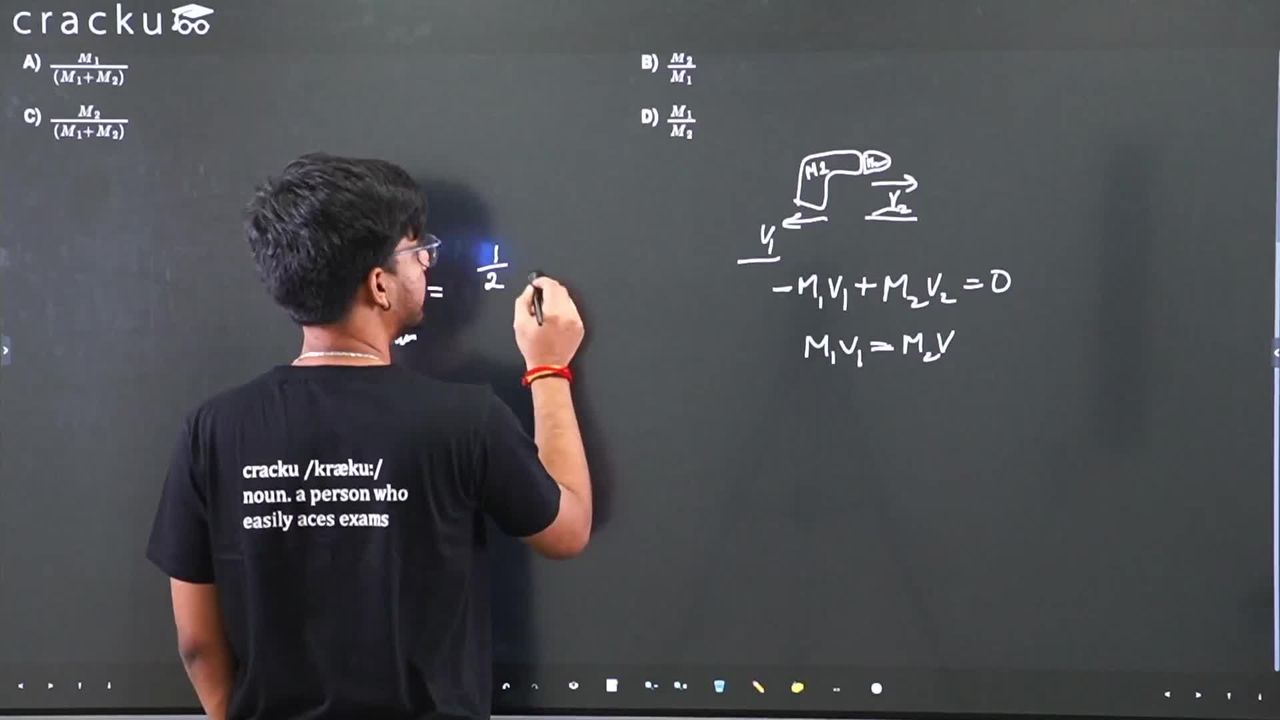
An artillery piece of mass $$M_1$$ fires a shell of mass $$M_2$$ horizontally. Instantaneously after the firing, the ratio of kinetic energy of the artillery and that of the shell is :
An artillery piece of mass $$M_1$$ fires a shell of mass $$M_2$$ horizontally, and we seek the ratio of the kinetic energy of the artillery to that of the shell immediately after firing.
Before firing, both the artillery and the shell are at rest, so the total momentum is zero. By conservation of momentum, the total momentum after firing must also be zero:
$$ M_1 v_1 + M_2 v_2 = 0 $$ where $$v_1$$ is the recoil velocity of the artillery and $$v_2$$ is the velocity of the shell. It follows that
$$ M_1 v_1 = -M_2 v_2 $$ and taking magnitudes gives
$$ |v_1| = \frac{M_2 |v_2|}{M_1} $$.
The kinetic energy of the artillery is
$$ KE_1 = \frac{1}{2}M_1 v_1^2 \quad (\text{artillery}) $$ and that of the shell is
$$ KE_2 = \frac{1}{2}M_2 v_2^2 \quad (\text{shell}) $$.
Their ratio is
$$ \frac{KE_1}{KE_2} = \frac{\frac{1}{2}M_1 v_1^2}{\frac{1}{2}M_2 v_2^2} = \frac{M_1}{M_2} \cdot \frac{v_1^2}{v_2^2} $$. Substituting $$v_1 = \frac{M_2 v_2}{M_1}$$ gives
$$ \frac{KE_1}{KE_2} = \frac{M_1}{M_2} \cdot \frac{M_2^2 v_2^2}{M_1^2 v_2^2} = \frac{M_1}{M_2} \cdot \frac{M_2^2}{M_1^2} = \frac{M_2}{M_1} $$.
An alternative derivation notes that both objects have the same magnitude of momentum ($$p = M_1|v_1| = M_2|v_2|$$), and since $$KE = \frac{p^2}{2M}$$ one obtains
$$ \frac{KE_1}{KE_2} = \frac{p^2/(2M_1)}{p^2/(2M_2)} = \frac{M_2}{M_1} $$.
The correct answer is Option (2): $$\frac{M_2}{M_1}$$.
Was this solution helpful?
Click on the Email ☝️ to Watch the Video Solution
Create a FREE account and get:
_1.webp)

Educational materials for JEE preparation

Ask our AI anything

AI can make mistakes. Please verify important information.
AI can make mistakes. Please verify important information.
