
Join Our JEE Preparation Group
Prep with like-minded aspirants; Get access to free daily tests and study material.
Sign in
Please select an account to continue using cracku.in
↓ →
Join Our JEE Preparation Group
Prep with like-minded aspirants; Get access to free daily tests and study material.
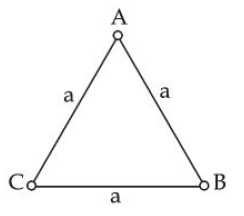
Three equal masses m are kept at vertices (A, B, C) of an equilateral triangle of side a in free space. At t=0, they are given an initial velocity $$\vec{V}_A = V_0 \overrightarrow{AC}$$, $$\vec{V}_B = V_0 \overrightarrow{BA}$$ and $$\vec{V}_C = V_0 \overrightarrow{CB}$$. Here $$\overrightarrow{AC}$$, $$\overrightarrow{CB}$$ and $$\overrightarrow{BA}$$ are unit vectors along the edges of the triangle. If the three masses interact gravitationally, then the magnitude of the net angular momentum of the system at the point of collision is :
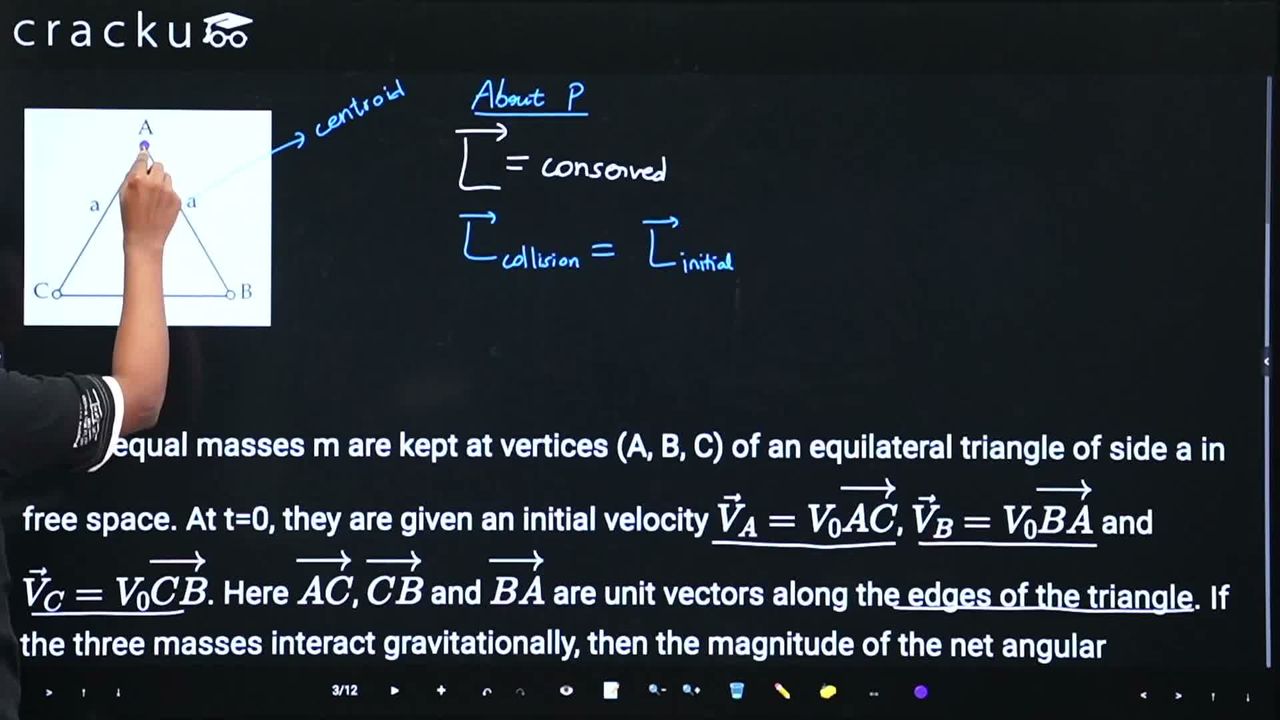
Since the masses interact only via internal gravitational forces, there is no external torque, and the total angular momentum ($$\vec{L}$$) remains constant from $$t=0$$ until the point of collision.
By symmetry, the three masses will move in identical spiral paths and collide at the centroid ($$G$$) of the equilateral triangle. It is most convenient to calculate the angular momentum about this point.
For an equilateral triangle of side $$a$$, the distance from any vertex to the centroid ($$r$$) is $$r = \frac{a}{\sqrt{3}}$$
The velocity vector $$\vec{V}_A$$ is directed along the side $$AC$$. The angle between the position vector $$\vec{r}_A$$ (from $$G$$ to $$A$$) and the side $$AC$$ is $$30^\circ$$. Therefore, the angle $$\phi$$ between the position vector and the velocity vector is $$150^\circ$$
$$L_1 = mvr \sin \phi$$
$$L_1 = m V_0 \left( \frac{a}{\sqrt{3}} \right) \sin(150^\circ)$$
$$L_1 = \frac{maV_0}{2\sqrt{3}}$$
$$L_{net} = 3 \times L_1 = 3 \times \frac{maV_0}{2\sqrt{3}}$$
$$L_{net} = \frac{\sqrt{3}}{2} amV_0$$
Was this solution helpful?
Click on the Email ☝️ to Watch the Video Solution
Create a FREE account and get:
_1.webp)

Educational materials for JEE preparation

Ask our AI anything

AI can make mistakes. Please verify important information.
AI can make mistakes. Please verify important information.
