JEE WhatsApp Group



JEE Oscillations PYQs
JEE Oscillations PYQs are an important part of the JEE Physics syllabus. They help you understand the kind of questions asked from this chapter and check how well you know the main ideas, such as simple harmonic motion, displacement, velocity, acceleration, time period, frequency, phase, and energy in oscillation.
In the exam, oscillations questions usually come as direct numerical problems or simple concept-based questions. The good thing is that this chapter becomes much easier when your basics are clear. Once you understand the concepts properly and know which formula to use, solving questions feels much more manageable. You do not need to think of oscillations as a very difficult chapter. With regular revision and smart practice, it can become one of the more scoring parts of JEE Physics.
In this blog, you will find a simple formula PDF, a section for important JEE Oscillations PYQs in download format, a few practice questions with answers, and some extra questions to solve on your own. You will also learn about common mistakes students often make and a few simple tips to save time in the exam.
JEE Oscillations Important PYQs PDF
This PDF can include the most important previous year questions from oscillations. It may cover topics like simple harmonic motion, displacement equation, velocity and acceleration in SHM, spring-mass system, pendulum, time period, frequency, energy in SHM, and phase difference.
Practicing these questions will help you understand the exam pattern better. It will also improve your speed, accuracy, and confidence before the exam.
Important Formulas for JEE Oscillations PYQs
You only need a few important formulas and ideas to solve most oscillations questions in JEE. These formulas help you understand SHM better and calculate time period, frequency, displacement, velocity, acceleration, and energy more easily.
You can download the full formula PDF from the link above. Here is a quick look at some of the main formulas:
Concept | Formula |
Displacement in SHM | x = A sin ωt or x = A cos ωt |
Velocity in SHM | v = ω√(A² − x²) |
Acceleration in SHM | a = -ω²x |
Time Period | T = 2π/ω |
Frequency | f = 1/T |
Angular Frequency | ω = 2πf |
Time Period of Spring-Mass System | T = 2π√(m/k) |
Time Period of Simple Pendulum | T = 2π√(l/g) |
Total Energy in SHM | E = ½kA² |
Potential Energy in SHM | U = ½kx² |
Kinetic Energy in SHM | K = ½k(A² − x²) |
These formulas are commonly used in questions based on simple harmonic motion, spring systems, pendulum motion, displacement, velocity, acceleration, and energy. If you revise them properly, many JEE questions will start to feel much easier.
Top 5 Common Mistakes to Avoid in JEE Oscillations PYQs
Many students find oscillations confusing at first because it includes both concepts and formulas. But most mistakes happen because small details are missed while solving. Here are some common mistakes you should avoid:
Mixing up displacement, velocity, and acceleration
In SHM, all three are related, but they are not the same. Displacement tells you the position, velocity tells you how fast the position is changing, and acceleration always acts toward the mean position.
Using the wrong formula for time period
The time period formula is different for a spring-mass system and a simple pendulum. Many students mix them up and lose easy marks.
Forgetting that acceleration is opposite to displacement
In SHM, acceleration always acts toward the mean position. If you ignore the negative sign in the formula, the concept can become confusing.
Confusing frequency and angular frequency
These two are related, but they are not the same. Frequency is measured in hertz, while angular frequency is measured in rad/s.
Making mistakes in energy-based questions
At the mean position, kinetic energy is maximum and potential energy is minimum. At the extreme position, potential energy is maximum and kinetic energy is zero. Students often mix up these conditions.
List of JEE Oscillations PYQs
Here is a short set of JEE-style oscillations questions for practice. These include common question types from SHM, time period, frequency, acceleration, and energy. Solving them regularly can help you become faster and more confident.
Question 1
The kinetic energy of a simple harmonic oscillator is oscillating with angular frequency of 176 rad/ s. The frequency of this simple harmonic oscillator is _____Hz. [take $$\pi = \frac{22}{7}$$]
correct answer:- 4
Question 2
Using a simple pendulum experiment g is determind by measuring its time period T. Which of the following plots represent the correct relation between the pendulum length L and time period T?
correct answer:- 2
Question 3
A simple pendulum of string length 30 cm performs 20 oscillations in 10 s. The length of the string required for the pendulum to perfo rm 40 oscillations in the same time duration is _________cm. [Assume that the mass of the pendulum remains same.]
correct answer:- 4
Question 4
A cylindrical block of mass M and area of cross section A is floating in a liquid of density $$\rho$$ and with its axis vertical. When depressed a little and released the block starts oscillating. The period of oscillation is ___
correct answer:- 1
Question 5
A spring of force constant 15 N/m is cut into two pieces. If the ratio of their length is 1:3, then the force constant of smaller piece is __ /m.
correct answer:- 3

Question 6
The displacement of a particle, executing simple harmonic motion with time period T, is expressed as $$x(t) = A\sin \omega t$$, where A is the amplitude. The maximum value of potential energy of this oscillator is found at $$t=T/2\beta$$. The value of $$\beta$$ is_____.
correct answer:- 2
Question 7
As shown in the figure, a spring is kept in a stretched position with some extension by holding the masses 1 kg and 0.2 kg with a separation more than spring natural length and are released. Assuming the horizontal serface to be frictionless, the angular frequency (in SI unit) of the system is:
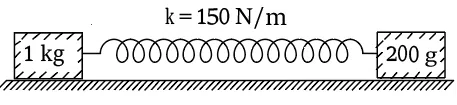
correct answer:- 4
Question 8
A particle is executing simple harmonic motion with time period $$2\,s$$ and amplitude $$1\,cm.$$ If $$D$$ and $$d$$ are the total distance and displacement covered by the particle in $$12.5\,s,$$ then $$\frac{D}{d}$$ is:
correct answer:- 4
Question 9
Given below are two statements : one is labelled as Assertion (A) and the other is labelled as Reason (R). Assertion (A) : Time period of a simple pendulum is longer at the top of a mountain than that at the base of the mountain. Reason (R): Time period of a simple pendulum decreases with increasing value of acceleration due to gravity and vice-versa. In the light of the above statements, choose the most appropriate answer from the options given below :
correct answer:- 1
Question 10
A light hollow cube of side length 10 cm and mass 10 g , is floating in water. It is pushed down and released to execute simple harmonic oscillations. The time period of oscillations is $$y\pi\times10^{-2}s$$, where the value of y is (Acceleration due to gravity, $$g=10 m/s^{2}$$, density of water $$=10^{3}kg/m^{3}$$
correct answer:- 2

Question 11
Two bodies A and B of equal mass are suspended from two massless springs of spring constant $$k_{1}$$ and $$k_{2}$$, respectively. If the bodies oscillate vertically such that their amplitudes are equal, the ratio of the maximum velocity of A to the maximum velocity of B is
correct answer:- 2
Question 12
An elastic spring under tension of 3 N has a length a. Its length is b under tension 2 N. For its length (3a − 2b), the value of tension will be ______ N.
correct answer:- 5
Question 13
Given below are two statements. One is labelled as Assertion (A) and the other is labelled as Reason (R). Assertion (A) : Knowing initial position $$x_{\circ}$$ and initial momentum $$p_{\circ}$$ is enough to determine the position and momentum at any time $$t$$ for a simple harmonic motion with a given angular frequency $$\omega$$. Reason (R): The amplitude and phase can be expressed in terms of $$x_{\circ}$$ and $$p_{\circ}$$. In the light of the above statements, choose the correct answer from the options given below :
correct answer:- 4
Question 14
A mass $$m$$ is suspended from a spring of negligible mass and the system oscillates with a frequency $$f_1$$. The frequency of oscillations if a mass $$9m$$ is suspended from the same spring is $$f_2$$. The value of $$\frac{f_1}{f_2}$$ is ______.
correct answer:- 3
Question 15
A particle executes simple harmonic motion with an amplitude of $$4$$ cm. At the mean position, velocity of the particle is $$10 \text{ cm s}^{-1}$$. The distance of the particle from the mean position when its speed becomes $$5 \text{ cm s}^{-1}$$ is $$\sqrt{\alpha}$$ cm, where $$\alpha =$$ ______.
correct answer:- 12

Question 16
A ball suspended by a thread swings in a vertical plane so that its magnitude of acceleration in the extreme position and lowest position are equal. The angle ($$\theta$$) of thread deflection in the extreme position will be :
correct answer:- 2
Question 17
When the displacement of a simple harmonic oscillator is one third of its amplitude, the ratio of total energy to the kinetic energy is $$\frac{x}{8}$$, where $$x =$$ _______.
correct answer:- 9
Question 18
A simple harmonic oscillator has an amplitude $$A$$ and time period $$6\pi$$ second. Assuming the oscillation starts from its mean position, the time required by it to travel from $$x = A$$ to $$x = \frac{\sqrt{3}}{2}A$$ will be $$\frac{\pi}{x}$$ s, where $$x =$$ ______.
correct answer:- 2
Question 19
A simple pendulum is placed at a place where its distance from the earth's surface is equal to the radius of the earth. If the length of the string is 4 m, then the time period of small oscillations will be _________ s. [take $$g = \pi^2$$ m s$$^{-2}$$]
correct answer:- 8
Question 20
A particle performs simple harmonic motion with amplitude $$A$$. Its speed is increased to three times at an instant when its displacement is $$\frac{2A}{3}$$. The new amplitude of motion is $$\frac{nA}{3}$$. The value of $$n$$ is _____.
correct answer:- 7

Question 21
The measured value of the length of a simple pendulum is 20 cm with 2 mm accuracy. The time for 50 oscillations was measured to be 40 seconds with 1 second resolution. From these measurements, the accuracy in the measurement of acceleration due to gravity is $$N$$%. The value of $$N$$ is:
correct answer:- 3
Question 22
The time period of simple harmonic motion of mass $$M$$ in the given figure is $$\pi\sqrt{\frac{\alpha M}{5K}}$$, where the value of $$\alpha$$ is
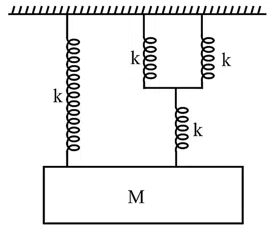
correct answer:- 12
Question 23
In simple harmonic motion, the total mechanical energy of given system is $$E$$. If mass of oscillating particle $$P$$ is doubled then the new energy of the system for same amplitude is
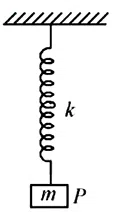
correct answer:- 1
Question 24
The displacement of a particle executing SHM is given by $$x = 10 \sin\left(\omega t + \frac{\pi}{3}\right)$$ m. The time period of motion is $$3.14$$ s. The velocity of the particle at $$t = 0$$ is _____ m/s.
correct answer:- 10
Question 25
A particle is doing simple harmonic motion of amplitude $$0.06 \text{ m}$$ and time period $$3.14 \text{ s}$$. The maximum velocity of the particle is _______ cm/s.
correct answer:- 12

Question 26
An object of mass 0.2 kg executes simple harmonic motion along x axis with frequency of $$\left(\frac{25}{\pi}\right)$$ Hz. At the position $$x = 0.04$$ m the object has kinetic energy 0.5 J and potential energy 0.4 J. The amplitude of oscillation is _____ cm.
correct answer:- 6
Question 27
The position, velocity and acceleration of a particle executing simple harmonic motion are found to have magnitudes of $$4$$ m, $$2$$ ms$$^{-1}$$ and $$16$$ ms$$^{-2}$$ at a certain instant. The amplitude of the motion is $$\sqrt{x}$$ m, where $$x$$ is ________
correct answer:- 17
Question 28
A particle of mass $$0.50 \text{ kg}$$ executes simple harmonic motion under force $$F = -50 \text{ (Nm}^{-1}\text{)}x$$. The time period of oscillation is $$\frac{\pi}{x}$$ s. The value of $$x$$ is ______ (Given $$\pi = \frac{22}{7}$$)
correct answer:- 5
Question 29
The amplitude of a particle executing SHM is 3 cm. The displacement at which its kinetic energy will be 25% more than the potential energy is: ______ cm.
correct answer:- 2
Question 30
A block is fastened to a horizontal spring. The block is pulled to a distance $$x = 10$$ cm from its equilibrium position (at $$x = 0$$) on a frictionless surface from rest. The energy of the block at $$x = 5$$ cm is 0.25 J. The spring constant of the spring is ______ $$\text{N m}^{-1}$$.
correct answer:- 67
Question 31
Choose the correct length $$(L)$$ versus square of time period $$(T_2)$$ graph for a simple pendulum executing simple harmonic motion
correct answer:- 4
Question 32
A block of mass 2 kg is attached with two identical springs of spring constant 20 $$\text{N m}^{-1}$$ each. The block is placed on a frictionless surface and the ends of the springs are attached to rigid supports (see figure). When the mass is displaced from its equilibrium position, it executes a simple harmonic motion. The time period of oscillation is $$\frac{\pi}{\sqrt{X}}$$ in SI unit. The value of $$X$$ is _____.
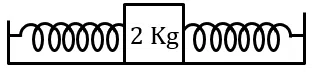
correct answer:- 5
Question 33
Two strings (A, B) having linear densities $$\mu_{A}=2\times10^{-4}kg/m\text{ and },\mu_{B}=4\times10^{-4}kg/m$$ and lengths $$L_{A}=2.5m$$ and $$L_{B}=1.5m$$ respectively are joined. Free ends of A and B are tied to two rigid supports C and D, respectively creating a tension of 500 N in the wire. Two identical pulses, sent from C and D ends, take time $$t_{1}\text{ and } t_{2}$$, respectively, to reach the joint. The ratio $$t_{1}/ t_{2}$$ is :
correct answer:- 4
Question 34
In an open organ pipe $$v_{3}$$ and $$v_{6}$$ are $$3^{rd}$$ and $$6^{th}$$ harmonic frequencies, respectively. If $$v_{6} - v_{3}$$ = 2200 Hz then length of the pipe is ____ mm .
(Take velocity of sound in air is 330 m/s.)
correct answer:- 4
Question 35
Two loudspeakers $$(L_{1} and L_{2})$$ are placed with a separation of 10 m , as shown in figure. Both speakers are fed with an audio input signal of same frequency with constant volume. A voice recorder, initially at point $$A$$ , at equidistance to both loud speakers, is moved by 25 m along the line $$AB$$ while monitoring the audio signal. The measured signal was found to undergo 10 cycles of minima and maxima during the movement. The frequency of the input signal is ________Hz
(Speed of sound in air is 324 m/s and $$ \sqrt{5}=2.23 $$)
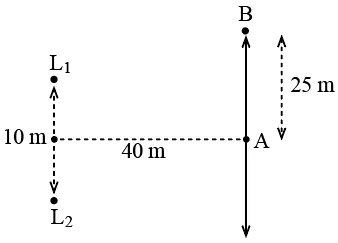
correct answer:- 600
Question 36
A point source is kept at the center of a spherically enclosed detector. If the volume of the detector increased by 8 times, the intensity will
correct answer:- 1
Question 37
The fifth harmonic of a closed organ pipe is found to be in unison with the first harmonic of an open pipe. The ratio of lengths of closed pipe to that of the open pipe is 5/x. The value of x is ______.
correct answer:- 3
Question 38
The velocity of sound in air is doubled when the temperature is raised from $$O^{o}$$C to $$\alpha ^{o}$$ C. The value of $$\alpha$$ is _______.
correct answer:- 819
Question 39
The speed of a longitudinal wave in a metallic bar is 400 m/s. If the density and Young's modulus of the bar material are increased by 0.5% and 1 %, respectively then the speed of the wave is changed approximately to m/ s.
correct answer:- 3
Question 40
Two tuning forks A and Bare sounded together giving rise to 8 beats in 2 s. When fork A is loaded with wax, the beat frequency is reduced to 4 beats in 2 s. If the original frequency of tuning fork B is 380 Hz then original frequency of tuning fork A is ____ Hz.
correct answer:- 384
Question 41
A closed organ and an open organ tube are filled by two different gases having same bulk modulus but different densities $$\rho_1$$ and $$\rho_2$$, respectively. The frequency of $$9^{th}$$ harmonic of closed tube is identical with $$4^{th}$$ harmonic of open tube. If the length of the closed tube is 10 cm and the density ratio of the gases is $$\rho_1 : \rho_2=1:16$$, then the length of the open tube is :
correct answer:- 4
Question 42
The equation of a transverse wave travelling along a string is $$y(x,t)=4.0\sin[20\times 10^{-3}x+600t]mm$$ where x is in mm and t is in second. The velocity of the wave is :
correct answer:- 2
Question 43
A particle oscillates along the $$ x $$-axis according to the law, $$ x(t)=x_0 \sin ^{2}\left(\frac{t}{2}\right) $$ where $$ x_0 = 1 m $$. The kinetic energy $$ (K) $$of the particle as a function of $$ x $$ is correctly represented by the graph
correct answer:- 4
Question 44
A tuning fork resonates with a sonometer wire of length $$1$$ m stretched with a tension of $$6$$ N. When the tension in the wire is changed to $$54$$ N, the same tuning fork produces $$12$$ beats per second with it. The frequency of the tuning fork is _______ Hz.
correct answer:- 6
Question 45
A closed organ pipe 150 cm long gives 7 beats per second with an open organ pipe of length 350 cm, both vibrating in fundamental mode. The velocity of sound is _____ m s$$^{-1}$$.
correct answer:- 294
Question 46
In a closed organ pipe, the frequency of fundamental note is $$30 \text{ Hz}$$. A certain amount of water is now poured in the organ pipe so that the fundamental frequency is increased to $$110 \text{ Hz}$$. If the organ pipe has a cross-sectional area of $$2 \text{ cm}^2$$, the amount of water poured in the organ tube is ________ g. (Take speed of sound in air is $$330 \text{ m s}^{-1}$$)
correct answer:- 400
Question 47
A point source is emitting sound waves of intensity $$16 \times 10^{-8}$$ W m$$^{-2}$$ at the origin. The difference in intensity (magnitude only) at two points located at distances of 2 m and 4 m from the origin respectively will be ________ $$\times 10^{-8}$$ W m$$^{-2}$$.
correct answer:- 3
Question 48
The fundamental frequency of a closed organ pipe is equal to the first overtone frequency of an open organ pipe. If length of the open pipe is 60 cm, the length of the closed pipe will be :
correct answer:- 4
Question 49
Two waves of intensity ratio $$1 : 9$$ cross each other at a point. The resultant intensities at the point, when (a) Waves are incoherent is $$I_1$$ (b) Waves are coherent is $$I_2$$ and differ in phase by $$60°$$. If $$\frac{I_1}{I_2} = \frac{10}{x}$$, then $$x$$ = _________.
correct answer:- 13
Question 50
The speed of sound in oxygen at S.T.P. will be approximately: (Given, $$R = 8.3$$ J K$$^{-1}$$, $$\gamma = 1.4$$)
correct answer:- 1