
Join Our JEE Preparation Group
Prep with like-minded aspirants; Get access to free daily tests and study material.
Sign in
Please select an account to continue using cracku.in
↓ →
Join Our JEE Preparation Group
Prep with like-minded aspirants; Get access to free daily tests and study material.
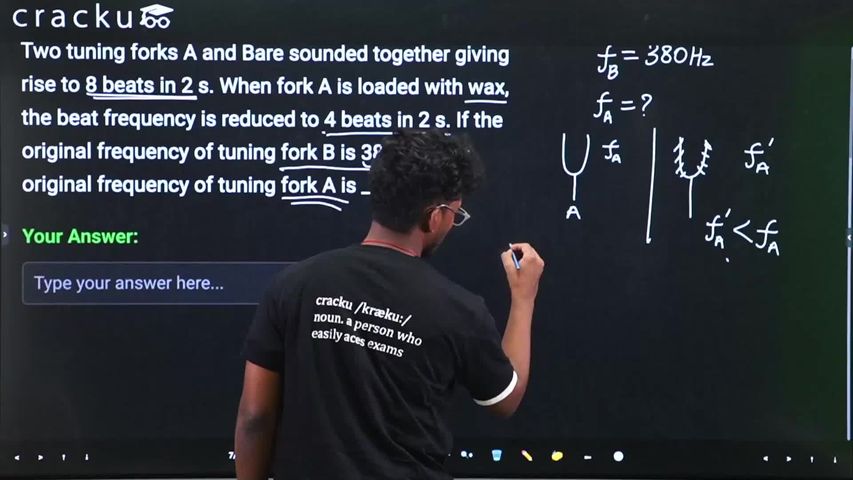
Two tuning forks A and Bare sounded together giving rise to 8 beats in 2 s. When fork A is loaded with wax, the beat frequency is reduced to 4 beats in 2 s. If the original frequency of tuning fork B is 380 Hz then original frequency of tuning fork A is ____ Hz.
Correct Answer: 384
Two tuning forks A and B produce 8 beats in 2 seconds, so the beat frequency is 4 Hz. The frequency of B is 380 Hz.
To determine possible frequencies of A, note that the beat frequency is $$|f_A - f_B| = 4$$ Hz. Thus $$f_A = 380 + 4 = 384$$ Hz or $$f_A = 380 - 4 = 376$$ Hz.
Using the wax-loading condition, when fork A is loaded with wax its frequency decreases (wax increases mass, lowering the frequency). After loading, the beat frequency becomes $$\dfrac{4}{2} = 2$$ beats/s. Let $$f_A'$$ be the new frequency of A after loading. Then $$f_A' < f_A$$ and $$|f_A' - 380| = 2$$.
For the case $$f_A = 384$$ Hz, after loading $$f_A'$$ decreases. Solving $$|f_A' - 380| = 2$$ gives $$f_A' = 382$$ or $$f_A' = 378$$. Since both are less than 384 and the beat frequency decreased from 4 to 2, the result $$f_A' = 382$$ Hz (getting closer to 380) is consistent.
For the case $$f_A = 376$$ Hz, after loading $$f_A'$$ would decrease further below 376. The condition $$|f_A' - 380| = 2$$ again gives $$f_A' = 378$$ or $$f_A' = 382$$, but neither is less than 376, so this case is invalid.
Therefore, the original frequency of tuning fork A is $$\boxed{384}$$ Hz.
Was this solution helpful?
Click on the Email ☝️ to Watch the Video Solution
Create a FREE account and get:
_1.webp)

Educational materials for JEE preparation

Ask our AI anything

AI can make mistakes. Please verify important information.
AI can make mistakes. Please verify important information.
