
Join Our JEE Preparation Group
Prep with like-minded aspirants; Get access to free daily tests and study material.
Sign in
Please select an account to continue using cracku.in
↓ →
Join Our JEE Preparation Group
Prep with like-minded aspirants; Get access to free daily tests and study material.
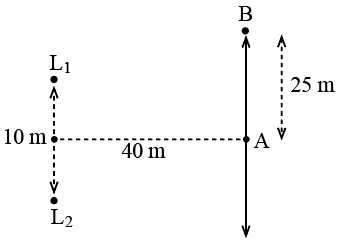
Two loudspeakers $$(L_{1} and L_{2})$$ are placed with a separation of 10 m , as shown in figure. Both speakers are fed with an audio input signal of same frequency with constant volume. A voice recorder, initially at point $$A$$ , at equidistance to both loud speakers, is moved by 25 m along the line $$AB$$ while monitoring the audio signal. The measured signal was found to undergo 10 cycles of minima and maxima during the movement. The frequency of the input signal is ________Hz
(Speed of sound in air is 324 m/s and $$ \sqrt{5}=2.23 $$)
Correct Answer: 600
Now we can solve it.
Speakers are separated by
$$L_1L_2=10m$$
so each is 5 m above and below midpoint.
Point A is 40 m from midpoint, and is equidistant from both speakers.
Distance from A to each speaker:
$$L_1A=L_2A=\sqrt{40^2+5^2}$$
$$=\sqrt{1625}$$At point B, recorder has moved 25 m upward, so coordinates relative to midpoint are
(40,25)
Distance to upper speaker $$L_1$$:
$$L_1B=\sqrt{40^2+20^2}$$
$$=20\sqrt{5}$$
Distance to lower speaker $$L_2$$:
$$L_2B=\sqrt{40^2+30^2}$$
$$=50$$
So path difference at BBB is
$$\Delta=50-20\sqrt{5}$$Using
$$\sqrt{5}=2.235=2.23$$
Δ=50−44.6=5.4 m
Initially at A,
Δ=0
So change in path difference is
5.4 m
During movement, recorder undergoes 10 cycles of minima and maxima, meaning 10 fringe changes:
$$10\lambda=5.4$$
λ=0.54 m
Frequency
$$f=\frac{v}{λ}$$
$$=\frac{324}{0.54}$$
=600
Was this solution helpful?
Create a FREE account and get:
_1.webp)

Educational materials for JEE preparation

Ask our AI anything

AI can make mistakes. Please verify important information.
AI can make mistakes. Please verify important information.
