

 Group
 Group


 Preferred Source

 Google Discover

JEE Units and Measurements PYQs
JEE Units and Measurements PYQs help you practise questions on SI units, dimensional analysis, measurement errors, significant figures, accuracy, and precision. Understanding these concepts also helps you check calculations and interpret measurements in other Physics chapters.
JEE Units and Measurements Questions can involve finding the dimensions of a physical quantity, calculating percentage errors, or reporting a result with the correct significant figures. Before solving, identify which rule applies and check whether the given quantities need unit conversion.
This blog provides a downloadable PYQ PDF, a formula PDF, practice questions with answers, and common mistakes to avoid. Use these resources alongside your JEE Study Material to revise concepts, test your understanding, and revisit questions you find difficult.
JEE Units and Measurements Important PYQs PDF
Download the JEE Units and Measurements PYQs PDF below for chapter-wise practice. Key areas to revise include fundamental and derived units, dimensional formulas, significant figures, measurement errors, vernier calipers, and screw gauge readings.
Attempt each question before checking its answer. For an incorrect response, identify whether the mistake came from a concept, calculation, unit conversion, or rounding rule. Reattempting these questions after revision can help you check whether you have understood the method.
You can also solve relevant questions from JEE Mains previous papers to practise these concepts within a complete Physics section. Compare your approach with the solution and look for steps that make your calculations clearer and quicker.
Important Formulas for JEE Units and Measurements PYQs
Important formulas for this chapter include mean value, absolute error, relative error, percentage error, and error propagation. You should also know how to derive dimensional formulas using fundamental quantities such as mass, length, and time.
Add these relations to your JEE Mains formula sheet for quick revision. Understand the conditions behind each error rule rather than memorising the expressions alone. Download the formula PDF below and use the table as a reference while practising.
| Concept | Formula |
|---|---|
| Mean Value of n Observations | $$\bar{x} = \frac{x_1+x_2+\cdots+x_n}{n}$$ |
| Absolute Error in an Observation Relative to the Mean | $$\Delta x_i = \left|x_i-\bar{x}\right|$$ |
| Mean Absolute Error | $$\Delta x = \frac{\Delta x_1+\Delta x_2+\cdots+\Delta x_n}{n}$$ |
| Relative Error | $$\text{Relative Error} = \frac{\Delta x}{|\bar{x}|}$$ |
| Percentage Error | $$\text{Percentage Error} = \frac{\Delta x}{|\bar{x}|}\times 100\%$$ |
| Maximum Absolute Error for a Sum or Difference: z = x ± y | $$\Delta z = \Delta x+\Delta y$$ |
| Maximum Fractional Error for a Product or Quotient: z = xy or x/y | $$\frac{\Delta z}{|z|} \approx \frac{\Delta x}{|x|}+\frac{\Delta y}{|y|}$$ |
| Maximum Fractional Error for a Power: z = xⁿ | $$\frac{\Delta z}{|z|} \approx |n|\frac{\Delta x}{|x|}$$ |
| Dimensional Formula of Velocity | $$[M^0LT^{-1}]$$ |
| Dimensional Formula of Force | $$[MLT^{-2}]$$ |
| Dimensional Formula of Energy | $$[ML^2T^{-2}]$$ |
Here, the mean value is represented by $$\bar{x}$$, and the mean absolute error by $$\Delta x$$. The product, quotient, and power rules shown above give first-order estimates of maximum fractional error when the measurement errors are small.
Dimensional analysis helps you check whether an equation is dimensionally consistent. However, it cannot determine dimensionless numerical constants or prove that an equation is physically correct.
Top 5 Common Mistakes to Avoid in JEE Units and Measurements PYQs
Common mistakes in JEE Units and Measurements PYQs include confusing accuracy with precision, rounding incorrectly, using the wrong error rule, and missing unit conversions. Checking these details during practice can help you avoid preventable errors.
1. Confusing accuracy and precision
Accuracy describes how close a measured value is to the true or accepted value. Precision describes how closely repeated measurements agree with one another. Measurements can be precise without being accurate, so read carefully before choosing an answer.
2. Applying significant figure rules incorrectly
For multiplication and division, report the result using the fewest significant figures among the measured inputs. For addition and subtraction, use the least precise decimal place. Keep extra digits during intermediate calculations and round the final answer as required.
3. Writing dimensional formulas from memory without checking
If you are unsure of a dimensional formula, derive it from a known relation. For example, force equals mass multiplied by acceleration, giving dimensions of $$[MLT^{-2}]$$. This reduces errors in the powers of mass, length, and time.
4. Mixing absolute and relative error rules
For a sum or difference, add the maximum absolute errors. For a product or quotient, add the maximum fractional errors to first order. When a measured quantity is raised to a power, multiply its fractional error by the absolute value of that power.
5. Missing unit conversions and instrument corrections
Convert quantities into consistent units before substituting values. For vernier caliper and screw gauge questions, check the least count and apply any zero correction with the correct sign. A correct calculation can still produce the wrong answer if the instrument reading is interpreted incorrectly.
List of JEE Units and Measurements PYQs
Here is a short set of JEE-style units and measurements questions for practice. These include common question types from dimensions, errors, significant figures, and basic measurements. Solving them regularly can help you become faster and more confident.
Question 1
Keeping tl1e significant figures in view, the sum of the physical quantities 52.01 m, 153.2 m and 0.123 m is:
correct answer:- 4
Question 2
Consider a modified Bernoulli equation.
$$\left( P + \frac{A}{B t^2} \right) + \rho g (h + B t) + \frac{1}{2}\,\rho V^2 = \text{constant}$$
If t has tile dimension of time then the dimensions of A and B are ___.___ respectively.
correct answer:- 4
Question 3
In an experiment the values of two spring constants were measured as $$k_{1}=(10\pm0.2)N/m\text{ and }k_{2}=(20\pm0.3)N/m$$. lf these springs are connected in parallel, then the percentage error in equivalent spring constant is :
correct answer:- 1
Question 4
If $$\epsilon$$, E and t represent the free space permittivity, electric field and time respectively, then the unit of $$ \frac{\epsilon E}{t}$$ will be :
correct answer:- 2
Question 5
Four persons measure the length of a rod as 20.00 cm, 19.75 cm, 17.01 cm and 18.25cm. The relative error in the measurement of average length of the rod is :
correct answer:- 4

Question 6
Match the LIST-I with LIST-II
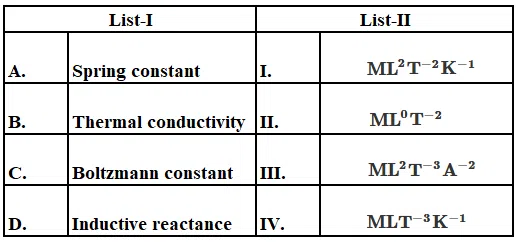
Choose the correct answer from the options given befow:
correct answer:- 2
Question 7
Match the LIST-I with LIST-II
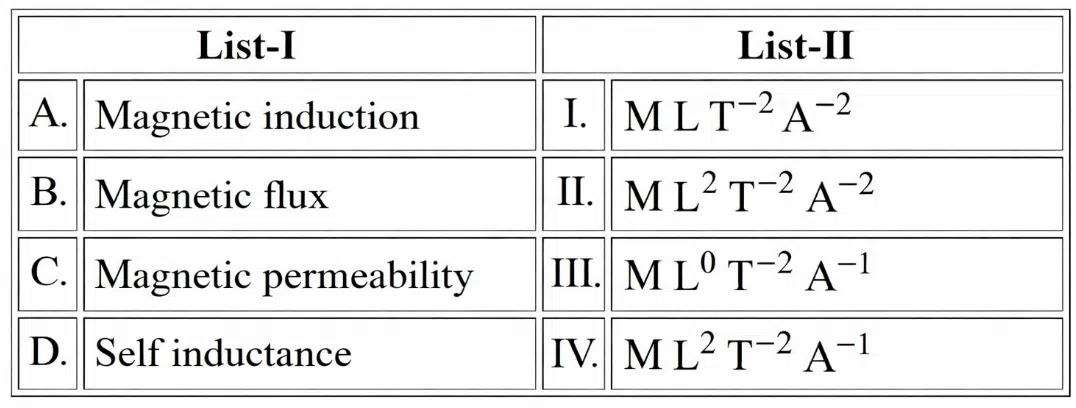
Choose the correct answer from the options given below:
correct answer:- 2
Question 8
Which one of the following is not a measurable quantity ?
correct answer:- 2
Question 9
The time period of a simple harmonic oscillator is $$T=2\pi \sqrt{\frac{k}{m}}$$. Measured value of mass (m) of the object is 10 g with an accuracy of 10 mg and time for 50 oscillations of the spring is found to be 60 s using a watch of 2 s resolution. Percentage error in determination of spring constant (k) is________%.
correct answer:- 4
Question 10
Matd1 List - I with List - II.
List - I List - II
A. Coefficient of viscosity I. $$[ML^{-1}T^{-2}]$$
B. Surface tension II. $$[ML^{2}T^{-2}]$$
C. Pressure III. $$[ML^{0}T^{-2}]$$
D. Surface energy IV. $$[ML^{-1}T^{-1}]$$
Choose the correct answer from the options given below:
correct answer:- 3

Question 11
In an experiment, a set of reading are obtained as follows - 1.24 mm, 1.25 mm, 1.23 mm, 1.21 mm. The expected least count of the instrwnent used in recording these readings is ___ mm.
correct answer:- 1
Question 12
Which one of the following is the correct dimensional formula for the capacitance in F ? M, L, T and C stand for unit of mass, length, time and charge,
correct answer:- 1
Question 13
The maximum percentage error in the measurment of density of a wire is [Given, mass of wire $$=(0.60 \pm 0.003)g$$ radius of wire $$=(10.00 \pm 0.05)cm$$]
correct answer:- 2
Question 14
If B is magnetic field and $$\mu_o$$ is permeability of free space, then the dimensions of $$(B/\mu_o)$$ is
correct answer:- 3
Question 15
The energy of a system is given as $$E(t)=\alpha^{3}e^{-\beta t}$$, where t is the time and $$\beta= 0.3s^{-1}$$. The errors in the measurement of $$\alpha$$ and t are 1.2% and 1.6%, respectively. At t=5s,maximum percentage error in the energy is:
correct answer:- 1

Question 16
Match List - I with List - II.
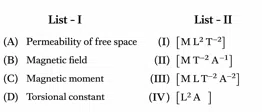
Choose the correct answer from the options given below :
correct answer:- 2
Question 17
For an experimental expression $$y=\frac{32.3\times125}{27.4},$$ where all the digits are significant. Then to report the value of $$y$$ we should write:
correct answer:- 2
Question 18
In a measurement, it is asked to find modulus of elasticity per unit torque applied on the system. The measured quantity has dimension of $$[M^{a}L^{b}T^{c}]$$. If b=-3 the value of c is___________
correct answer:- 0
Question 19
The expression given below shows the variation of velocity $$(\upsilon)$$ with time $$(t),\upsilon = At^{2}+\frac{Bt}{C+t}$$. The dimension of ABC is :
correct answer:- 4
Question 20
The pair of physical quantities not having same dimensions is :
correct answer:- 2

Question 21
The position of a particle moving on x-axis is given by $$x(t)=A\sin t+B\cos^{2}t+Ct^{2}+D$$, where is time. The dimension of $$\frac{ABC}{D}$$ is
correct answer:- 1
Question 22
Consider a moving coil galvanomenter (MCG):
A. The torsional constant in moving coil galvanometer has dimentions $$[ML^{2}T^{-2}]$$
B. Increasing the current sensitivity may not necessarily increase the voltage sensitivity.
C. If we increase number of turns (N) to its double (2N), then the voltage sensitivity doubles.
D. MCG can be converted into an ammeter by introducing a shunt resistance of large value in parallel with galvanometer.
E. Current sensitivity of MCG depends inversely on number of turns of coil. Choose the correct answer from the options given below:
correct answer:- 4
Question 23
Match List - I with List - II.
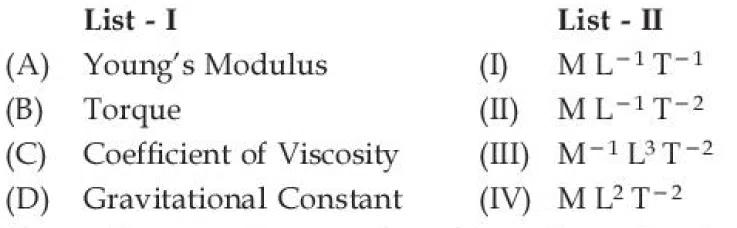
Choose the correct answer from the options given below :
correct answer:- 3
Question 24
Match List - I with List - II.
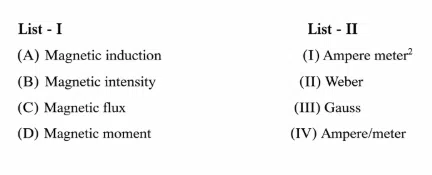
correct answer:- 4
Question 25
A physical quantity Q is related to four observables a,b,c,d as follows : $$Q = \frac{ab^{4}}{cd}$$ where, $$a = (60 \pm 3)\,\text{Pa}$$; $$b = (20 \pm 0.1)\,\text{m}$$; $$c = (40 \pm 0.2)\,\text{Nsm}^{-2}$$; and $$d = (50 \pm 0.1)\,\text{m}$$ , then the percentage error in Q is $$\frac{x}{1000}$$ , where x = ________ .
correct answer:- 7700

Question 26
In an experiment to measure focal length (f) of convex lens, the least counts of the measuring scales for the position of object (u) and for the position of image (v) are $$\Delta u$$ and $$\Delta v$$, respectively. The error in the measurement of the focal length of the convex lens will be:
correct answer:- 3
Question 27
The equation of stationary wave is: $$y = 2a\sin\left(\frac{2\pi nt}{\lambda}\right)\cos\left(\frac{2\pi x}{\lambda}\right)$$. Which of the following is NOT correct:
correct answer:- 1
Question 28
Match List - I with List - II.
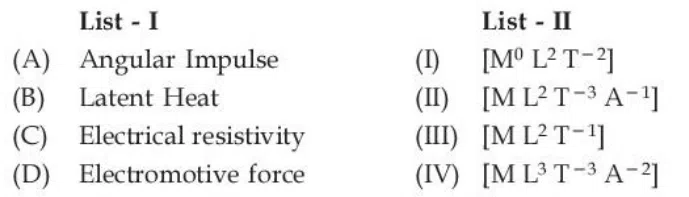
correct answer:- 4
Question 29
The radius $$r$$, length $$l$$ and resistance $$R$$ of a metal wire was measured in the laboratory as $$r = 0.35 \pm 0.05$$ cm, $$R = 100 \pm 10$$ ohm, $$l = 15 \pm 0.2$$ cm. The percentage error in resistivity of the material of the wire is :
correct answer:- 2
Question 30
The dimensional formula of angular impulse is :
correct answer:- 4
Question 31
With rise in temperature, the Young's modulus of elasticity
correct answer:- 2
Question 32
$$10$$ divisions on the main scale of a Vernier calliper coincide with $$11$$ divisions on the Vernier scale. If each division on the main scale is of $$5$$ units, the least count of the instrument is :
correct answer:- 4
Question 33
Match List - I with List - II.
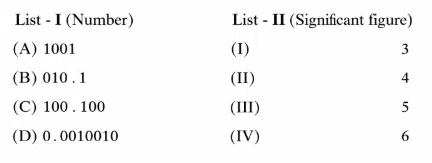
Choose the correct answer from the options given below:
correct answer:- 3
Question 34
Given below are two statements:
Statement (I) : Planck's constant and angular momentum have the same dimensions.
Statement (II) : Linear momentum and moment of force have the same dimensions. In light of the above statements, choose the correct answer from the options given below :
correct answer:- 1
Question 35
Identify the physical quantity that cannot be measured using spherometer :
correct answer:- 2
Question 36
The equation of state of a real gas is given by $$\left(P + \frac{a}{V^2}\right)(V - b) = RT$$, where $$P$$, $$V$$ and $$T$$ are pressure, volume and temperature respectively and $$R$$ is the universal gas constant. The dimensions of $$\frac{a}{b^2}$$ is similar to that of :
correct answer:- 2
Question 37
Given below are two statements : one is labelled as Assertion (A) and the other is labelled as Reason (R).
Assertion (A) : In Vernier calliper if positive zero error exists, then while taking measurements, the reading taken will be more than the actual reading.
Reason (R) : The zero error in Vernier Calliper might have happened due to manufacturing defect or due to rough handling.
In the light of the above statements, choose the correct answer from the options given below :
correct answer:- 2
Question 38
The resistance $$R = \frac{V}{I}$$, where $$V = (200 \pm 5)$$ V and $$I = (20 \pm 0.2)$$ A, the percentage error in the measurement of $$R$$ is :
correct answer:- 1
Question 39
A physical quantity $$Q$$ is found to depend on quantities $$a, b, c$$ by the relation $$Q = \frac{a^4 b^3}{c^2}$$. The percentage error in $$a, b$$ and $$c$$ are $$3\%, 4\%$$ and $$5\%$$ respectively. Then, the percentage error in $$Q$$ is:
correct answer:- 3
Question 40
Match List-I with List-II.
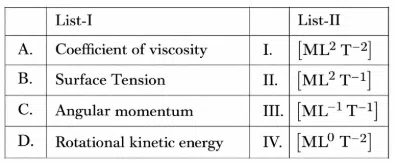
correct answer:- 3
Question 41
If mass is written as $$m = kc^{P}G^{-1/2}h^{1/2}$$, then the value of $$P$$ will be : (Constants have their usual meaning with $$k$$ a dimensionless constant)
correct answer:- 1
Question 42
If 50 Vernier divisions are equal to 49 main scale divisions of a travelling microscope and one smallest reading of main scale is 0.5 mm, the Vernier constant of travelling microscope is:
correct answer:- 4
Question 43
If the percentage errors in measuring the length and the diameter of a wire are $$0.1\%$$ each. The percentage error in measuring its resistance will be:
correct answer:- 2
Question 44
A force is represented by $$F = ax^2 + bt^{1/2}$$, where $$x$$ = distance and $$t$$ = time. The dimensions of $$\frac{b^2}{a}$$ are :
correct answer:- 1
Question 45
Consider two physical quantities $$A$$ and $$B$$ related to each other as $$E = \frac{B - x^2}{At}$$ where $$E$$, $$x$$ and $$t$$ have dimensions of energy, length and time respectively. The dimension of $$AB$$ is
correct answer:- 2
Question 46
Applying the principle of homogeneity of dimensions, determine which one is correct, where $$T$$ is time period, $$G$$ is gravitational constant, $$M$$ is mass, $$r$$ is radius of orbit.
correct answer:- 3
Question 47
What is the dimensional formula of $$ab^{-1}$$ in the equation $$\left(P + \frac{a}{V^2}\right)(V - b) = RT$$, where letters have their usual meaning.
correct answer:- 3
Question 48
A vernier callipers has 20 divisions on the vernier scale, which coincides with $$19^{th}$$ division on the main scale. The least count of the instrument is $$0.1$$ mm. One main scale division is equal to ______ mm.
correct answer:- 2
Question 49
Time periods of oscillation of the same simple pendulum measured using four different measuring clocks were recorded as $$4.62 \text{ s}, 4.632 \text{ s}, 4.6 \text{ s}$$ and $$4.64 \text{ s}$$. The arithmetic mean of these readings in correct significant figure is :
correct answer:- 3
Question 50
Match List I with List II :
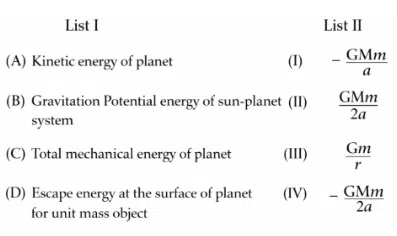
(Where $$a$$ = radius of planet orbit, $$r$$ = radius of planet, $$M$$ = mass of Sun, $$m$$ = mass of planet)
correct answer:- 2