

 Group
Group
 Group
Group


 Preferred Source

 Google Discover

JEE Fluid Mechanics PYQs
JEE Fluid Mechanics PYQs are an important part of the JEE Physics syllabus. Practising these questions helps you understand key ideas such as pressure, density, buoyancy, surface tension, viscosity, streamline flow, Bernoulli’s principle, the continuity equation, and the motion of fluids.
Questions from Fluid Mechanics can appear in JEE as direct numericals, concept-based problems, or questions that combine more than one concept. The chapter may seem a little confusing at first because many formulas look similar and are used under different conditions. Once you understand what each formula means and when it should be applied, solving the questions becomes much easier.
Instead of memorising every result, focus on the physics behind it. Try to understand why pressure changes with depth, how liquids flow through narrow pipes, and what causes an object to float or sink. Regular practice with JEE Fluid Mechanics Questions can improve your conceptual clarity and calculation speed. Solving chapter-wise JEE Questions and attempting a JEE Mains Mock Test can also help you become more confident with the exam pattern.
In this blog, you will find important Fluid Mechanics PYQs in downloadable format, practice questions with answers, a few extra problems for self-practice, and simple tips to avoid common mistakes. You can also compare your preparation with questions from JEE Mains Previous Papers to get a better idea of the level and style of questions asked in the exam.
JEE Fluid Mechanics Important PYQs PDF
This PDF can include some of the most useful previous-year questions from Fluid Mechanics. The questions may cover hydrostatic pressure, Pascal’s law, Archimedes’ principle, buoyant force, surface tension, capillary rise, viscosity, terminal velocity, the continuity equation, and Bernoulli’s theorem.
Practising these questions will help you understand how different Fluid Mechanics concepts are tested in JEE. It can also improve your speed, accuracy, and ability to choose the right approach. Working through a well-organised set of previous-year questions is especially helpful because it allows you to recognise common patterns and avoid wasting time during the exam.
Important Fluid Mechanics Formula Sheet for JEE
You only need a limited number of important formulas to solve most questions from this chapter. These formulas are mainly used to calculate pressure, buoyant force, fluid speed, surface tension, viscous force, and terminal velocity.
| Concept | Formula |
|---|---|
| Pressure | $$P = \frac{F}{A}$$ |
| Pressure at a Depth | $$P = P_0 + \rho gh$$ |
| Buoyant Force | $$F_B = \rho Vg$$ |
| Continuity Equation | $$A_1v_1 = A_2v_2$$ |
| Bernoulli’s Equation | $$P + \frac{1}{2}\rho v^2 + \rho gh = \text{constant}$$ |
| Surface Tension | $$T = \frac{F}{l}$$ |
| Excess Pressure in a Drop | $$\Delta P = \frac{2T}{r}$$ |
| Excess Pressure in a Soap Bubble | $$\Delta P = \frac{4T}{r}$$ |
| Stokes’ Law | $$F = 6\pi\eta rv$$ |
| Terminal Velocity | $$v_t = \frac{2r^2(\rho-\sigma)g}{9\eta}$$ |
These formulas are commonly used in problems involving fluid pressure, floating bodies, liquid flow, surface tension, viscosity, and terminal velocity. Revising them with reliable JEE Study Material can help you remember the correct conditions and avoid small calculation errors.
Top 5 Common Mistakes to Avoid in JEE Fluid Mechanics PYQs
Many students lose marks in this chapter because of small conceptual or calculation mistakes. Here are some common errors you should watch out for:
Using pressure instead of pressure difference
In many problems, the required answer depends on the difference between two pressures. Always check whether atmospheric pressure should be included or whether it cancels out.
Applying Bernoulli’s equation without checking the conditions
Bernoulli’s equation is generally used for steady, incompressible, and non-viscous flow along a streamline. Make sure the situation satisfies these conditions before using it.
Confusing density with relative density
Density has units, while relative density is a ratio and has no unit. Mixing them up can lead to an incorrect answer.
Using the wrong excess-pressure formula
The formula for a liquid drop is different from the formula for a soap bubble. A soap bubble has two surfaces, so its excess pressure is greater.
Ignoring unit conversions
Values such as radius, viscosity, density, and surface tension may be given in different units. Convert everything into SI units before starting the calculation.
Regular chapter-wise practice can help you notice these mistakes early and improve your accuracy in the exam.
List of JEE Fluid Mechanics PYQs
Below is a test-style set of questions based on pressure, buoyancy, Bernoulli’s principle, continuity, surface tension, viscosity, and terminal velocity. Try to solve each question on your own before checking the answer.
Question 1
A soap bubble of surface tension 0.04 N/m is blown to a diameter of 7 cm. If (15000 - x) $$\mu J$$ of work is done in blowing it further to make its diameterl4 cm, then the value of x is_____.
$$\left(\pi=22/7\right)$$
correct answer:- 11304
Question 2
The amount of work done to break a big water drop of radius $$' R '$$ into 27 small drops of equal radius is $$10\,J.$$ The work done required to break the same big drop into 64 small drops of equal radius will be:
correct answer:- 1
Question 3
Small water droplets of radius 0.01 mm are formed in the upper atmosphere and falling with a terminal velocity of 10 cm/s. Due to condensation, if 8 such droplets are coalesced and formed a larger drop, the new terminal velocity will be _____ cm/s.
correct answer:- 40
Question 4
A bubble has surface tension $$S$$. The ideal gas inside the bubble has ratio of specific heats $$\gamma = \dfrac{5}{3}$$. The bubble is exposed to the atmosphere and it always retains its spherical shape. When the atmospheric pressure is $$P_{a1}$$, the radius of the bubble is found to be $$r_1$$ and the temperature of the enclosed gas is $$T_1$$. When the atmospheric pressure is $$P_{a2}$$, the radius of the bubble and the temperature of the enclosed gas are $$r_2$$ and $$T_2$$, respectively.
Which of the following statement(s) is(are) correct?
correct answer:- 3,4
Question 5
In an experiment to verify Stokes law, a small spherical ball of radius $$r$$ and density $$\rho$$ falls under gravity through a distance $$h$$ in air before entering a tank of water. If the terminal velocity of the ball inside water is same as its velocity just before entering the water surface, then the value of $$h$$ is proportional to: (ignore viscosity of air)
correct answer:- 1

Question 6
Water from a pipe is coming at a rate of 100 liters per minute. If the radius of the pipe is 5 cm, the Reynolds number for the flow is of the order of: (density of water = 100 kg/m$$^{3}$$, coefficient of viscosity of water = 1 mPa s)
correct answer:- 2
Question 7
A tub is filled with water and a wooden cube 10 cm × 10 cm × 10 cm is placed in the water. The wooden cube is found to float on the water with a part of it submerged in water. When a metal coin is placed on the wooden cube, the submerged part is increased by 3.87 cm. The mass of the metal coin is __________ gram. (Take water density as 1 g/cm$$^3$$ and density of wood = 0.4 g/cm$$^3$$)
correct answer:- 387
Question 8
A hollow spherical shell at outer radius $$R$$ floats just submerged under the water surface. The inner radius of the shell is $$r$$. If the specific gravity of the shell material is $$\frac{27}{8}$$ with respect to water, the value of $$r$$ is:
correct answer:- 1
Question 9
A square hole of side length $$\ell$$ is made at a depth of $$h$$ and a circular hole of radius $$r$$ is made at a depth of $$4h$$ from the surface of water in a water tank kept on a horizontal surface. If $$\ell << h, r << h$$ and the rate of water flow from the holes is the same, then $$r$$ is equal to
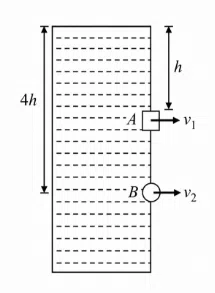
correct answer:- 1
Question 10
An ideal fluid of density $$800$$ kg m$$^{-3}$$, flows smoothly through a bent pipe (as shown in the figure) that tapers in cross-sectional area from $$a$$ to $$\frac{a}{2}$$. The pressure difference between the wide and narrow sections of pipe is $$4100$$ Pa. At the wider section, the velocity of the fluid is $$\frac{\sqrt{x}}{6}$$ m s$$^{-1}$$ for $$x =$$ ______. (Given $$g = 10$$ m s$$^{-2}$$)
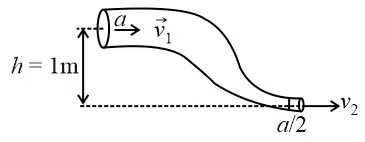
correct answer:- 363

Question 11
Air of density 1.2 kg m$$^{-3}$$ is blowing across the horizontal wings of an aeroplane in such a way that its speeds above and below the wings are 150 ms$$^{-1}$$ and 100 ms$$^{-1}$$, respectively. The pressure difference between the upper and lower sides of the wings, is :
correct answer:- 3
Question 12
$$N$$ identical small liquid droplets, each of radius $$r$$, coalesce to form a single large drop of radius $$R$$. If $$\sigma$$ is the surface tension of the liquid, the total energy released in this process is:
correct answer:- 1
Question 13
Two liquids of densities $$\rho_1$$ and $$\rho_2$$ ($$\rho_2 = 2\rho_1$$) are filled up behind a square wall of side 10 m as shown in figure. Each liquid has a height of 5 m. The ratio of the forces due to these liquids exerted on upper part MN to that at the lower part NO is (Assume that the liquids are not mixing):
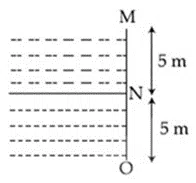
correct answer:- 4
Question 14
A tank contains two immiscible liquids of densities $$6\rho$$ and $$2\rho$$. The higher density liquid is filled up to a height $$L/2$$ from the bottom. A thin rod of density $$\rho$$ and length $$L$$ is fully immersed and hinged at the bottom so that it can oscillate freely, as shown in the figure. If the rod is slightly disturbed from its equilibrium, the time period of small oscillations is $$\dfrac{2\pi}{n}\sqrt{\dfrac{L}{g}}$$, where $$g$$ is the acceleration due to gravity. The value of $$n$$ is:
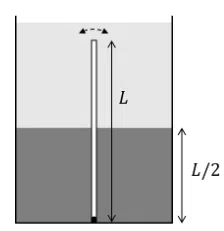
correct answer:- 1.73
Question 15
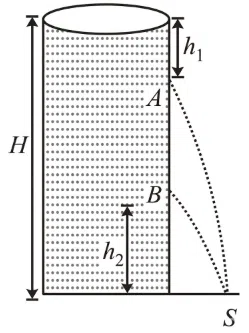
In a cylindrical water tank, there are two small holes $$A$$ and $$B$$ on the wall at a depth of $$h_1$$, from the surface of water and at a height of $$h_2$$ from the bottom of water tank. Surface of water is at height $$h_2$$ from the bottom of water tank. Surface of water is at height $$H$$ from the bottom of water tank. Water coming out from both holes strikes the ground at the same point $$S$$. Find the ratio of $$h_1$$ and $$h_2$$.
correct answer:- 1

Question 16
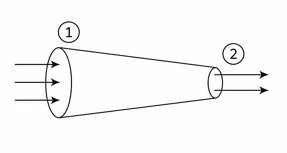
A tube of length L is shown in the figure. The radius of the cross section at point (1) is 2 cm and at point (2) is 1 cm , respectively. If the velocity of water entering at point (1) is 2 m/s, then the velocity of water leaving point (2) will be
correct answer:- 4
Question 17
Two large, identical water tanks, 1 and 2, kept on the top of a building of height $$H$$, are filled with water up to height $$h$$ in each tank. Both the tanks contain an identical hole of small radius on their sides, close to their bottom. A pipe of the same internal radius as that of the hole is connected to tank 2, and the pipe ends at the ground level. When the water flows the tanks 1 and 2 through the holes, the times taken to empty the tanks are $$t_1$$ and $$t_2$$, respectively. If $$H = \left(\frac{16}{9}\right)h$$, then the ratio $$t_1/t_2$$ is ______.
correct answer:- 3
Question 18
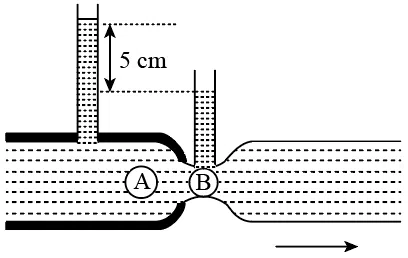
Water flows through a horizontal tube as shown in the figure. The difference in height between the water colunms in vertical tubes is 5 cm and the area of cross-sections at A and B are $$6cm^{2}$$ and $$3cm^{2}$$ respectively. The rate of flow will be ____ $$cm^{3/s}$$. $$(take g=10m/s^{2})$$
correct answer:- 1
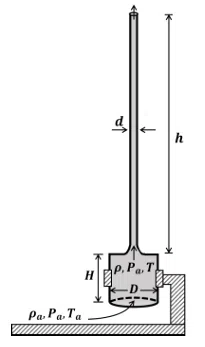
A cylindrical furnace has height (H) and diameter (D) both 1 m. It is maintained at temperature 360 K. The air gets heated inside the furnace at constant pressure $$P_a$$ and its temperature becomes $$T = 360$$ K. The hot air with density $$\rho$$ rises up a vertical chimney of diameter $$d = 0.1$$ m and height $$h = 9$$ m above the furnace and exits the chimney. As a result, atmospheric air of density $$\rho_a = 1.2$$ kg m$$^{-3}$$, pressure $$P_a$$ and temperature $$T_a = 300$$ K enters the furnace. Assume air as an ideal gas, neglect the variations in $$\rho$$ and $$T$$ inside the chimney and the furnace. Also ignore the viscous effects.
[Given: The acceleration due to gravity $$g = 10$$ ms$$^{-2}$$ and $$\pi = 3.14$$]
Question 19
When the chimney is closed using a cap at the top, a pressure difference $$\Delta P$$ develops between the top and the bottom surfaces of the cap. If the changes in the temperature and density of the hot air, due to the stoppage of air flow, are negligible then the value of $$\Delta P$$ is ____ Nm$$^{-2}$$.
correct answer:- 30
Question 20
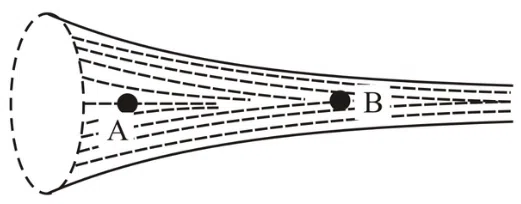
The figure shows a liquid of a given density flowing steadily in a horizontal tube of a varying cross-section. Cross-sectional area at A is $$1.5$$ cm$$^2$$, and that at B is $$25$$ mm$$^2$$, if the speed of liquid at B is $$60$$ cm s$$^{-1}$$ then $$(P_A - P_B)$$ is
(Given $$P_A$$ and $$P_B$$ are liquid pressures at A and B points. Density $$\rho = 1000$$ kg m$$^{-3}$$. A and B are on the axis of tube)
correct answer:- 3

Question 21
An ideal non-viscous, incompressible fluid flows steadily through a horizontal pipe of varying cross-section. At a point where the cross-sectional area of the pipe is $$A$$, the velocity of the fluid stream is $$v$$ and the static pressure is $$P$$. At another point down the pipe line where the cross-sectional area reduces to $$\frac{A}{3}$$, the static pressure becomes $$\frac{P}{2}$$. If the density of the fluid is $$\rho$$, the initial velocity $$v$$ of the fluid is given by:
correct answer:- 3
Question 22
A cylindrical block of wood (density = 650 kg m$$^{-3}$$), of base area 30 cm$$^2$$ and height 54 cm, floats in a liquid of density 900 kg m$$^{-3}$$. The block is depressed slightly and then released. The time period of the resulting oscillations of the block would be equal to that of a simple pendulum of length (nearly):
correct answer:- 3
Question 23
A wide tank drains through a small orifice of cross-sectional area $$a$$ located at its side, with the orifice center situated at a depth $$h$$ below the free surface. The tank’s main cross-sectional area $$A$$ is exceptionally large ($$A \gg a$$) and remains essentially constant. Neglecting fluid viscosity and assuming atmospheric pressure acts at both the free upper surface and the exit nozzle, how long does it take for the water level to fall from an initial height $$h_0$$ to a lower height $$h_1$$ ($$h_1 > 0$$)?
correct answer:- 1
Question 24
A cubical block of side 0.5 m floats on water with 30% of its volume under water. What is the maximum weight that can be put on the block without fully submerging it under water?
[Take, density of water = 10$$^3$$ kg/m$$^3$$]
correct answer:- 1
Question 25
An air bubble of radius 1 cm in water has an upward acceleration of 9.8 cms$$^{-2}$$. The density of water is 1 gm cm$$^{-3}$$ and water offers negligible drag force on the bubble. The mass of the bubble is $$(g = 980$$ cm/s$$^2)$$.
correct answer:- 3

Question 26
A solid sphere, of radius R acquires a terminal velocity $$v_1$$ when falling (due to gravity) through a viscous fluid having a coefficient of viscosity $$\eta$$. The sphere is broken into 27 identical solid spheres. If each of these spheres acquires a terminal velocity, $$v_2$$, when falling through the same fluid, the ratio $$\left(\frac{v_1}{v_2}\right)$$ equals:
correct answer:- 4
Question 27
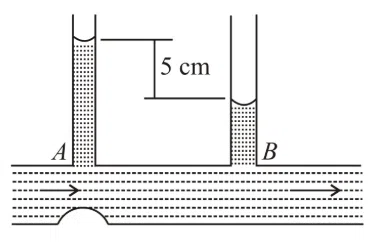
In the diagram shown, the difference in the two tubes of the manometer is 5 cm, the cross-section of the tube at A and B is 6 mm$$^2$$ and 10 mm$$^2$$ respectively. The rate at which water flows through the tube is (g = 10 m s$$^{-2}$$)
correct answer:- 1
Question 28
The top of a water tank is open to air and its water level is maintained. It is giving out 0.74 m$$^3$$ water per minute through a circular opening of 2 cm radius in its wall. The depth of the centre of the opening from the level of water in the tank is close to:
correct answer:- 2
Question 29
A horizontal pipe has a non-uniform cross-section. The velocity of water at a point where the radius is $$2r$$ is found to be $$v$$. The velocity of water at another point in the same pipe where the radius is $$r$$ will be:
correct answer:- 4
Question 30
A small spherical ball of radius $$r$$ falls from rest in a viscous liquid. Due to friction, heat is produced. When the ball attains its terminal velocity, the rate of production of heat is proportional to:
correct answer:- 4