
Join Our JEE Preparation Group
Prep with like-minded aspirants; Get access to free daily tests and study material.
Sign in
Please select an account to continue using cracku.in
↓ →
Join Our JEE Preparation Group
Prep with like-minded aspirants; Get access to free daily tests and study material.
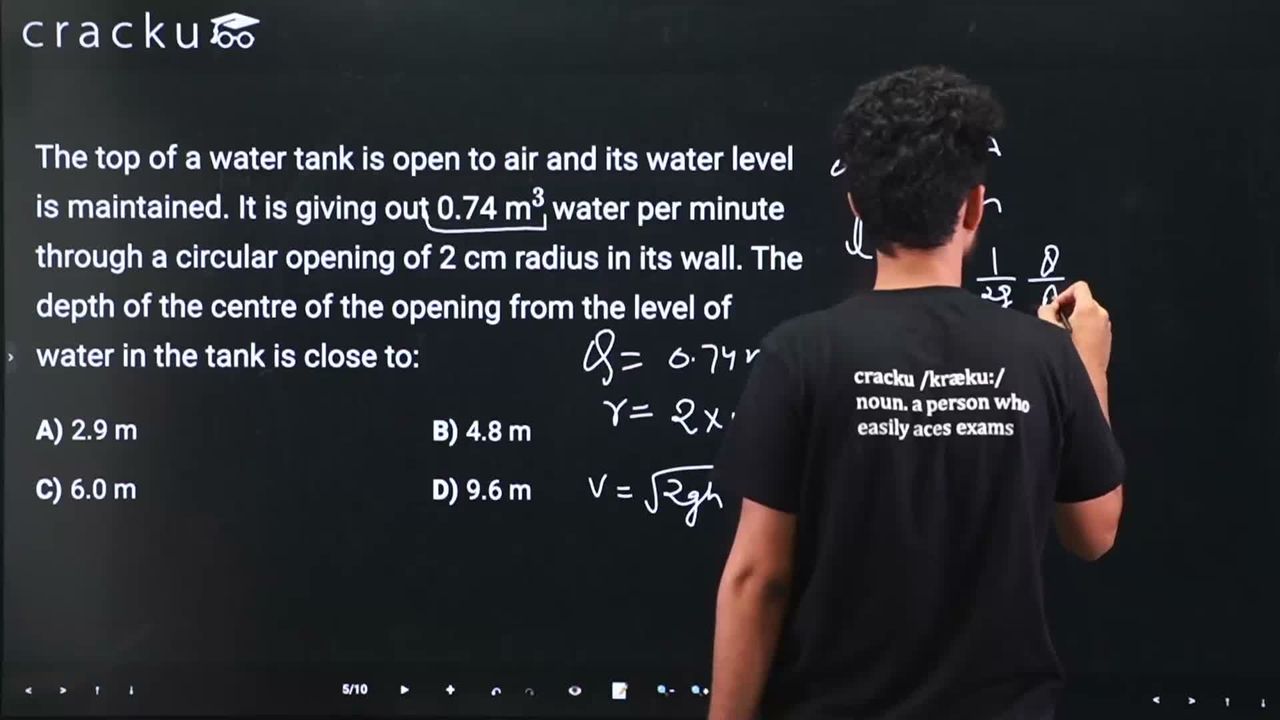
The top of a water tank is open to air and its water level is maintained. It is giving out 0.74 m$$^3$$ water per minute through a circular opening of 2 cm radius in its wall. The depth of the centre of the opening from the level of water in the tank is close to:
We have an open tank, so the water surface and the jet emerging from the circular opening are both exposed to atmospheric pressure. For an ideal (non-viscous, incompressible) fluid this allows the use of Torricelli’s theorem, which states first that the speed with which the liquid emerges is the same as that which a body would acquire in freely falling through the vertical distance $$h$$ between the liquid surface and the centre of the orifice. Mathematically,
$$v \;=\; \sqrt{2 g h},$$
where $$g$$ is the acceleration due to gravity and $$h$$ is the required depth.
If the radius of the opening is $$r$$, its cross-sectional area $$A$$ is
$$A \;=\; \pi r^{2}.$$
The volume flow rate, or discharge $$Q$$, is the volume that leaves the tank per unit time. For steady flow we simply multiply the area by the exit velocity:
$$Q \;=\; A \, v.$$
Substituting $$v = \sqrt{2 g h}$$ into the discharge relation gives
$$Q \;=\; A \, \sqrt{2 g h}.$$
Now we solve algebraically for $$h$$. First, isolate the square root:
$$\sqrt{2 g h} \;=\; \dfrac{Q}{A}.$$
Next square both sides:
$$2 g h \;=\; \left(\dfrac{Q}{A}\right)^{2}.$$
Finally, divide by $$2g$$ to obtain the required depth:
$$h \;=\; \dfrac{1}{2 g}\,\left(\dfrac{Q}{A}\right)^{2}.$$
We now substitute the numerical values step by step.
Radius of the opening:
$$r = 2 \text{ cm} = 0.02 \text{ m}.$$
Area of the opening:
$$A = \pi r^{2} = \pi (0.02)^{2} = \pi \times 0.0004 = 0.001256637 \text{ m}^{2}.$$
Discharge in cubic metres per second (convert from “per minute”):
$$Q = 0.74 \text{ m}^{3}\text{/min} = \dfrac{0.74}{60} \text{ m}^{3}\text{/s} = 0.012333\text{ m}^{3}\text{/s}.$$
Compute the ratio $$Q/A$$:
$$\dfrac{Q}{A} = \dfrac{0.012333}{0.001256637} = 9.813 \text{ m/s}.$$
Insert this value into the depth formula (take $$g = 9.8 \text{ m/s}^{2}$$):
$$h = \dfrac{1}{2 \times 9.8}\,(9.813)^{2} \;=\; \dfrac{1}{19.6} \times 96.280 \;=\; 4.913 \text{ m}.$$
The value obtained is very close to $$4.8 \text{ m}$$ when rounded to the nearest tenth of a metre, matching one of the given choices.
Hence, the correct answer is Option B.
Was this solution helpful?
Click on the Email ☝️ to Watch the Video Solution
Create a FREE account and get:
_1.webp)

Educational materials for JEE preparation

Ask our AI anything

AI can make mistakes. Please verify important information.
AI can make mistakes. Please verify important information.


