Join WhatsApp Icon JEE WhatsApp Group

NTA JEE Main 9th January 2019 Shift 2

For the following questions answer them individually

The position co-ordinates of a particle moving in a 3D coordinate system is given by
$$x = a\cos\omega t$$
$$y = a\sin\omega t$$
and $$z = a\omega t$$
The speed of the particle is:

Expression for time in terms of $$G$$ (universal gravitational constant), $$h$$ (Planck constant) and $$c$$ (speed of light) is proportional to:

In a car race on straight road, car A takes a time $$t$$ less than car $$B$$ at the finish and passes finishing point with a speed $$v$$ more than that of car $$B$$. Both the cars start from rest and travel with constant acceleration $$a_1$$ and $$a_2$$ respectively. Then $$v$$ is equal to:

A mass of 10 kg is suspended vertically by a rope from the roof. When a horizontal force is applied on the rope at some point, the rope deviated at an angle of 45$$^{\circ}$$ at the roof point. If the suspended mass is at equilibrium, the magnitude of the force applied is ($$g = 10$$ m s$$^{-2}$$)

A force acts on a 2 kg object so that its position is given as a function of time as $$x = 3t^2 + 5$$. What is the work done by this force in first 5 seconds?

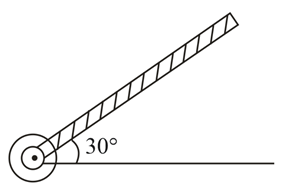
A rod of length 50 cm is pivoted at one end. It is raised such that it makes an angle of 30$$^{\circ}$$ from the horizontal as shown and released from rest. Its angular speed when it passes through the horizontal (in rad s$$^{-1}$$) will be: ($$g = 10$$ ms$$^{-2}$$)

The energy required to take a satellite to a height $$h$$ above the Earth surface (radius of Earth $$= 6.4 \times 10^3$$ km) is $$E_1$$, and the kinetic energy required for the satellite to be in a circular orbit at this height is $$E_2$$. The value of $$h$$ for which $$E_1$$ and $$E_2$$ are equal, is:

The top of a water tank is open to air and its water level is maintained. It is giving out 0.74 m$$^3$$ water per minute through a circular opening of 2 cm radius in its wall. The depth of the centre of the opening from the level of water in the tank is close to:

Two carnot engines $$A$$ and $$B$$ are operated in series. The first one, $$A$$, receives heat at $$T_1 (= 600K)$$ and rejects to a reservoir at temperature $$T_2$$. The second engine $$B$$ receives heat rejected by the first engine and, in turn, rejects to a heat reservoir at $$T_3 (= 400K)$$. Calculate the temperature $$T_2$$ if the work outputs of the two engines are equal:

A particle is executing simple harmonic motion (SHM) of amplitude $$A$$, along the $$x$$-axis, about $$x = 0$$. When its potential Energy (PE) equal kinetic energy (KE), the position of the particle will be:

A rod of mass $$M$$ and length $$2L$$ is suspended at its middle by a wire. It exhibits torsional oscillations. If two masses, each of mass $$m$$, are attached at a distance $$L/2$$ from its centre on both sides, it reduces the oscillation frequency by 20%. The value of ratio $$m/M$$ is close to:

A musician using an open flute of length 50 cm produces second harmonic sound waves. A person runs towards the musician from another end of a hall at a speed of 10 km h$$^{-1}$$. If the wave speed is 330 m s$$^{-1}$$, the frequency heard by the running person shall be close to:

Charge is distributed within a sphere of radius $$R$$ with a volume charge density $$\rho(r) = \frac{A}{r^2}e^{-\frac{2r}{a}}$$, where $$A$$ and $$a$$ are constants. If $$Q$$ is the total charge of this charge distribution, the radius $$R$$ is:

Two point charges $$q_1(\sqrt{10}$$ $$\mu$$C) and $$q_2(-25$$ $$\mu$$C) are placed on the $$x$$-axis at $$x = 1$$ m and $$x = 4$$ m respectively. The electric field (in V/m) at a point $$y = 3$$ m on $$y$$-axis is, [Take $$\frac{1}{4\pi\varepsilon_0} = 9 \times 10^9$$ N m$$^2$$C$$^{-2}$$]

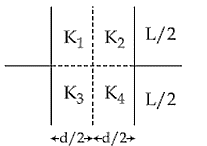
A parallel plate capacitor with square plates is filled with four dielectrics of dielectric constants $$K_1$$, $$K_2$$, $$K_3$$, $$K_4$$ arranged as shown in the figure. The effective dielectric constant $$K$$ will be:

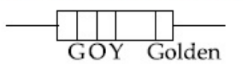
A carbon resistance has a following colour code. What is the value of the resistance?


GOY Golden

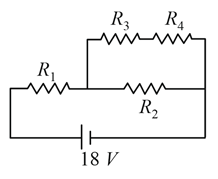
In the given circuit the internal resistance of the 18V cell is negligible. If $$R_1 = 400$$ $$\Omega$$, $$R_3 = 100$$ $$\Omega$$ and $$R_4 = 500$$ $$\Omega$$ and the reading of an ideal voltmeter across $$R_4$$ is 5 V, then the value of $$R_2$$ will be:

A particle having the same charge as of electron moves in a circular path of radius 0.5 cm under the influence of a magnetic field of 0.5 T. If an electric field of 100 V/m makes it to move in a straight path, then the mass of the particle is (Given charge of electron $$= 1.6 \times 10^{-19}$$ C)

One of the two identical conducting wires of length $$L$$ is bent in the form of a circular loop and the other one into a circular coil of $$N$$ identical turns. If the same current is passed in both, the ratio of the magnetic field at the centre of the loop $$(B_L)$$ to that at the centre of the coil $$(B_C)$$, i.e. $$\frac{B_L}{B_C}$$ will be:

A power transmission line feeds input power at 2300 V to a step down transformer with its primary windings having 4000 turns. The output power is delivered at 230 V by the transformer. If the current in the primary of the transformer is 5 A and its efficiency is 90%, the output current would be:

A series AC circuit containing an inductor (20 mH), a capacitor (120 $$\mu$$F) and a resistor (60 $$\Omega$$) is driven by an AC source of 24 V/50 Hz. The energy dissipated in the circuit in 60 s is:

Two plane mirrors are inclined to each other such that a ray of light incident on the first mirror $$(M_1)$$ and parallel to the second mirror $$(M_2)$$ is finally reflected from the second mirror $$(M_2)$$ and parallel to the first mirror $$(M_1)$$. The angle between the two mirrors will be:

In a young's double slit experiment, the slits are placed 0.320 mm apart. Light of wavelength $$\lambda = 500$$ nm is incident on the slits. The total number of bright fringes that are observed in the angular range $$-30^{\circ} \leq \theta \leq 30^{\circ}$$ is:

The magnetic field associated with a light wave is given, at the origin, by $$B = B_0 [\sin(3.14 \times 10^7)ct + \sin(6.28 \times 10^7)ct]$$. If this light falls on a silver plate having a work function of 4.7 eV, what will be the maximum kinetic energy of the photoelectrons? ($$c = 3 \times 10^8$$ m s$$^{-1}$$, $$h = 6.6 \times 10^{-34}$$ J s)

At a given instant, say $$t = 0$$, two radioactive substance A and B have equal activities. The ratio $$\frac{R_B}{R_A}$$ of their activities after time $$t$$ itself decays with time $$t$$ as $$e^{-3t}$$. If the half-life of A is $$\ln 2$$, the half-life of B is:

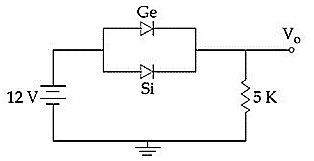
Ge and Si diodes start conducting at 0.3 V and 0.7 V respectively. In the following figure if Ge diode connection are reversed, the value of $$V_0$$ changes by: (assume that the Ge diode has large breakdown voltage)

In a communication system operating at wavelength 800 nm, only one percent of source frequency is available as signal bandwidth. The number of channels accommodated for transmitting TV signals of band width 6 MHz are (Take velocity of light $$c = 3 \times 10^8$$ m/s, $$h = 6.6 \times 10^{-34}$$ J-s)

The pitch and the number of divisions, on the circular scale, for a given screw gauge are 0.5 mm and 100 respectively. When the screw gauge is fully tightened without any object, the zero of its circular scale lies 3 divisions below the mean line. The readings of the main scale and the circular scale, for a thin sheet, are 5.5 mm and 48 respectively, the thickness of this sheet is:

Which of the following combination of statements is true regarding the interpretation of the atomic orbitals?
(A) An electron in an orbital of high angular momentum stays away from the nucleus than an electron in the orbital of lower angular momentum.
(B) For a given value of the principal quantum number, the size of the orbit is inversely proportional to the azimuthal quantum number.
(C) According to wave mechanics, the ground state angular momentum is equal to $$\frac{h}{2\pi}$$.
(D) The plot of $$\psi$$ Vs $$r$$ for various azimuthal quantum numbers, shows peak shifting towards higher $$r$$ value.

When the first electron gain enthalpy $$(\Delta H_{eg})$$ of oxygen is $$-141$$ kJ/mol, its second electron gain enthalpy is:

In which of the following processes, the bond order has increased and paramagnetic character has changed to diamagnetic?

The entropy change associated with the conversion of 1 kg of ice at 273 K to water vapours at 383 K is: (Specific heat of water liquid and water vapour are 4.2 kJ K$$^{-1}$$ and 2.0 kJ K$$^{-1}$$ kg$$^{-1}$$; heat of liquid fusion and vaporization of water are 334 kJ kg$$^{-1}$$ and 2491 kJ kg$$^{-1}$$, respectively). (log 273 = 2.436, log 373 = 2.572, log 383 = 2.583)

At 100$$^{\circ}$$C, copper (Cu) has FCC unit cell structure with cell edge length of $$x$$ $$\text{Å}$$. What is the approximate density of Cu (in g cm$$^{-3}$$) at this temperature? [Atomic Mass of Cu = 63.55 u]

If the standard electrode potential for a cell is 2 V at 300 K, the equilibrium constant (K) for the reaction.
$$Zn(s) + Cu^{2+}(aq) \rightleftharpoons Zn^{2+}(aq) + Cu(s)$$
at 300 K is approximately: ($$R = 8$$ J K$$^{-1}$$ mol$$^{-1}$$, $$F = 96000$$ C mol$$^{-1}$$)

For the reaction, $$2A + B \rightarrow$$ products, when the concentration of $$A$$ and $$B$$ both were doubled, the rate of the reaction increased from 0.3 mol L$$^{-1}$$ s$$^{-1}$$ to 2.4 mol L$$^{-1}$$ s$$^{-1}$$. When the concentration of $$A$$ alone is doubled, the rate increased from 0.3 mol L$$^{-1}$$ s$$^{-1}$$ to 0.6 mol L$$^{-1}$$ s$$^{-1}$$. Which one of the following statements is correct?

Consider the following reversible chemical reactions:
$$A_2(g) + B_2(g) \stackrel{k_1}{\rightleftharpoons} 2AB(g) \ldots (1)$$ 
$$6AB(g) \stackrel{k_2}{\rightleftharpoons} 3A_2(g) + 3B_2(g) \ldots (2)$$ 
The relation between $$K_1$$ and $$K_2$$ is:

The correct match between Item I and Item II is:
Item I                        Item II
(A) Benzaldehyde      (P) Mobile phase
(B) Alumina               (Q) Adsorbent
(C) Acetonitrile         (R) Adsorbate

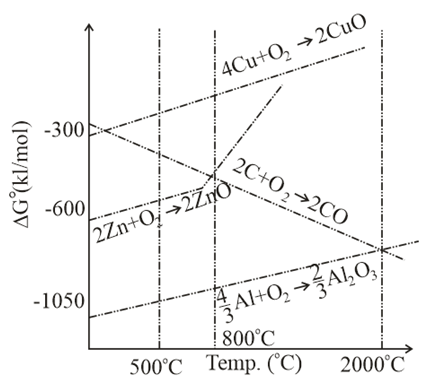
The correct statement regarding the given Ellingham diagram is:

Homoleptic octahedral complexes of a metal ion $$M^{3+}$$ with three monodentate ligands $$L_1$$, $$L_2$$ and $$L_3$$ absorb wavelengths in the region of green, blue and red respectively. The increasing order of the ligand strength is:

The test performed on compound x and their inferences are:
Test                                             Inference
(a) 2,4-DNP test                    Coloured precipitate yellow
(b) Iodoform test                  Yellow precipitate
(c) Azo-dye test                    No dye formation
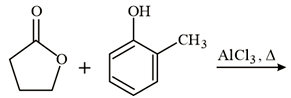
Compound 'x' is:

Let $$S$$ be the set of all triangles in the $$xy$$-plane, each having one vertex at the origin and the other two vertices lie on coordinate axes with integral coordinates. If each triangle in $$S$$ has area 50 sq. units, then the number of elements in the set $$S$$ is:

Let the equations of two sides of a triangle be $$3x - 2y + 6 = 0$$ and $$4x + 5y - 20 = 0$$. If the orthocenter of this triangle is at $$(1, 1)$$ then the equation of its third side is:

Let $$A(4, -4)$$ and $$B(9, 6)$$ be points on the parabola, $$y^2 = 4x$$. Let $$C$$ be chosen on the arc AOB of the parabola, where $$O$$ is the origin, such that the area of $$\triangle ACB$$ is maximum. Then, the area (in sq. units) of $$\triangle ACB$$, is:

If $$A = \begin{bmatrix} e^t & e^{-t}\cos t & e^{-t}\sin t \\ e^t & -e^{-t}\cos t - e^{-t}\sin t & -e^{-t}\sin t + e^{-t}\cos t \\ e^t & 2e^{-t}\sin t & -2e^{-t}\cos t \end{bmatrix}$$, then $$A$$ is:

Let $$f: [0,1] \to R$$ be such that $$f(xy) = f(x) \cdot f(y)$$, for all $$x, y \in [0,1]$$, and $$f(0) \neq 0$$. If $$y = y(x)$$ satisfies the differential equation, $$\frac{dy}{dx} = f(x)$$ with $$y(0) = 1$$, then $$y\left(\frac{1}{4}\right) + y\left(\frac{3}{4}\right)$$ is equal to:

Let $$\vec{a} = \hat{i} + \hat{j} + \sqrt{2}\hat{k}$$, $$\vec{b} = b_1\hat{i} + b_2\hat{j} + \sqrt{2}\hat{k}$$ and $$\vec{c} = 5\hat{i} + \hat{j} + \sqrt{2}\hat{k}$$ be three vectors such that the projection vector of $$\vec{b}$$ on $$\vec{a}$$ is $$|\vec{a}|$$. If $$\vec{a} + \vec{b}$$ is perpendicular to $$\vec{c}$$, then $$|\vec{b}|$$ is equal to:

The equation of the plane containing the straight line $$\frac{x}{2} = \frac{y}{3} = \frac{z}{4}$$ and perpendicular to the plane containing the straight lines $$\frac{x}{3} = \frac{y}{4} = \frac{z}{2}$$ and $$\frac{x}{4} = \frac{y}{2} = \frac{z}{3}$$ is:

An urn contains 5 red and 2 green balls. A ball is drawn at random from the urn. If the drawn ball is green, then a red ball is added to the urn and if the drawn ball is red, then a green ball is added to the urn; the original ball is not returned to the urn. Now, a second ball is drawn at random from it. The probability that the second ball is red, is: