
Join Our JEE Preparation Group
Prep with like-minded aspirants; Get access to free daily tests and study material.
Sign in
Please select an account to continue using cracku.in
↓ →
Join Our JEE Preparation Group
Prep with like-minded aspirants; Get access to free daily tests and study material.
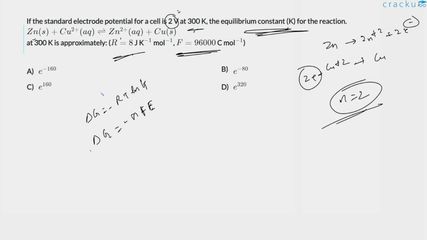
If the standard electrode potential for a cell is 2 V at 300 K, the equilibrium constant (K) for the reaction.
$$Zn(s) + Cu^{2+}(aq) \rightleftharpoons Zn^{2+}(aq) + Cu(s)$$
at 300 K is approximately: ($$R = 8$$ J K$$^{-1}$$ mol$$^{-1}$$, $$F = 96000$$ C mol$$^{-1}$$)
First, we recall the two fundamental thermodynamic relations that connect cell potential, Gibbs free energy and the equilibrium constant.
We have the electrochemical relation $$\Delta G^\circ = -\,n\,F\,E^\circ_{cell}$$ where $$n$$ is the number of electrons transferred, $$F$$ is Faraday’s constant and $$E^\circ_{cell}$$ is the standard cell potential.
We also have the thermodynamic definition of the equilibrium constant: $$\Delta G^\circ = -\,R\,T\,\ln K$$ where $$R$$ is the universal gas constant, $$T$$ is the absolute temperature and $$K$$ is the equilibrium constant.
Because both right-hand sides are equal to $$\Delta G^\circ$$, we can equate them:
$$-\,n\,F\,E^\circ_{cell} \;=\; -\,R\,T\,\ln K$$
Canceling the minus signs on both sides gives
$$n\,F\,E^\circ_{cell} \;=\; R\,T\,\ln K$$
We are asked about the reaction $$Zn(s) + Cu^{2+}(aq) \rightleftharpoons Zn^{2+}(aq) + Cu(s)$$. Zinc goes from an oxidation state of 0 to +2 and copper goes from +2 to 0, so exactly two electrons are transferred. Hence, $$n = 2$$.
Now we substitute the numerical values provided in the question:
$$n = 2,\quad F = 96000\;{\rm C\,mol^{-1}},\quad E^\circ_{cell} = 2\;{\rm V},\quad R = 8\;{\rm J\,K^{-1}\,mol^{-1}},\quad T = 300\;{\rm K}$$
Compute the numerator $$n\,F\,E^\circ_{cell}$$:
$$n\,F\,E^\circ_{cell} = 2 \times 96000 \times 2 = 384000\;{\rm J\,mol^{-1}}$$
Compute the denominator $$R\,T$$:
$$R\,T = 8 \times 300 = 2400\;{\rm J\,mol^{-1}}$$
Now form the quotient and obtain $$\ln K$$:
$$\ln K = \frac{n\,F\,E^\circ_{cell}}{R\,T} = \frac{384000}{2400} = 160$$
Finally, convert the natural logarithm back to $$K$$ by exponentiation:
$$K = e^{160}$$
Hence, the correct answer is Option C.
Was this solution helpful?
Click on the Email ☝️ to Watch the Video Solution
Create a FREE account and get:
_1.webp)

Educational materials for JEE preparation

Ask our AI anything

AI can make mistakes. Please verify important information.
AI can make mistakes. Please verify important information.


