
Join Our JEE Preparation Group
Prep with like-minded aspirants; Get access to free daily tests and study material.
Sign in
Please select an account to continue using cracku.in
↓ →
Join Our JEE Preparation Group
Prep with like-minded aspirants; Get access to free daily tests and study material.
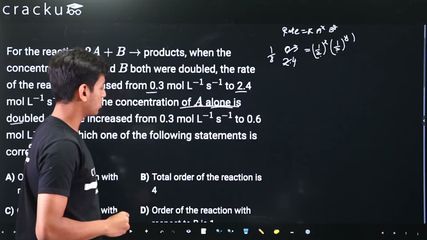
For the reaction, $$2A + B \rightarrow$$ products, when the concentration of $$A$$ and $$B$$ both were doubled, the rate of the reaction increased from 0.3 mol L$$^{-1}$$ s$$^{-1}$$ to 2.4 mol L$$^{-1}$$ s$$^{-1}$$. When the concentration of $$A$$ alone is doubled, the rate increased from 0.3 mol L$$^{-1}$$ s$$^{-1}$$ to 0.6 mol L$$^{-1}$$ s$$^{-1}$$. Which one of the following statements is correct?
We assume that the rate follows the usual rate law expression $$r = k[A]^m[B]^n$$, where $$m$$ is the order with respect to $$A$$ and $$n$$ is the order with respect to $$B$$. The symbol $$k$$ is the rate constant.
For the initial experiment we let the initial concentrations be $$[A]=a$$ and $$[B]=b$$. The initial rate is given to be
$$r_1 = k\,a^{\,m}\,b^{\,n} = 0.3\;\text{mol L}^{-1}\text{s}^{-1}.$$
Now both $$[A]$$ and $$[B]$$ are doubled, so they become $$2a$$ and $$2b$$ respectively. The new rate therefore is
$$r_2 = k\,(2a)^{\,m}\,(2b)^{\,n}.$$
Using the laws of exponents, we write
$$r_2 = k\,2^{\,m}a^{\,m}\,2^{\,n}b^{\,n} = 2^{\,m+n}\,k\,a^{\,m}b^{\,n} = 2^{\,m+n}\,r_1.$$
We are told that the numerical value of the rate increases from $$0.3$$ to $$2.4$$, so
$$\dfrac{r_2}{r_1}=\dfrac{2.4}{0.3}=8.$$
Comparing with the algebraic factor we obtained, we have
$$2^{\,m+n}=8.$$
Since $$8=2^{3}$$, we immediately deduce
$$m+n = 3.$$
Thus, the total order of the reaction is three, but we still need individual orders $$m$$ and $$n$$.
Next, only $$[A]$$ is doubled while $$[B]$$ is kept unchanged. The concentration of $$A$$ becomes $$2a$$ and that of $$B$$ stays $$b$$. The resulting rate is
$$r_3 = k\,(2a)^{\,m}\,b^{\,n} = 2^{\,m}\,k\,a^{\,m}b^{\,n}=2^{\,m}\,r_1.$$
The problem states that the rate rises from $$0.3$$ to $$0.6$$, so
$$\dfrac{r_3}{r_1}=\dfrac{0.6}{0.3}=2.$$
Equating the two factors gives
$$2^{\,m}=2 \quad\Longrightarrow\quad m = 1.$$
Substituting $$m = 1$$ into the earlier relation $$m+n = 3$$, we obtain
$$1 + n = 3 \quad\Longrightarrow\quad n = 2.$$
Therefore, the order with respect to $$A$$ is $$1$$ and the order with respect to $$B$$ is $$2$$. The only statement among the options that reflects this outcome is “Order of the reaction with respect to B is 2.”
Hence, the correct answer is Option A.
Was this solution helpful?
Click on the Email ☝️ to Watch the Video Solution
Create a FREE account and get:
_1.webp)

Educational materials for JEE preparation

Ask our AI anything

AI can make mistakes. Please verify important information.
AI can make mistakes. Please verify important information.


