
Join Our JEE Preparation Group
Prep with like-minded aspirants; Get access to free daily tests and study material.
Sign in
Please select an account to continue using cracku.in
↓ →
Join Our JEE Preparation Group
Prep with like-minded aspirants; Get access to free daily tests and study material.
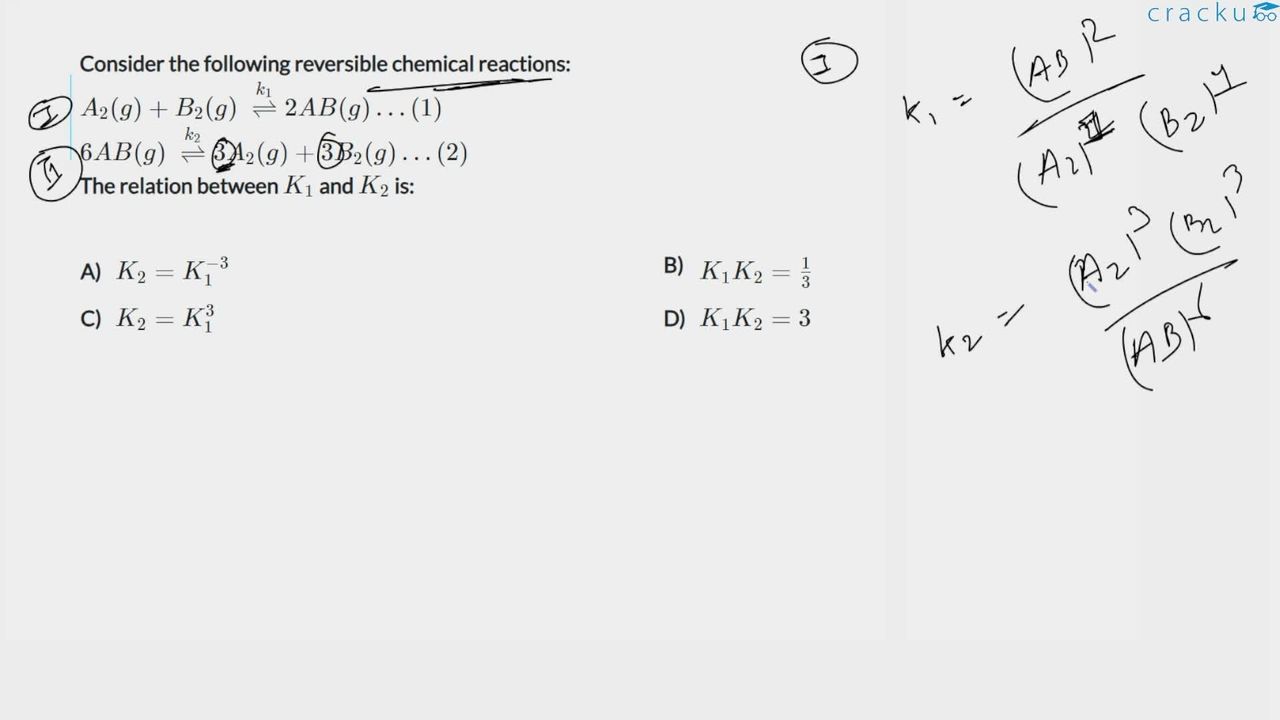
Consider the following reversible chemical reactions:
$$A_2(g) + B_2(g) \stackrel{k_1}{\rightleftharpoons} 2AB(g) \ldots (1)$$
$$6AB(g) \stackrel{k_2}{\rightleftharpoons} 3A_2(g) + 3B_2(g) \ldots (2)$$
The relation between $$K_1$$ and $$K_2$$ is:
We start with the first reversible reaction
$$A_2(g)+B_2(g)\rightleftharpoons 2AB(g)\qquad\text{with equilibrium constant }K_1$$
The second reaction given in the question is
$$6AB(g)\rightleftharpoons 3A_2(g)+3B_2(g)\qquad\text{with equilibrium constant }K_2$$
To compare the two constants we use two well-known rules of chemical equilibrium:
1. If the coefficients in a balanced equation are all multiplied by a factor $$n$$, the new equilibrium constant is the old one raised to the $$n^{\text{th}}$$ power: $$K_{\text{new}}=K_{\text{old}}^{\,n}.$$
2. If an equilibrium reaction is written in the reverse direction, the new equilibrium constant is the reciprocal of the original: $$K_{\text{reverse}}=\dfrac{1}{K_{\text{forward}}}.$$
Now we apply these rules step by step. First we multiply every coefficient in reaction (1) by 3 so that the number of $$AB$$ molecules matches the 6 that appear in reaction (2). Doing this gives
$$3A_2(g)+3B_2(g)\rightleftharpoons 6AB(g)$$
Because each coefficient was multiplied by 3, the equilibrium constant for this new equation becomes
$$K_1^{\,3}.$$
Next we observe that the direction of this multiplied equation is opposite to that of reaction (2). Reaction (2) has $$6AB$$ on the left and $$3A_2+3B_2$$ on the right, whereas our multiplied equation has the reverse. Therefore, to obtain exactly reaction (2) we must reverse the multiplied equation. Reversing it gives
$$6AB(g)\rightleftharpoons 3A_2(g)+3B_2(g)$$
and, by the second rule, its equilibrium constant becomes the reciprocal of $$K_1^{\,3}$$, namely
$$\dfrac{1}{K_1^{\,3}}=K_1^{-3}.$$
This expression is precisely the equilibrium constant $$K_2$$ for reaction (2). So we have
$$K_2 = K_1^{-3}.$$
Hence, the correct answer is Option A.
Was this solution helpful?
Click on the Email ☝️ to Watch the Video Solution
Create a FREE account and get:
_1.webp)

Educational materials for JEE preparation

Ask our AI anything

AI can make mistakes. Please verify important information.
AI can make mistakes. Please verify important information.


