
Join Our JEE Preparation Group
Prep with like-minded aspirants; Get access to free daily tests and study material.
Sign in
Please select an account to continue using cracku.in
↓ →
Join Our JEE Preparation Group
Prep with like-minded aspirants; Get access to free daily tests and study material.
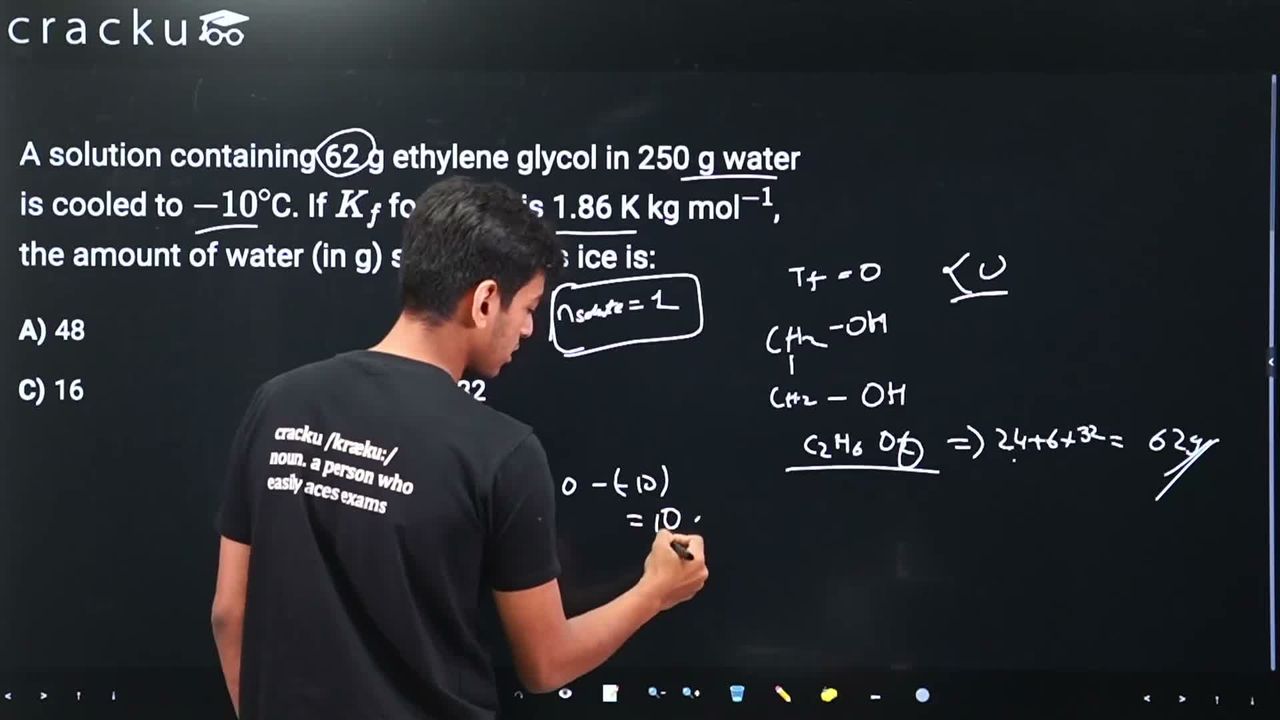
A solution containing 62 g ethylene glycol in 250 g water is cooled to $$-10^{\circ}$$C. If $$K_f$$ for water is 1.86 K kg mol$$^{-1}$$, the amount of water (in g) separated as ice is:
We start by recalling the formula for depression of the freezing point of a dilute solution:
$$\Delta T_f = K_f \, m$$
where $$\Delta T_f$$ is the lowering of the freezing point, $$K_f$$ is the cryoscopic constant of the solvent (for water, $$K_f = 1.86\ \text{K kg mol}^{-1}$$), and $$m$$ is the molality of the solution.
The solution contains ethylene glycol, $$C_2H_6O_2$$, which is a nonelectrolyte, so its van ’t Hoff factor $$i = 1$$. The given data are:
Mass of ethylene glycol added = $$62\ \text{g}$$
Molar mass of ethylene glycol = $$62\ \text{g mol}^{-1}$$
Initial mass of water = $$250\ \text{g} = 0.250\ \text{kg}$$
Observed final temperature = $$-10^{\circ}\text{C}$$
Pure water freezes at $$0^{\circ}\text{C}$$, so $$\Delta T_f = 0 - (-10) = 10\ \text{K}$$.
First we determine the moles of solute present:
$$n_{\text{solute}} = \frac{62\ \text{g}}{62\ \text{g mol}^{-1}} = 1\ \text{mol}$$
When the solution is cooled, some water separates out as ice. Let $$x\ \text{g}$$ be the mass of water that freezes. The mass of liquid water left behind (the solvent for the remaining solution) is therefore $$250 - x\ \text{g}$$, or $$\dfrac{250 - x}{1000}\ \text{kg}$$.
Hence the molality of the solution after separation of ice is
$$m = \frac{\text{moles of solute}}{\text{kilograms of liquid water}} = \frac{1}{\dfrac{250 - x}{1000}} = \frac{1000}{250 - x}\ \text{mol kg}^{-1}.$$
Substituting this molality and the given values of $$\Delta T_f$$ and $$K_f$$ in the freezing-point depression formula, we have
$$\Delta T_f = K_f\, m \quad\Longrightarrow\quad 10 = 1.86 \left(\frac{1000}{250 - x}\right).$$
Now we solve for $$x$$ step by step:
$$10(250 - x) = 1.86 \times 1000$$
$$2500 - 10x = 1860$$
$$2500 - 1860 = 10x$$
$$640 = 10x$$
$$x = \frac{640}{10} = 64\ \text{g}.$$
This value of $$x$$ represents the mass of water that has crystallised out as ice.
Hence, the correct answer is Option B.
Was this solution helpful?
Click on the Email ☝️ to Watch the Video Solution
Create a FREE account and get:
_1.webp)

Educational materials for JEE preparation

Ask our AI anything

AI can make mistakes. Please verify important information.
AI can make mistakes. Please verify important information.


