
Join Our JEE Preparation Group
Prep with like-minded aspirants; Get access to free daily tests and study material.
Sign in
Please select an account to continue using cracku.in
↓ →
Join Our JEE Preparation Group
Prep with like-minded aspirants; Get access to free daily tests and study material.
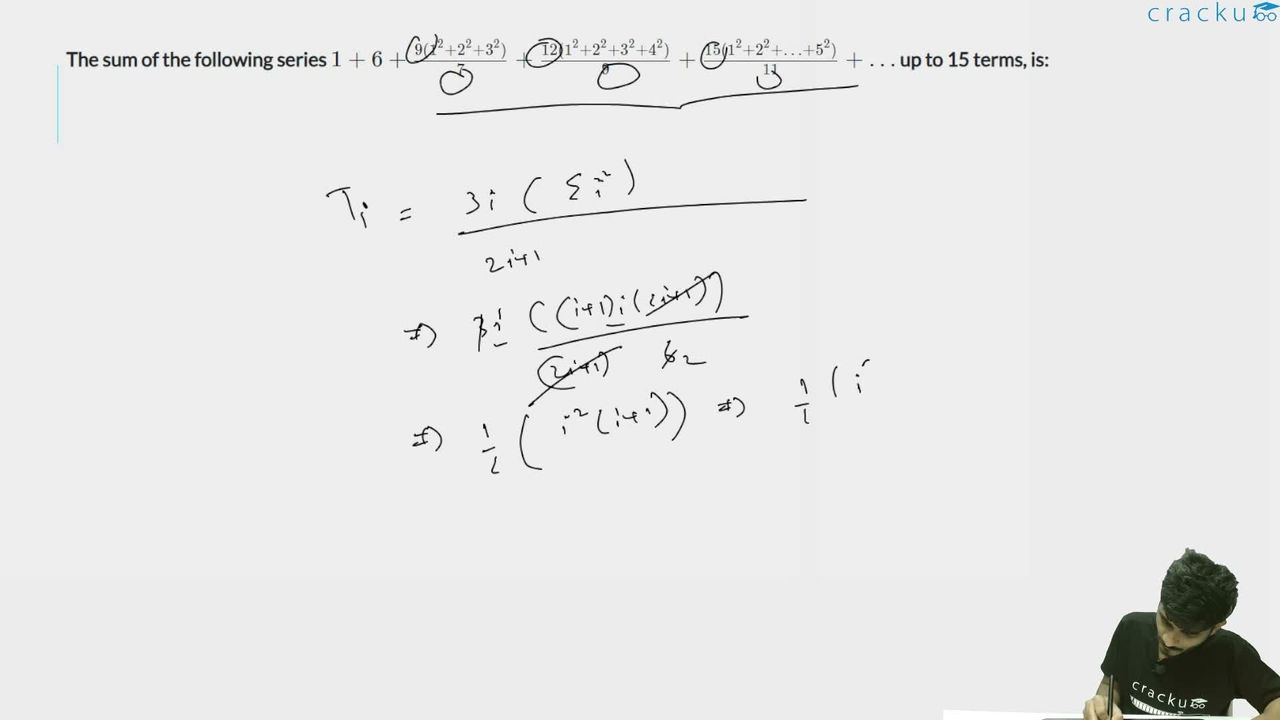
The sum of the following series $$1 + 6 + \frac{9(1^2 + 2^2 + 3^2)}{7} + \frac{12(1^2 + 2^2 + 3^2 + 4^2)}{9} + \frac{15(1^2 + 2^2 + \ldots + 5^2)}{11} + \ldots$$ up to 15 terms, is:
We begin by denoting the required sum of the first 15 terms by $$S_{15}\,.$$
The first two terms are written down directly:
$$T_1 = 1 ,\qquad T_2 = 6.$$
From the third term onward we observe a clear pattern. For the $$r^{\text{th}}$$ term ($$r\ge 3$$)
$$T_r=\frac{3r}{2r+1}\Bigl(1^2+2^2+\cdots+r^2\Bigr).$$
For the inner summation we recall the standard formula
$$\sum_{k=1}^{r} k^{2}= \frac{r(r+1)(2r+1)}{6}.$$
Substituting this result into the expression for $$T_r$$ we obtain
$$T_r=\frac{3r}{2r+1}\cdot\frac{r(r+1)(2r+1)}{6}.$$
The factor $$(2r+1)$$ in the numerator and denominator cancels out, giving
$$T_r=\frac{3r\,r(r+1)}{6}=\frac{r^{2}(r+1)}{2}.$$
Thus for every $$r\ge 3$$ we have
$$T_r=\frac{r^{2}(r+1)}{2}= \frac{r^{3}+r^{2}}{2}.$$
Now we write $$S_{15}$$ explicitly:
$$S_{15}=T_1+T_2+\sum_{r=3}^{15}T_r \;=\;1+6+\sum_{r=3}^{15}\frac{r^{3}+r^{2}}{2}.$$
Pulling out the factor $$\tfrac12$$ for convenience,
$$S_{15}=7+\frac12\sum_{r=3}^{15}\bigl(r^{3}+r^{2}\bigr).$$
To evaluate the remaining summation, we use the standard formulas
$$\sum_{r=1}^{n} r^{2}= \frac{n(n+1)(2n+1)}{6}, \qquad \sum_{r=1}^{n} r^{3}= \left[\frac{n(n+1)}{2}\right]^2.$$
First compute the totals up to $$n=15$$:
$$\sum_{r=1}^{15} r^{2}= \frac{15\cdot16\cdot31}{6}=1240, \qquad \sum_{r=1}^{15} r^{3}= \left(\frac{15\cdot16}{2}\right)^{2}=120^{2}=14400.$$
Next compute the totals up to $$n=2$$ (so that they can be subtracted to begin the summation at $$r=3$$):
$$\sum_{r=1}^{2} r^{2}= \frac{2\cdot3\cdot5}{6}=5, \qquad \sum_{r=1}^{2} r^{3}= \left(\frac{2\cdot3}{2}\right)^{2}=3^{2}=9.$$
Therefore, for the range $$r=3$$ to $$15$$ we have
$$\sum_{r=3}^{15} r^{2}=1240-5=1235,$$
$$\sum_{r=3}^{15} r^{3}=14400-9=14391.$$
Adding these two results term-wise:
$$\sum_{r=3}^{15}\bigl(r^{3}+r^{2}\bigr)=14391+1235=15626.$$
Returning to $$S_{15}$$ we substitute this value:
$$S_{15}=7+\frac12\cdot15626=7+7813=7820.$$
Hence, the correct answer is Option D.
Was this solution helpful?
Click on the Email ☝️ to Watch the Video Solution
Create a FREE account and get:
_1.webp)

Educational materials for JEE preparation

Ask our AI anything

AI can make mistakes. Please verify important information.
AI can make mistakes. Please verify important information.


