
Join Our JEE Preparation Group
Prep with like-minded aspirants; Get access to free daily tests and study material.
Sign in
Please select an account to continue using cracku.in
↓ →
Join Our JEE Preparation Group
Prep with like-minded aspirants; Get access to free daily tests and study material.
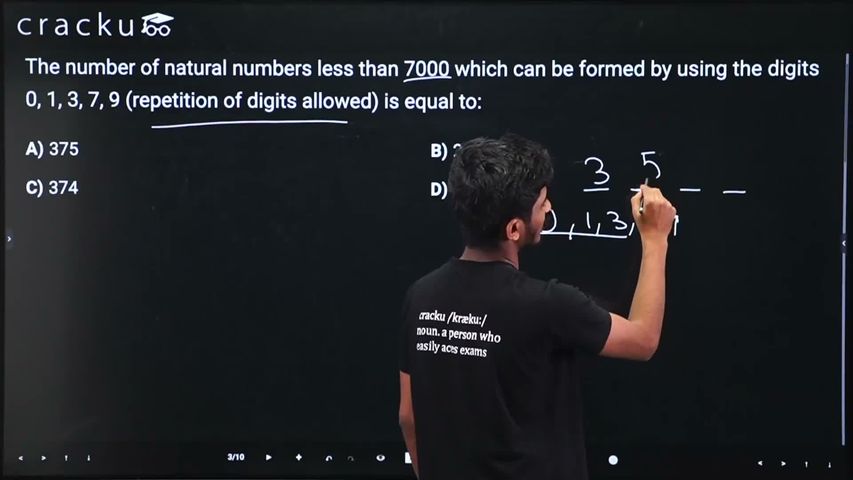
The number of natural numbers less than 7000 which can be formed by using the digits 0, 1, 3, 7, 9 (repetition of digits allowed) is equal to:
We have to count every natural number that is strictly less than $$7000$$ and that can be written with the digits $$0,1,3,7,9$$, where a digit may be repeated any number of times.
Any natural number below $$7000$$ can have one, two, three or four digits. Hence we split the work into those four separate cases and then add up the results. The basic counting principle we will use again and again is:
$$\text{(Number of ways for position 1)} \times \text{(Number of ways for position 2)} \times \dots$$
Case 1 - one-digit numbers: The single digit may not be $$0$$ because a natural number cannot start with zero. The permissible one-digit choices are $$1,3,7,9$$. Hence the count here is $$4$$.
Case 2 - two-digit numbers: For the tens place we again cannot use $$0$$. So we have $$1,3,7,9$$, i.e. $$4$$ choices. For the units place we may use any of the five digits $$0,1,3,7,9$$, giving $$5$$ choices. Using the multiplication principle, the total is $$4 \times 5 = 20.$$
Case 3 - three-digit numbers: The hundreds place still cannot be $$0$$, so it has the same $$4$$ possibilities $$\{1,3,7,9\}$$. Both the tens and the units places may each take any of the $$5$$ digits. Thus the count is $$4 \times 5 \times 5 = 100.$$
Case 4 - four-digit numbers less than $$7000$$: Here the thousands digit is crucial. If it were $$7$$ or $$9$$ the number would be at least $$7000$$, which is not allowed. The digit $$0$$ is also disallowed in the thousands place because then the number would not be a four-digit number at all. Therefore only $$1$$ or $$3$$ are valid, giving $$2$$ possibilities. Each of the remaining three places (hundreds, tens, units) can take any of the $$5$$ digits. So the count becomes $$2 \times 5 \times 5 \times 5 = 250.$$
Finally, we add the disjoint cases: $$4 + 20 + 100 + 250 = 374.$$
Hence, the correct answer is Option C.
Was this solution helpful?
Click on the Email ☝️ to Watch the Video Solution
Create a FREE account and get:
_1.webp)

Educational materials for JEE preparation

Ask our AI anything

AI can make mistakes. Please verify important information.
AI can make mistakes. Please verify important information.


