
Join Our JEE Preparation Group
Prep with like-minded aspirants; Get access to free daily tests and study material.
Sign in
Please select an account to continue using cracku.in
↓ →
Join Our JEE Preparation Group
Prep with like-minded aspirants; Get access to free daily tests and study material.
Let $$a$$, $$b$$ and $$c$$ be the 7$$^{th}$$, 11$$^{th}$$ and 13$$^{th}$$ terms respectively of a non-constant A.P. If these are also the three consecutive terms of a G.P., then $$\frac{a}{c}$$ is equal to:
Let us denote the first term of the arithmetic progression (A.P.) by $$A$$ and its common difference by $$d$$.
The $$n^{\text{th}}$$ term of an A.P. is given by the well-known formula
$$T_n \;=\; A + (n-1)d.$$
Using this, we translate the information given in the question:
We have
$$a \;=\; \text{7}^{\text{th}}\text{ term} \;=\; A + 6d,$$
$$b \;=\; \text{11}^{\text{th}}\text{ term} \;=\; A + 10d,$$
$$c \;=\; \text{13}^{\text{th}}\text{ term} \;=\; A + 12d.$$
Now the same three numbers $$a,\,b,\,c$$ also form three consecutive terms of a geometric progression (G.P.). In any G.P., for three consecutive terms, the middle term squared equals the product of the other two terms. Symbolically,
$$b^{2} \;=\; a\,c.$$
Substituting the expressions of $$a,\,b,\,c$$ from above, we get
$$\bigl(A + 10d\bigr)^{2} \;=\; \bigl(A + 6d\bigr)\,\bigl(A + 12d\bigr).$$
Expanding the left side completely,
$$\bigl(A + 10d\bigr)^{2} \;=\; A^{2} + 20Ad + 100d^{2}.$$
Next, expanding the right side,
$$\bigl(A + 6d\bigr)\,\bigl(A + 12d\bigr) \;=\; A^{2} + 12Ad + 6Ad + 72d^{2} \;=\; A^{2} + 18Ad + 72d^{2}.$$
Equating the two expansions, we have
$$A^{2} + 20Ad + 100d^{2} \;=\; A^{2} + 18Ad + 72d^{2}.$$
The $$A^{2}$$ terms cancel out from both sides, leaving
$$20Ad + 100d^{2} \;=\; 18Ad + 72d^{2}.$$
Bringing all terms to one side,
$$20Ad - 18Ad + 100d^{2} - 72d^{2} \;=\; 0,$$
$$2Ad + 28d^{2} \;=\; 0.$$
Now we can factor out $$2d$$ (remember the A.P. is non-constant, so $$d \neq 0$$), giving
$$2d\;\bigl(A + 14d\bigr) \;=\; 0.$$
Since $$2d \neq 0,$$ the remaining factor must vanish:
$$A + 14d \;=\; 0,$$
hence
$$A \;=\; -\,14d.$$
We now compute the required ratio $$\dfrac{a}{c}$$. Using $$A = -14d$$ we obtain
$$a \;=\; A + 6d \;=\; -14d + 6d \;=\; -\,8d,$$
$$c \;=\; A + 12d \;=\; -14d + 12d \;=\; -\,2d.$$
Therefore,
$$\frac{a}{c} \;=\; \frac{-8d}{-2d} \;=\; 4.$$
Hence, the correct answer is Option D.
Was this solution helpful?
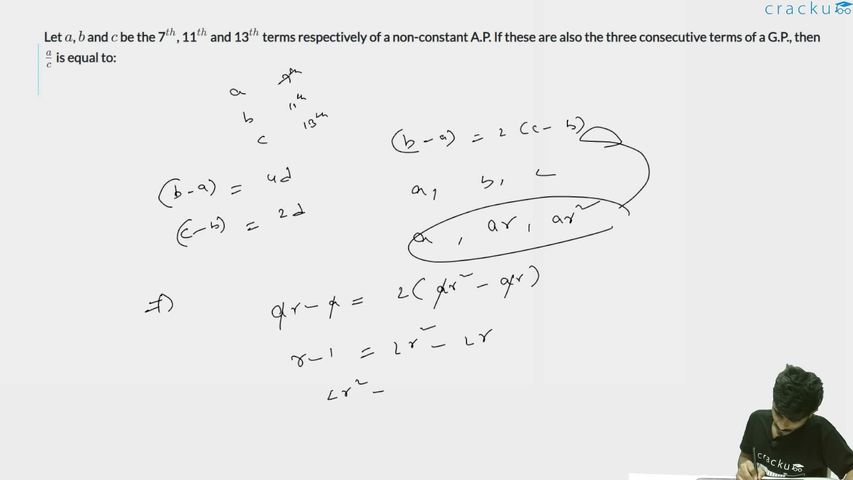
Click on the Email ☝️ to Watch the Video Solution
Create a FREE account and get:
_1.webp)

Educational materials for JEE preparation

Ask our AI anything

AI can make mistakes. Please verify important information.
AI can make mistakes. Please verify important information.


