
Join Our JEE Preparation Group
Prep with like-minded aspirants; Get access to free daily tests and study material.
Sign in
Please select an account to continue using cracku.in
↓ →
Join Our JEE Preparation Group
Prep with like-minded aspirants; Get access to free daily tests and study material.
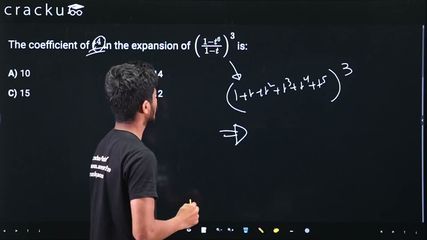
The coefficient of $$t^4$$ in the expansion of $$\left(\frac{1 - t^6}{1 - t}\right)^3$$ is:
We have to find the coefficient of $$t^4$$ in the expression $$\left(\dfrac{1-t^{6}}{1-t}\right)^3$$.
First, recall the geometric‐series identity
$$\frac{1-x^{n}}{1-x}=1+x+x^{2}+x^{3}+\dots +x^{n-1}.$$
Applying this with $$x=t$$ and $$n=6$$, we get
$$\frac{1-t^{6}}{1-t}=1+t+t^{2}+t^{3}+t^{4}+t^{5}.$$
So our given expression becomes
$$\left(1+t+t^{2}+t^{3}+t^{4}+t^{5}\right)^3.$$
In this product each factor contributes a power of $$t$$ from the set $$\{0,1,2,3,4,5\}$$. To obtain the term $$t^4$$, we must select three exponents (one from each factor) whose sum is exactly $$4$$.
Let those exponents be $$i$$, $$j$$ and $$k$$. Then
$$i+j+k=4,$$
with the restrictions $$0\le i\le5,\;0\le j\le5,\;0\le k\le5.$$ Because the required sum is only $$4$$, every solution automatically satisfies $$i,j,k\le5$$, so we may ignore these upper limits.
The problem of counting ordered triples $$(i,j,k)$$ of non-negative integers satisfying $$i+j+k=4$$ is a standard stars-and-bars problem. The formula is:
Number of non-negative integer solutions of $$x_1+x_2+\dots+x_r = n$$ is $$\binom{n+r-1}{r-1}.$$
Here $$r=3$$ and $$n=4$$, so we have
$$\binom{4+3-1}{3-1}=\binom{6}{2}=15.$$
Each such ordered triple contributes $$1\cdot1\cdot1=1$$ to the coefficient because every individual term in the parenthesis has coefficient $$1$$. Therefore, summing over the $$15$$ different triples, the coefficient of $$t^4$$ is $$15$$.
Hence, the correct answer is Option C.
Was this solution helpful?
Click on the Email ☝️ to Watch the Video Solution
Create a FREE account and get:
_1.webp)

Educational materials for JEE preparation

Ask our AI anything

AI can make mistakes. Please verify important information.
AI can make mistakes. Please verify important information.


