
Join Our JEE Preparation Group
Prep with like-minded aspirants; Get access to free daily tests and study material.
Sign in
Please select an account to continue using cracku.in
↓ →
Join Our JEE Preparation Group
Prep with like-minded aspirants; Get access to free daily tests and study material.
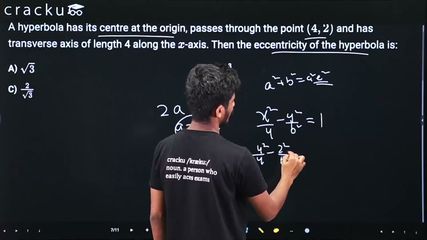
A hyperbola has its centre at the origin, passes through the point $$(4, 2)$$ and has transverse axis of length 4 along the $$x$$-axis. Then the eccentricity of the hyperbola is:
We are told that the centre of the hyperbola is the origin, its transverse axis lies along the $$x$$-axis and the length of this transverse axis is 4.
For a hyperbola whose transverse axis is along the $$x$$-axis with centre at the origin, the standard equation is
$$\frac{x^{2}}{a^{2}}-\frac{y^{2}}{b^{2}}=1.$$
Here $$2a$$ represents the length of the transverse axis. Since the given length is 4, we have
$$2a = 4.$$
Dividing both sides by 2, we get
$$a = 2.$$
So the equation of the required hyperbola can now be written as
$$\frac{x^{2}}{2^{2}}-\frac{y^{2}}{b^{2}}=1,$$
which simplifies to
$$\frac{x^{2}}{4}-\frac{y^{2}}{b^{2}}=1.$$
The hyperbola passes through the point $$(4,\,2)$$. That means when $$x = 4$$ and $$y = 2$$, the left side of the equation must equal 1. Substituting these values, we have
$$\frac{(4)^{2}}{4}-\frac{(2)^{2}}{b^{2}} = 1.$$
Calculating the squares gives
$$\frac{16}{4}-\frac{4}{b^{2}} = 1.$$
Simplifying the first fraction, we obtain
$$4-\frac{4}{b^{2}} = 1.$$
Now we isolate the term containing $$b^{2}$$ by subtracting 1 from both sides:
$$4-\frac{4}{b^{2}}-1 = 0 \quad\Longrightarrow\quad 3-\frac{4}{b^{2}} = 0.$$
Next, we add $$\dfrac{4}{b^{2}}$$ to both sides to remove the negative sign:
$$3 = \frac{4}{b^{2}}.$$
To solve for $$b^{2}$$, we take the reciprocal of both sides:
$$\frac{1}{3} = \frac{b^{2}}{4}.$$
Multiplying both sides by 4, we get
$$b^{2} = \frac{4}{3}.$$
We are now ready to compute the eccentricity $$e$$. For a hyperbola in the form
$$\frac{x^{2}}{a^{2}}-\frac{y^{2}}{b^{2}} = 1,$$
the formula for the eccentricity is
$$e = \sqrt{1+\frac{b^{2}}{a^{2}}}.$$
We already have $$a^{2}=4$$ and $$b^{2}=\dfrac{4}{3}$$. Substituting these values into the formula gives
$$e = \sqrt{1+\frac{\dfrac{4}{3}}{4}}.$$
Inside the square root, the fraction simplifies as follows:
$$\frac{\dfrac{4}{3}}{4} = \frac{4}{3}\times\frac{1}{4} = \frac{1}{3}.$$
Hence the expression under the radical becomes
$$1 + \frac{1}{3} = \frac{4}{3}.$$
Therefore, we obtain
$$e = \sqrt{\frac{4}{3}}.$$
Taking the square root of the numerator and the denominator separately, we arrive at
$$e = \frac{2}{\sqrt{3}}.$$
Thus the eccentricity of the hyperbola is $$\dfrac{2}{\sqrt{3}}$$.
Hence, the correct answer is Option C.
Was this solution helpful?
Click on the Email ☝️ to Watch the Video Solution
Create a FREE account and get:
_1.webp)

Educational materials for JEE preparation

Ask our AI anything

AI can make mistakes. Please verify important information.
AI can make mistakes. Please verify important information.


