
Join Our JEE Preparation Group
Prep with like-minded aspirants; Get access to free daily tests and study material.
Sign in
Please select an account to continue using cracku.in
↓ →
Join Our JEE Preparation Group
Prep with like-minded aspirants; Get access to free daily tests and study material.
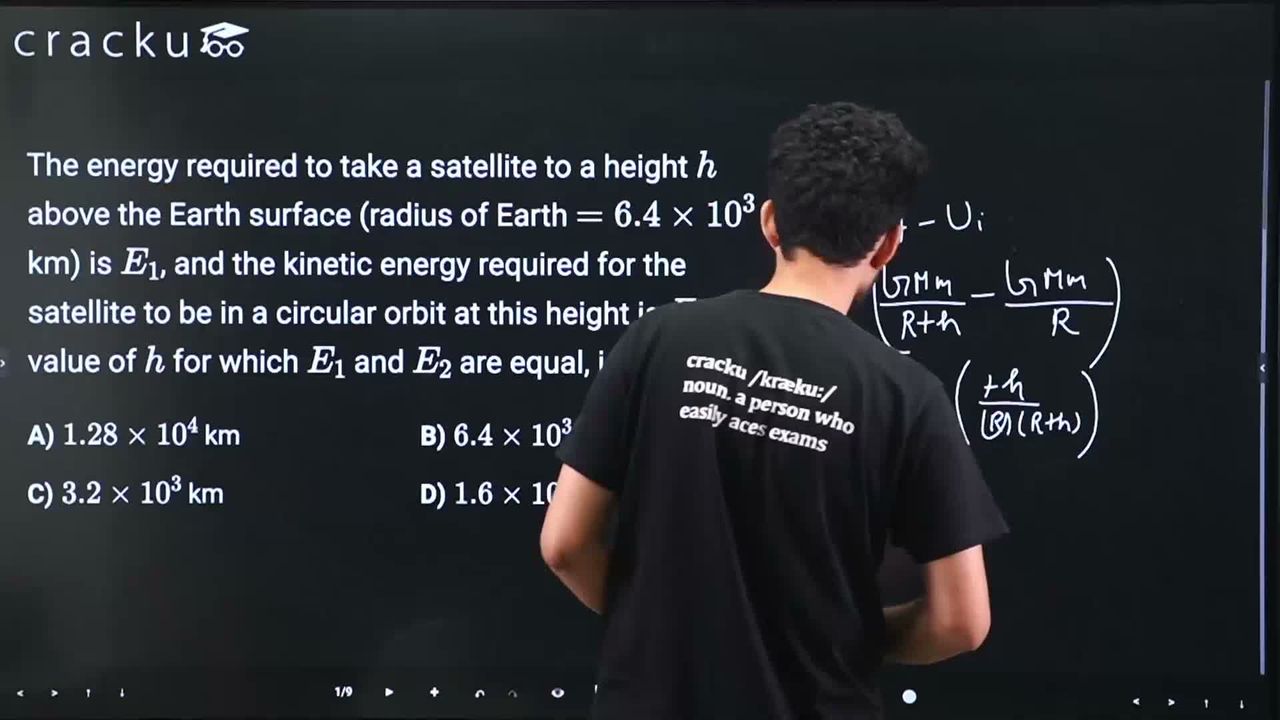
The energy required to take a satellite to a height $$h$$ above the Earth surface (radius of Earth $$= 6.4 \times 10^3$$ km) is $$E_1$$, and the kinetic energy required for the satellite to be in a circular orbit at this height is $$E_2$$. The value of $$h$$ for which $$E_1$$ and $$E_2$$ are equal, is:
Let the mass of the satellite be $$m$$ and the universal gravitational constant be $$G$$. The radius of the Earth is given as $$R = 6.4 \times 10^3 \text{ km}$$.
First, recall the formula for gravitational potential energy of a body of mass $$m$$ at a distance $$r$$ from the centre of the Earth:
$$U = -\dfrac{G M m}{r},$$
where $$M$$ is the mass of the Earth. The negative sign shows that the potential energy is taken to be zero at infinity.
The energy required to lift the satellite from the Earth’s surface (where the distance from the centre is $$R$$) to a height $$h$$ (where the distance from the centre is $$R + h$$) is simply the increase in potential energy. We therefore write
$$E_1 = U_{\text{final}} - U_{\text{initial}}.$$
Substituting the expressions for the potentials, we have
$$E_1 = \Bigl(-\dfrac{G M m}{R + h}\Bigr) \;-\; \Bigl(-\dfrac{G M m}{R}\Bigr) = G M m\Bigl(\dfrac{1}{R} - \dfrac{1}{R + h}\Bigr).$$
Now, to keep the satellite moving in a circular orbit of radius $$R + h$$, it must possess some kinetic energy. For a circular orbit, the necessary speed $$v$$ is found from the equality of centripetal force and gravitational attraction:
$$\dfrac{m v^2}{R + h} = \dfrac{G M m}{(R + h)^2}.$$
Simplifying, we get the orbital speed
$$v^2 = \dfrac{G M}{R + h}.$$
The kinetic energy corresponding to this speed is
$$E_2 = \dfrac{1}{2} m v^2 = \dfrac{1}{2} m \Bigl(\dfrac{G M}{R + h}\Bigr) = \dfrac{G M m}{2\,(R + h)}.$$
We are asked to find the height $$h$$ for which the lifting energy $$E_1$$ equals the orbital kinetic energy $$E_2$$. Hence we equate them:
$$G M m\Bigl(\dfrac{1}{R} - \dfrac{1}{R + h}\Bigr) = \dfrac{G M m}{2\,(R + h)}.$$
We notice that the common factor $$G M m$$ appears on both sides, so it can be cancelled:
$$\dfrac{1}{R} - \dfrac{1}{R + h} = \dfrac{1}{2\,(R + h)}.$$
To combine the left-hand side into a single fraction, we bring it to a common denominator:
$$\dfrac{(R + h) - R}{R\,(R + h)} = \dfrac{h}{R\,(R + h)}.$$
So the equality becomes
$$\dfrac{h}{R\,(R + h)} = \dfrac{1}{2\,(R + h)}.$$
Because the factor $$R + h$$ occurs in both denominators, it can again be cancelled from numerator and denominator on each side, yielding
$$\dfrac{h}{R} = \dfrac{1}{2}.$$
Now we solve for $$h$$:
$$h = \dfrac{R}{2}.$$
The radius of the Earth is $$R = 6.4 \times 10^3 \text{ km}$$, so substituting, we have
$$h = \dfrac{6.4 \times 10^3 \text{ km}}{2} = 3.2 \times 10^3 \text{ km}.$$
Hence, the correct answer is Option C.
Was this solution helpful?
Click on the Email ☝️ to Watch the Video Solution
Create a FREE account and get:
_1.webp)

Educational materials for JEE preparation

Ask our AI anything

AI can make mistakes. Please verify important information.
AI can make mistakes. Please verify important information.


