
Join Our JEE Preparation Group
Prep with like-minded aspirants; Get access to free daily tests and study material.
Sign in
Please select an account to continue using cracku.in
↓ →
Join Our JEE Preparation Group
Prep with like-minded aspirants; Get access to free daily tests and study material.
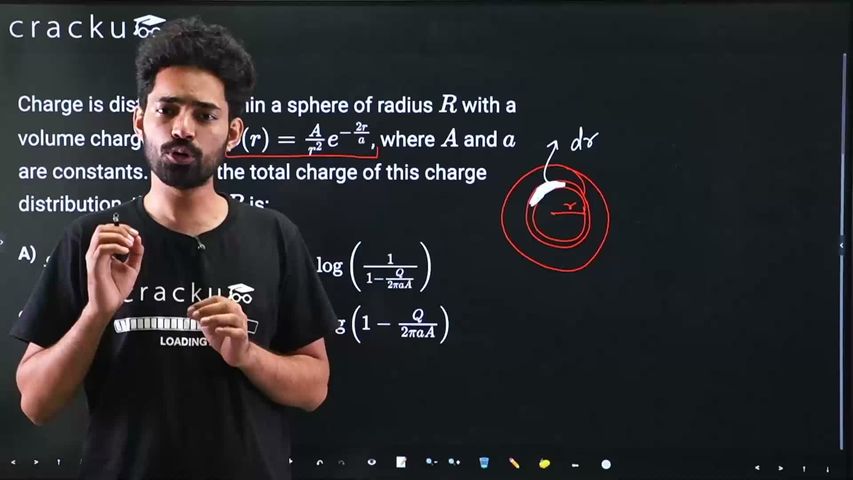
Charge is distributed within a sphere of radius $$R$$ with a volume charge density $$\rho(r) = \frac{A}{r^2}e^{-\frac{2r}{a}}$$, where $$A$$ and $$a$$ are constants. If $$Q$$ is the total charge of this charge distribution, the radius $$R$$ is:
We have a spherically symmetric charge distribution whose volume charge density is given by
$$\rho(r)=\frac{A}{r^{2}}\,e^{-\frac{2r}{a}},$$
where $$A$$ and $$a$$ are constants and $$r$$ is the radial distance from the centre. The total charge $$Q$$ contained in a sphere of radius $$R$$ is obtained by integrating the charge density over the entire volume from the centre ( $$r=0$$ ) to the surface ( $$r=R$$ ).
First, we recall that in spherical coordinates the elemental volume is
$$dV = 4\pi r^{2}\,dr.$$
Therefore, the total charge is
$$Q = \int_{0}^{R} \rho(r)\;dV = \int_{0}^{R} \left(\frac{A}{r^{2}}e^{-\frac{2r}{a}}\right) \left(4\pi r^{2}\,dr\right).$$
Now we observe that the factor $$r^{2}$$ in $$dV$$ cancels the $$r^{-2}$$ in $$\rho(r)$$, leaving
$$Q = 4\pi A \int_{0}^{R} e^{-\frac{2r}{a}}\;dr.$$
Next, we evaluate the exponential integral. We first state the standard integral formula
$$\int e^{kx}\,dx = \frac{1}{k}\,e^{kx}+C.$$
Here our integrand is $$e^{-\frac{2r}{a}}$$, so $$k=-\frac{2}{a}$$. Applying the formula, we get
$$\int e^{-\frac{2r}{a}}\;dr = \frac{1}{-\dfrac{2}{a}}\,e^{-\frac{2r}{a}} = -\frac{a}{2}\,e^{-\frac{2r}{a}}.$$
We now apply the definite limits from $$r=0$$ to $$r=R$$:
$$\int_{0}^{R} e^{-\frac{2r}{a}}\,dr = \left[-\frac{a}{2}\,e^{-\frac{2r}{a}}\right]_{0}^{R} = -\frac{a}{2}\,e^{-\frac{2R}{a}} + \frac{a}{2}\,e^{0} = \frac{a}{2}\left(1 - e^{-\frac{2R}{a}}\right).$$
Substituting this result back into the expression for $$Q$$, we obtain
$$Q = 4\pi A \left[\frac{a}{2}\left(1 - e^{-\frac{2R}{a}}\right)\right] = 2\pi aA\left(1 - e^{-\frac{2R}{a}}\right).$$
To isolate $$R$$, we first divide both sides by $$2\pi aA$$:
$$\frac{Q}{2\pi aA} = 1 - e^{-\frac{2R}{a}}.$$
Rearranging, we get
$$e^{-\frac{2R}{a}} = 1 - \frac{Q}{2\pi aA}.$$
We now take the natural logarithm (ln) of both sides. Using the fact that $$\ln(e^{x}) = x$$, we have
$$-\frac{2R}{a} = \ln\!\left(1 - \frac{Q}{2\pi aA}\right).$$
Multiplying both sides by $$-\dfrac{a}{2}$$ gives
$$R = -\frac{a}{2}\,\ln\!\left(1 - \frac{Q}{2\pi aA}\right).$$
Finally, we exploit the property $$-\ln(x) = \ln\!\left(\dfrac{1}{x}\right)$$ to present the radius in the more compact positive-logarithm form:
$$R = \frac{a}{2}\,\ln\!\left(\frac{1}{1 - \dfrac{Q}{2\pi aA}}\right).$$
This matches Option A.
Hence, the correct answer is Option A.
Was this solution helpful?
Click on the Email ☝️ to Watch the Video Solution
Create a FREE account and get:
_1.webp)

Educational materials for JEE preparation

Ask our AI anything

AI can make mistakes. Please verify important information.
AI can make mistakes. Please verify important information.


