
Join Our JEE Preparation Group
Prep with like-minded aspirants; Get access to free daily tests and study material.
Sign in
Please select an account to continue using cracku.in
↓ →
Join Our JEE Preparation Group
Prep with like-minded aspirants; Get access to free daily tests and study material.
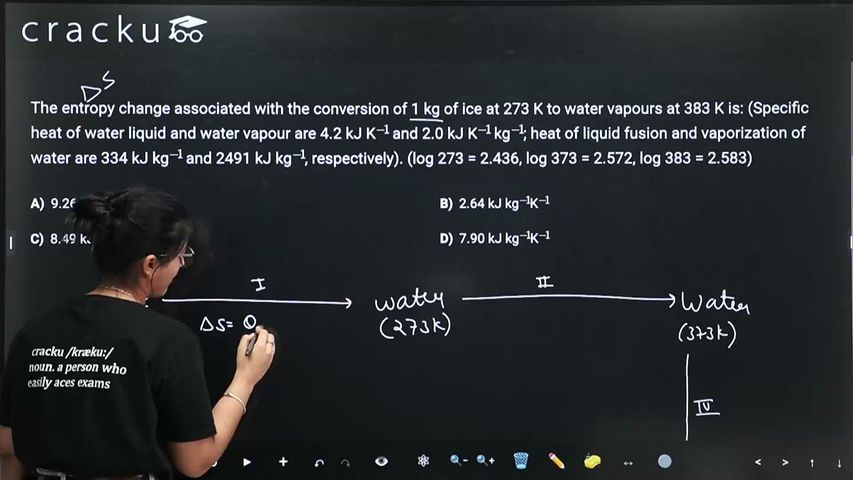
The entropy change associated with the conversion of 1 kg of ice at 273 K to water vapours at 383 K is: (Specific heat of water liquid and water vapour are 4.2 kJ K$$^{-1}$$ and 2.0 kJ K$$^{-1}$$ kg$$^{-1}$$; heat of liquid fusion and vaporization of water are 334 kJ kg$$^{-1}$$ and 2491 kJ kg$$^{-1}$$, respectively). (log 273 = 2.436, log 373 = 2.572, log 383 = 2.583)
We have to follow the path
ice (solid) at $$T_1 = 273\ \text{K}\; \longrightarrow\;$$ liquid water at 273 K (fusion)
liquid water 273 K $$\longrightarrow$$ liquid water at $$T_2 = 373\ \text{K}$$ (heating)
liquid water 373 K $$\longrightarrow$$ water vapour at 373 K (vaporisation)
water vapour 373 K $$\longrightarrow$$ water vapour at $$T_3 = 383\ \text{K}$$ (heating)
The net entropy change will be the algebraic sum of the entropy changes of these four reversible steps.
Step 1 : Fusion of ice at 273 K
For a phase change occurring reversibly at constant temperature, the entropy change is given by the definition
$$\Delta S = \frac{Q_{\text{rev}}}{T}.$$
The heat absorbed is the latent heat of fusion of water, $$L_f = 334\ \text{kJ kg}^{-1}.$$
So, for 1 kg
$$\Delta S_1 = \frac{334\ \text{kJ}}{273\ \text{K}} = 1.223\ \text{kJ kg}^{-1}\,\text{K}^{-1}.$$
Step 2 : Heating the liquid from 273 K to 373 K
For heating at constant pressure the formula is stated first:
$$\Delta S = m\,C_p \ln\!\left(\frac{T_2}{T_1}\right).$$
Here $$m = 1\ \text{kg},\; C_p(\text{liquid}) = 4.2\ \text{kJ kg}^{-1}\,\text{K}^{-1},\; T_1 = 273\ \text{K},\; T_2 = 373\ \text{K}.$$
To evaluate the natural logarithm we recall the relation $$\ln x = 2.303\,\log_{10}x.$$
Using the given common logarithms
$$\log_{10} 373 = 2.572,\qquad \log_{10} 273 = 2.436,$$
so
$$\ln\!\left(\frac{373}{273}\right)= 2.303\left(2.572-2.436\right)=2.303(0.136)=0.313.$$
Substituting in the entropy formula:
$$\Delta S_2 = 1 \times 4.2 \times 0.313 = 1.315\ \text{kJ kg}^{-1}\,\text{K}^{-1}.$$
Step 3 : Vaporisation of water at 373 K
Again using $$\Delta S = \dfrac{Q_{\text{rev}}}{T}$$ for a phase change,
$$L_v = 2491\ \text{kJ kg}^{-1},\quad T = 373\ \text{K},$$
so
$$\Delta S_3 = \frac{2491\ \text{kJ}}{373\ \text{K}} = 6.678\ \text{kJ kg}^{-1}\,\text{K}^{-1}.$$
Step 4 : Heating the vapour from 373 K to 383 K
The same constant-pressure formula is used:
$$\Delta S = m\,C_p \ln\!\left(\frac{T_3}{T_2}\right).$$
Here $$C_p(\text{vapour}) = 2.0\ \text{kJ kg}^{-1}\,\text{K}^{-1},\; T_2 = 373\ \text{K},\; T_3 = 383\ \text{K}.$$
Using the given logs
$$\log_{10} 383 = 2.583,\qquad \log_{10} 373 = 2.572,$$
we get
$$\ln\!\left(\frac{383}{373}\right)= 2.303\left(2.583-2.572\right)=2.303(0.011)=0.0253.$$
Substituting:
$$\Delta S_4 = 1 \times 2.0 \times 0.0253 = 0.0506\ \text{kJ kg}^{-1}\,\text{K}^{-1}.$$
Total entropy change
Adding all four contributions:
$$$
\begin{aligned}
\Delta S_{\text{total}} &= \Delta S_1 + \Delta S_2 + \Delta S_3 + \Delta S_4\\[2mm]
&= 1.223 + 1.315 + 6.678 + 0.0506\\[2mm]
&= 9.267\ \text{kJ kg}^{-1}\,\text{K}^{-1}.
\end{aligned}
$$$
Rounding appropriately, $$\Delta S_{\text{total}}\; \approx\; 9.26\ \text{kJ kg}^{-1}\,\text{K}^{-1}.$$
Hence, the correct answer is Option A.
Was this solution helpful?
Click on the Email ☝️ to Watch the Video Solution
Create a FREE account and get:
_1.webp)

Educational materials for JEE preparation

Ask our AI anything

AI can make mistakes. Please verify important information.
AI can make mistakes. Please verify important information.


