
Join Our JEE Preparation Group
Prep with like-minded aspirants; Get access to free daily tests and study material.
Sign in
Please select an account to continue using cracku.in
↓ →
Join Our JEE Preparation Group
Prep with like-minded aspirants; Get access to free daily tests and study material.
We recall from elementary water chemistry that hardness is produced by dissolved salts of calcium and magnesium.
First, we separate hardness into two kinds.
$$\text{Hardness} = \text{Temporary hardness} + \text{Permanent hardness}$$
Temporary hardness arises from those salts that can be removed simply by boiling. The salts that decompose on heating are the bicarbonates of calcium and magnesium.
For example, when we boil water containing calcium bicarbonate, the following decomposition occurs:
$$Ca(HCO_3)_2 \xrightarrow{\text{boil}} CaCO_3 \downarrow + CO_2\uparrow + H_2O$$
The formation of the insoluble precipitate $$CaCO_3$$ takes the calcium ion out of solution, so hardness is removed. Because this hardness disappears on heating, it is called temporary.
Now we look at each option.
Option A gives $$Na_2SO_4$$. Sodium ions do not cause hardness, and sulphates of sodium remain soluble on boiling, so this cannot account for temporary hardness.
Option B offers $$NaCl$$. Again, sodium chloride contains no calcium or magnesium, so it does not cause hardness at all.
Option C presents $$CaCl_2$$. Although the salt has calcium, chlorides do not decompose on heating:
$$CaCl_2 \xrightarrow{\text{boil}} \text{no change}$$
Therefore the hardness produced by $$CaCl_2$$ is not removed by boiling; this belongs to permanent hardness.
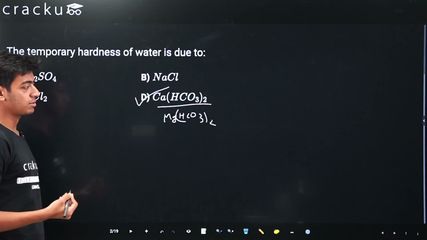
Option D lists $$Ca(HCO_3)_2$$, the very bicarbonate that breaks down on boiling and hence is the textbook cause of temporary hardness.
Among all the choices, only $$Ca(HCO_3)_2$$ satisfies the requirement for temporary hardness.
Hence, the correct answer is Option D.
Was this solution helpful?
Click on the Email ☝️ to Watch the Video Solution
Create a FREE account and get:
_1.webp)

Educational materials for JEE preparation

Ask our AI anything

AI can make mistakes. Please verify important information.
AI can make mistakes. Please verify important information.


