
Join Our JEE Preparation Group
Prep with like-minded aspirants; Get access to free daily tests and study material.
Sign in
Please select an account to continue using cracku.in
↓ →
Join Our JEE Preparation Group
Prep with like-minded aspirants; Get access to free daily tests and study material.
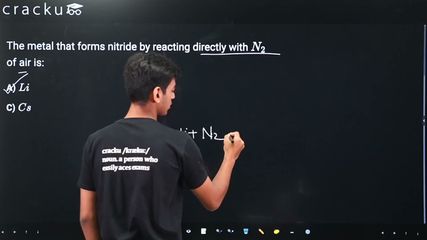
We begin by recalling the special reactivity of the lightest alkali metal, lithium. Because of its small atomic and ionic size as well as its comparatively high lattice-energy contribution, lithium alone among the alkali metals can combine directly with the nitrogen present in air to give a stable ionic nitride.
We express this reaction in a balanced chemical equation. First we write the skeletal form:
$$Li + N_2 \longrightarrow Li_3N$$
Now we balance the atoms. One molecule of $$N_2$$ contains two nitrogen atoms, while each formula unit of lithium nitride, $$Li_3N$$, contains only one nitrogen atom. Therefore, to accommodate both nitrogen atoms we require two formula units of $$Li_3N$$ on the right-hand side:
$$Li + N_2 \longrightarrow 2\,Li_3N$$
Each unit of $$Li_3N$$ contains three lithium atoms, so two units will need six lithium atoms in total. Hence we place the coefficient 6 before $$Li$$ on the left-hand side to balance lithium:
$$6\,Li + N_2 \longrightarrow 2\,Li_3N$$
Now both lithium and nitrogen atoms are balanced, so the final balanced chemical equation is
$$6\,Li + N_2 \rightarrow 2\,Li_3N$$
This shows clearly that lithium reacts directly with molecular nitrogen to form lithium nitride.
For comparison, the heavier alkali metals such as potassium, rubidium and caesium do not form nitrides directly with $$N_2$$ under ordinary conditions; instead, when they interact with substances containing nitrogen (for example liquid ammonia) they preferentially form amides like $$MNH_2$$. Consequently, only lithium exhibits the direct nitride-forming behavior described in the question statement.
Therefore, among the given options, the metal that reacts directly with $$N_2$$ of air to give its nitride is lithium.
Hence, the correct answer is Option A.
Was this solution helpful?
Click on the Email ☝️ to Watch the Video Solution
Create a FREE account and get:
_1.webp)

Educational materials for JEE preparation

Ask our AI anything

AI can make mistakes. Please verify important information.
AI can make mistakes. Please verify important information.


