
Join Our JEE Preparation Group
Prep with like-minded aspirants; Get access to free daily tests and study material.
Sign in
Please select an account to continue using cracku.in
↓ →
Join Our JEE Preparation Group
Prep with like-minded aspirants; Get access to free daily tests and study material.
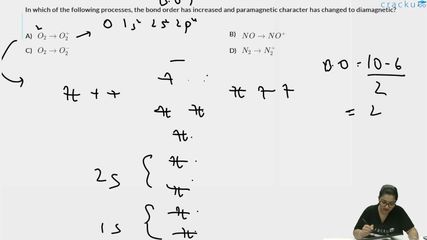
In which of the following processes, the bond order has increased and paramagnetic character has changed to diamagnetic?
We have to check, for every given process, two things simultaneously: whether the bond order $$\left(BO\right)$$ has increased and whether a paramagnetic molecule (containing at least one unpaired electron) has become diamagnetic (all electrons paired) after the process.
First of all, recall the formula that comes from Molecular Orbital Theory:
$$BO=\dfrac{N_b-N_a}{2}$$
where $$N_b$$ is the total number of electrons present in bonding molecular orbitals and $$N_a$$ is the total number of electrons present in antibonding molecular orbitals.
The magnetic property is judged as follows: if any molecular orbital has an unpaired electron, the species is paramagnetic; if every electron is paired, the species is diamagnetic.
Now we shall apply these ideas one‐by‐one to every option.
Option A : $$O_2\;\rightarrow\;O_2^{+}$$
• For $$O_2$$ the total number of electrons is $$16$$. The valence-shell molecular orbital configuration (for elements after atomic number $$7$$) is
$$\sigma_{2p_z}^2\;\pi_{2p_x}^2=\pi_{2p_y}^2\;\pi_{2p_x}^{*\,1}=\pi_{2p_y}^{*\,1}$$
This gives $$N_b=10,\;N_a=6$$ and hence
$$BO(O_2)=\dfrac{10-6}{2}=2$$
The two $$\pi_{2p}^{*}$$ electrons are unpaired, so $$O_2$$ is paramagnetic.
• In $$O_2^{+}$$ one electron is removed, obviously from the highest‐energy orbital $$\pi_{2p}^{*}$$. The configuration becomes
$$\sigma_{2p_z}^2\;\pi_{2p_x}^2=\pi_{2p_y}^2\;\pi_{2p_x}^{*\,1}$$
Now $$N_b=10,\;N_a=5$$, giving
$$BO(O_2^{+})=\dfrac{10-5}{2}=2.5$$
There is still one unpaired electron, so the cation remains paramagnetic. Bond order has indeed increased, but magnetic nature is unchanged. Hence this option does not satisfy the requirement.
Option B : $$NO\;\rightarrow\;NO^{+}$$
Because $$NO$$ is heteronuclear, we count electrons directly. Nitrogen contributes $$7$$ electrons, oxygen contributes $$8$$, making $$15$$ in all.
Using the same orbital ordering as $$O_2$$ (a good approximation), the last electron enters a $$\pi_{2p}^{*}$$ orbital, giving one unpaired electron. Thus $$NO$$ is paramagnetic.
Bond-order calculation:
$$N_b=10,\;N_a=5\quad\Rightarrow\quad BO(NO)=\dfrac{10-5}{2}=2.5$$
Now we remove one electron to form $$NO^{+}$$. The electron leaves that singly occupied $$\pi_{2p}^{*}$$ orbital, so the cation has $$14$$ electrons—exactly the same count as $$N_2$$, with all electrons paired.
The numbers now are $$N_b=10,\;N_a=4$$, so
$$BO(NO^{+})=\dfrac{10-4}{2}=3$$
Hence, bond order increases from $$2.5$$ to $$3$$, and because no orbital contains an unpaired electron, $$NO^{+}$$ is diamagnetic. Therefore this process fulfils both required conditions.
Option C : $$O_2\;\rightarrow\;O_2^{-}$$
Adding one electron to $$O_2$$ means the new electron enters a $$\pi_{2p}^{*}$$ orbital, giving
$$\pi_{2p_x}^{*\,2}=\pi_{2p_y}^{*\,1}$$
Now $$N_b=10,\;N_a=7$$, so
$$BO(O_2^{-})=\dfrac{10-7}{2}=1.5$$
Because a $$\pi_{2p}^{*}$$ orbital still holds an unpaired electron, the anion remains paramagnetic, and bond order has in fact decreased. Hence this option fails on both counts.
Option D : $$N_2\;\rightarrow\;N_2^{+}$$
• For $$N_2$$ (total electrons $$=14$$) the ordering up to $$\sigma_{2p_z}$$ is
$$\sigma_{2p_z}^2\;\pi_{2p_x}^2=\pi_{2p_y}^2$$
All electrons are paired, so $$N_2$$ is diamagnetic. The bonding and antibonding electrons are $$N_b=10,\;N_a=4$$, giving
$$BO(N_2)=\dfrac{10-4}{2}=3$$
• Removing one electron to form $$N_2^{+}$$ takes it from the highest occupied bonding orbital $$\pi_{2p}$$, resulting in one unpaired electron.
Now $$N_b=9,\;N_a=4$$, so
$$BO(N_2^{+})=\dfrac{9-4}{2}=2.5$$
The bond order has fallen and the magnetic behaviour has changed from diamagnetic to paramagnetic, i.e.\ in the wrong direction.
After examining every option we see that only the process $$NO\rightarrow NO^{+}$$ simultaneously raises the bond order and converts a paramagnetic molecule into a diamagnetic one.
Hence, the correct answer is Option B.
Was this solution helpful?
Click on the Email ☝️ to Watch the Video Solution
Create a FREE account and get:
_1.webp)

Educational materials for JEE preparation

Ask our AI anything

AI can make mistakes. Please verify important information.
AI can make mistakes. Please verify important information.


