
Join Our JEE Preparation Group
Prep with like-minded aspirants; Get access to free daily tests and study material.
Sign in
Please select an account to continue using cracku.in
↓ →
Join Our JEE Preparation Group
Prep with like-minded aspirants; Get access to free daily tests and study material.
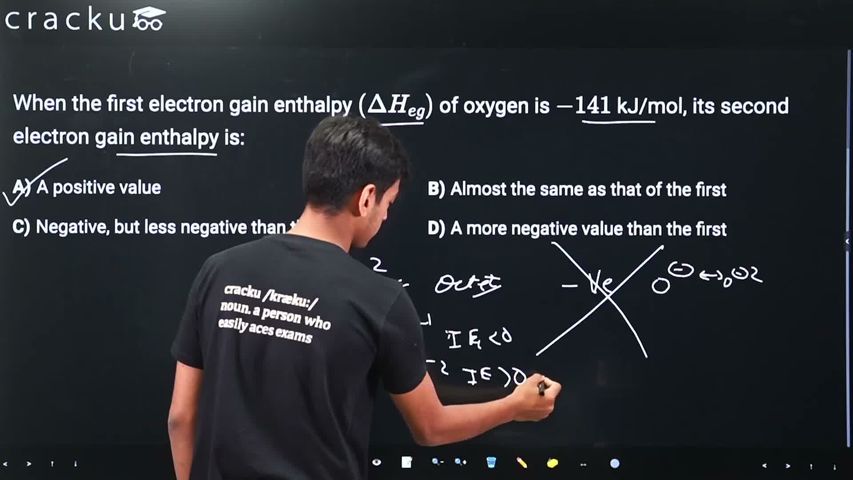
When the first electron gain enthalpy $$(\Delta H_{eg})$$ of oxygen is $$-141$$ kJ/mol, its second electron gain enthalpy is:
We first recall the definition of electron gain enthalpy. When one electron is added to a gaseous atom, the accompanying enthalpy change is called the first electron-gain enthalpy and is denoted by $$\Delta H_{eg}^{(1)}$$. Mathematically we write
$$\text{O(g)} + e^{-} \;\longrightarrow\; \text{O}^{-}\text{(g)}, \qquad \Delta H = \Delta H_{eg}^{(1)}.$$
Because energy is released in this step, the given value $$\Delta H_{eg}^{(1)} = -141\;\text{kJ mol}^{-1}$$ is negative (exothermic).
Now we consider the second electron-gain enthalpy, denoted by $$\Delta H_{eg}^{(2)}$$. For this step the reaction is
$$\text{O}^{-}\text{(g)} + e^{-} \;\longrightarrow\; \text{O}^{2-}\text{(g)}, \qquad \Delta H = \Delta H_{eg}^{(2)}.$$
Here we are forcing a negatively charged ion $$\text{O}^{-}$$ to accept yet another electron, so we must overcome the electrostatic repulsion between the existing negative charge and the incoming electron. This work requires an input of energy. Therefore, instead of releasing energy, the system absorbs energy, making $$\Delta H_{eg}^{(2)}$$ positive (endothermic).
Symbolically we can write
$$\Delta H_{eg}^{(2)} \;>\; 0.$$
The sign alone settles the comparison: the second electron gain enthalpy cannot be negative or even less negative; it must be a positive quantity.
Hence, the correct answer is Option A.
Was this solution helpful?
Click on the Email ☝️ to Watch the Video Solution
Create a FREE account and get:
_1.webp)

Educational materials for JEE preparation

Ask our AI anything

AI can make mistakes. Please verify important information.
AI can make mistakes. Please verify important information.


