
Join Our JEE Preparation Group
Prep with like-minded aspirants; Get access to free daily tests and study material.
Sign in
Please select an account to continue using cracku.in
↓ →
Join Our JEE Preparation Group
Prep with like-minded aspirants; Get access to free daily tests and study material.
Which of the following combination of statements is true regarding the interpretation of the atomic orbitals?
(A) An electron in an orbital of high angular momentum stays away from the nucleus than an electron in the orbital of lower angular momentum.
(B) For a given value of the principal quantum number, the size of the orbit is inversely proportional to the azimuthal quantum number.
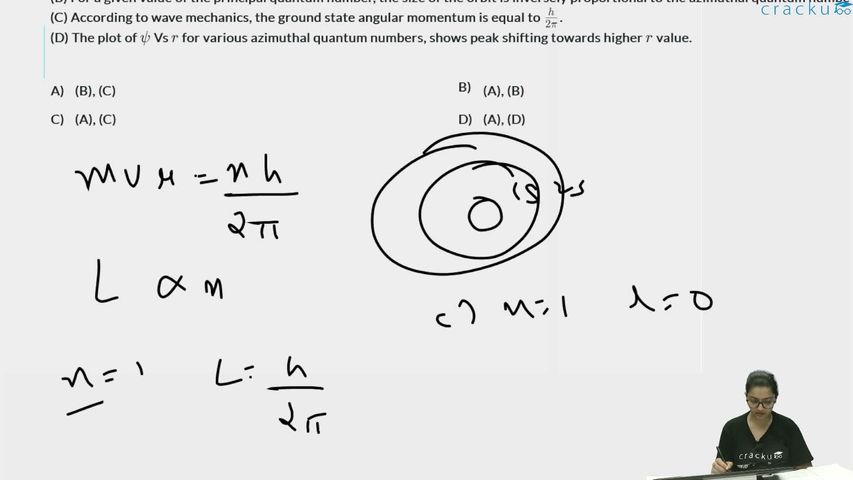
(C) According to wave mechanics, the ground state angular momentum is equal to $$\frac{h}{2\pi}$$.
(D) The plot of $$\psi$$ Vs $$r$$ for various azimuthal quantum numbers, shows peak shifting towards higher $$r$$ value.
First, recall that in quantum mechanics four quantum numbers -$$n,\,l,\,m_l,\,m_s$$- describe an electron in an atom. Out of these, the principal quantum number $$n$$ mainly controls the general size (average distance from the nucleus), while the azimuthal or orbital angular-momentum quantum number $$l$$ decides the shape and the angular momentum of the orbital.
For the magnitude of orbital angular momentum, wave mechanics gives the exact formula
$$L=\sqrt{l(l+1)}\,\hbar,$$
where $$\hbar=\dfrac{h}{2\pi}$$ is the reduced Planck constant. We now examine each given statement in the light of this accepted theory.
Examining statement (A): “An electron in an orbital of high angular momentum stays away from the nucleus than an electron in the orbital of lower angular momentum.”
When $$l$$ is larger (for the same $$n$$) the centrifugal term in the Schrödinger radial equation, $$\dfrac{l(l+1)\hbar^{2}}{2mr^{2}},$$ becomes larger. This term pushes the electron probability density outward; equivalently, the most probable radius $$r_{mp}$$ increases with $$l$$. Therefore electrons in p, d … orbitals (larger $$l$$) are on the average farther from the nucleus than electrons in an s orbital ($$l=0$$). So statement (A) is true.
Examining statement (B): “For a given value of the principal quantum number, the size of the orbit is inversely proportional to the azimuthal quantum number.”
As just reasoned, when $$l$$ increases, $$r_{mp}$$ also increases; there is no inverse proportionality such as $$r\propto\dfrac1l$$. Instead, the trend is the opposite (direct, not inverse). Hence statement (B) is false.
Examining statement (C): “According to wave mechanics, the ground-state angular momentum is equal to $$\dfrac{h}{2\pi}$$.”
In the ground state of hydrogen (and hydrogen-like atoms) we have $$n=1$$ and, by quantum rules, $$l=0$$. Substituting $$l=0$$ in the angular-momentum formula gives
$$L=\sqrt{0(0+1)}\,\hbar=0.$$
Thus wave mechanics predicts zero orbital angular momentum for the ground state, not $$\hbar=\dfrac{h}{2\pi}$$. The quoted value corresponds to the Bohr model, not to the Schrödinger description. Therefore statement (C) is false.
Examining statement (D): “The plot of $$\psi$$ vs $$r$$ for various azimuthal quantum numbers shows peak shifting towards higher $$r$$ value.”
For a fixed principal quantum number $$n$$, increasing $$l$$ moves the maximum of the radial wave function $$R_{nl}(r)$$ outward, as discussed for (A). Hence the peak of $$\psi$$ (or of the radial probability distribution) indeed shifts toward a larger $$r$$. Statement (D) is true.
Combining our results:
$$\text{(A) = True},$$ $$\text{(B) = False},$$ $$\text{(C) = False},$$ $$\text{(D) = True}.$$
The only option that lists statements (A) and (D) together is Option 4.
Hence, the correct answer is Option D.
Was this solution helpful?
Click on the Email ☝️ to Watch the Video Solution
Create a FREE account and get:
_1.webp)

Educational materials for JEE preparation

Ask our AI anything

AI can make mistakes. Please verify important information.
AI can make mistakes. Please verify important information.


