
Join Our JEE Preparation Group
Prep with like-minded aspirants; Get access to free daily tests and study material.
Sign in
Please select an account to continue using cracku.in
↓ →
Join Our JEE Preparation Group
Prep with like-minded aspirants; Get access to free daily tests and study material.
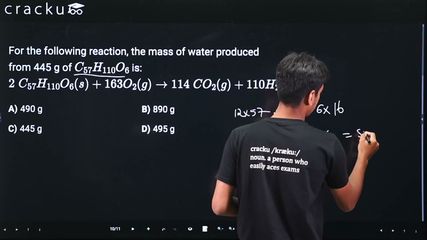
For the following reaction, the mass of water produced from 445 g of $$C_{57}H_{110}O_6$$ is:
$$2 \; C_{57}H_{110}O_6(s) + 163O_2(g) \rightarrow 114 \; CO_2(g) + 110H_2O(l)$$
We are given the balanced chemical equation
$$2\,C_{57}H_{110}O_6(s) \;+\; 163\,O_2(g) \;\longrightarrow\; 114\,CO_2(g) \;+\; 110\,H_2O(l)$$
and we have to find the mass of water that can be obtained from 445 g of the solid $$C_{57}H_{110}O_6$$ when there is an excess of oxygen.
First we need the molar mass of $$C_{57}H_{110}O_6$$. Using the atomic masses $$C = 12\ \text{g mol}^{-1},\; H = 1\ \text{g mol}^{-1},\; O = 16\ \text{g mol}^{-1}$$, we write
$$M(C_{57}H_{110}O_6) \;=\; 57(12) \;+\; 110(1) \;+\; 6(16).$$
Calculating term by term, we obtain
$$57(12) = 684,$$
$$110(1) = 110,$$
$$6(16) = 96.$$
Now adding these contributions,
$$M(C_{57}H_{110}O_6) = 684 + 110 + 96 = 890\ \text{g mol}^{-1}.$$
Next we convert the given mass of the compound into moles by using the formula
$$n = \dfrac{m}{M},$$
where $$n$$ is the number of moles, $$m$$ is the mass and $$M$$ is the molar mass. Substituting the numerical values,
$$n(C_{57}H_{110}O_6) = \dfrac{445\ \text{g}}{890\ \text{g mol}^{-1}} = 0.5\ \text{mol}.$$
The balanced equation shows the stoichiometric relationship between the reactant and water. We read that
$$2\ \text{mol}\ C_{57}H_{110}O_6 \;\longrightarrow\; 110\ \text{mol}\ H_2O.$$
Dividing both coefficients by 2 gives the simpler relation
$$1\ \text{mol}\ C_{57}H_{110}O_6 \;\longrightarrow\; 55\ \text{mol}\ H_2O.$$
Therefore, the number of moles of water produced from the 0.5 mol of the compound is
$$n(H_2O) = 0.5\ \text{mol}\times 55 = 27.5\ \text{mol}.$$
Finally, we convert the moles of water into mass by using the molar mass of water, which is $$18\ \text{g mol}^{-1}$$. Thus,
$$m(H_2O) = n(H_2O)\times M(H_2O) = 27.5\ \text{mol}\times 18\ \text{g mol}^{-1}.$$
Multiplying, we find
$$m(H_2O) = 495\ \text{g}.$$
Hence, the correct answer is Option D.
Was this solution helpful?
Click on the Email ☝️ to Watch the Video Solution
Create a FREE account and get:
_1.webp)

Educational materials for JEE preparation

Ask our AI anything

AI can make mistakes. Please verify important information.
AI can make mistakes. Please verify important information.


