
Join Our JEE Preparation Group
Prep with like-minded aspirants; Get access to free daily tests and study material.
Sign in
Please select an account to continue using cracku.in
↓ →
Join Our JEE Preparation Group
Prep with like-minded aspirants; Get access to free daily tests and study material.
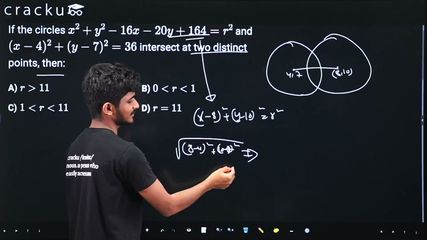
If the circles $$x^2 + y^2 - 16x - 20y + 164 = r^2$$ and $$(x-4)^2 + (y-7)^2 = 36$$ intersect at two distinct points, then:
First we rewrite the given equations so that the centres and radii are clearly visible.
The first circle is
$$x^2 + y^2 - 16x - 20y + 164 = r^2.$$
We complete the squares. Using $$(x^2 - 16x) = (x-8)^2 - 8^2 = (x-8)^2 - 64$$ and $$(y^2 - 20y) = (y-10)^2 - 10^2 = (y-10)^2 - 100,$$ we have
$$x^2 + y^2 - 16x - 20y + 164$$ $$= (x-8)^2 - 64 + (y-10)^2 - 100 + 164$$ $$= (x-8)^2 + (y-10)^2 - 164 + 164$$ $$= (x-8)^2 + (y-10)^2.$$
So the first circle finally becomes
$$\;(x-8)^2 + (y-10)^2 = r^2,$$
which shows that its centre is $$C_1(8,\,10)$$ and its radius is $$r_1 = r.$$
The second circle is already in standard form:
$$\;(x-4)^2 + (y-7)^2 = 36,$$
so its centre is $$C_2(4,\,7)$$ and its radius is $$r_2 = 6.$$
For two circles with radii $$r_1,\,r_2$$ and distance between centres $$d$$ to cut each other in two distinct points, the necessary and sufficient condition is
$$|\,r_2 - r_1\,| \; < \; d \; < \; r_1 + r_2.$$
We first find the distance between the centres:
$$d = \sqrt{(8-4)^2 + (10-7)^2} = \sqrt{4^2 + 3^2} = \sqrt{16 + 9} = \sqrt{25} = 5.$$
Now we apply the intersection condition with $$r_1 = r$$ and $$r_2 = 6$$:
$$|\,6 - r\,| \; < \; 5 \; < \; r + 6.$$
We handle the modulus inequality in two cases.
Case 1 (r ≥ 6):
Then $$|6 - r| = r - 6,$$ so
$$r - 6 < 5 \quad\Longrightarrow\quad r < 11.$$
The right-hand inequality $$5 < r + 6$$ is always true when $$r > 0.$$ Hence in this case we get
$$6 \le r < 11.$$
Case 2 (r < 6):
Now $$|6 - r| = 6 - r,$$ so
$$6 - r < 5 \quad\Longrightarrow\quad -r < -1 \quad\Longrightarrow\quad r > 1.$$
Again, $$5 < r + 6$$ is automatically satisfied. Thus we obtain
$$1 < r < 6.$$
Combining the two cases, the complete set of values that satisfy the double inequality is
$$1 < r < 11.$$
This interval corresponds exactly to Option C.
Hence, the correct answer is Option C.
Was this solution helpful?
Click on the Email ☝️ to Watch the Video Solution
Create a FREE account and get:
_1.webp)

Educational materials for JEE preparation

Ask our AI anything

AI can make mistakes. Please verify important information.
AI can make mistakes. Please verify important information.


