
Join Our JEE Preparation Group
Prep with like-minded aspirants; Get access to free daily tests and study material.
Sign in
Please select an account to continue using cracku.in
↓ →
Join Our JEE Preparation Group
Prep with like-minded aspirants; Get access to free daily tests and study material.
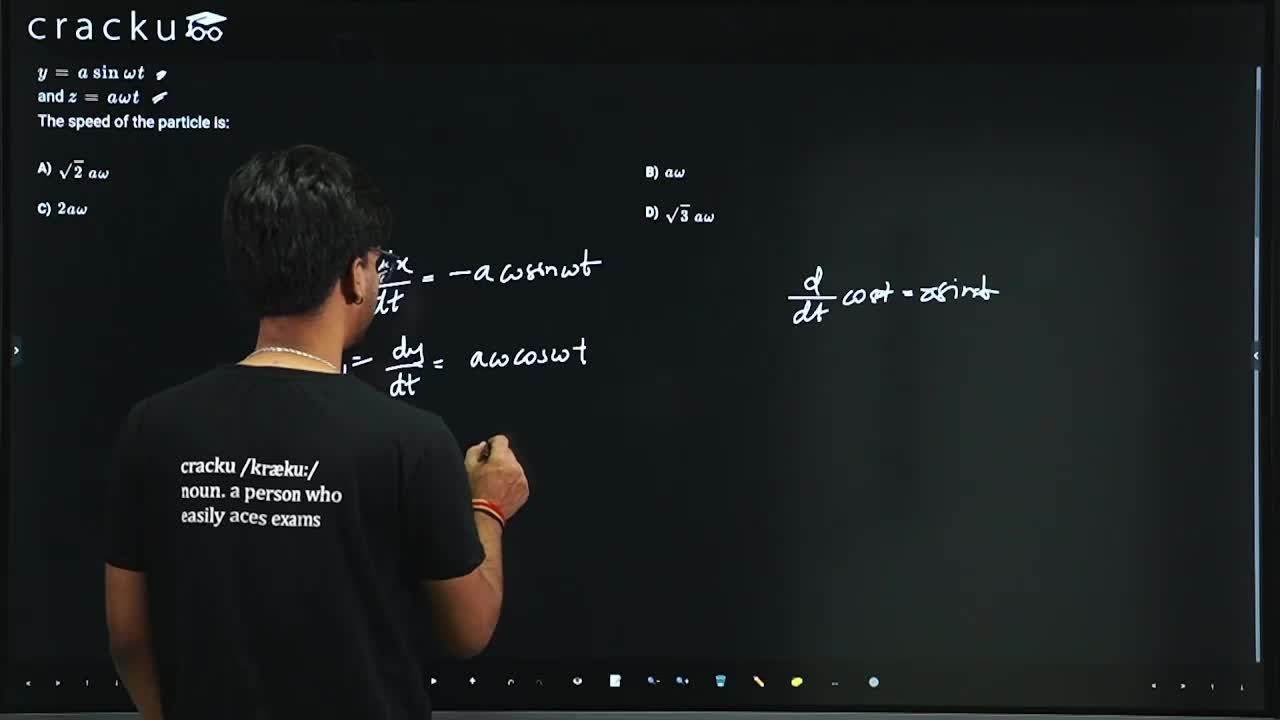
The position co-ordinates of a particle moving in a 3D coordinate system is given by
$$x = a\cos\omega t$$
$$y = a\sin\omega t$$
and $$z = a\omega t$$
The speed of the particle is:
We are told that the instantaneous position of the particle is described, as a function of time $$t,$$ by the three co-ordinate equations
$$x = a \cos \omega t,$$
$$y = a \sin \omega t,$$
and
$$z = a \, \omega t.$$
To obtain the speed we must first find the velocity vector. By definition, the velocity components are the time derivatives of the corresponding position components. In symbols, if $$x(t),\,y(t),\,z(t)$$ are known, then
$$v_x = \dfrac{dx}{dt}, \qquad v_y = \dfrac{dy}{dt}, \qquad v_z = \dfrac{dz}{dt}.$$
Carrying out these differentiations one by one, we have
$$v_x = \dfrac{d}{dt}\!\bigl(a \cos \omega t\bigr).$$
Because the derivative of $$\cos (\omega t)$$ with respect to $$t$$ is $$-\omega \sin (\omega t),$$ we obtain
$$v_x = a\;(-\omega \sin \omega t) = -\,a \omega \sin \omega t.$$
Next, for the $$y$$ component,
$$v_y = \dfrac{d}{dt}\!\bigl(a \sin \omega t\bigr) = a \,\omega \cos \omega t,$$
since the derivative of $$\sin (\omega t)$$ is $$\omega \cos (\omega t).$$
Finally, for the $$z$$ component,
$$v_z = \dfrac{d}{dt}\!\bigl(a \omega t\bigr) = a \omega,$$
because the derivative of a linear function $$\omega t$$ is simply $$\omega.$$
Thus the full velocity vector is
$$\vec v = \bigl(-a\omega \sin \omega t\,,\; a\omega \cos \omega t\,,\; a\omega\bigr).$$
The speed $$v$$ is the magnitude of this vector. The magnitude (or Euclidean norm) of a vector $$\!(v_x,v_y,v_z)$$ is given by the formula
$$v = \sqrt{\,v_x^2 + v_y^2 + v_z^2\,}.$$
Now we substitute the three components just calculated:
$$v = \sqrt{\bigl(-a\omega \sin \omega t\bigr)^2 + \bigl(a\omega \cos \omega t\bigr)^2 + \bigl(a\omega\bigr)^2}.$$
Expanding each squared term inside the radical gives
$$v = \sqrt{a^2\omega^2 \sin^2 \omega t + a^2\omega^2 \cos^2 \omega t + a^2\omega^2}.$$
We notice that the first two terms share the common factor $$a^2\omega^2,$$ so we group them:
$$v = \sqrt{a^2\omega^2 \bigl(\sin^2 \omega t + \cos^2 \omega t\bigr) + a^2\omega^2}.$$
From trigonometry we know the fundamental identity $$\sin^2 \theta + \cos^2 \theta = 1.$$ Applying this identity (with $$\theta = \omega t$$) converts the grouped bracket to $$1$$, giving
$$v = \sqrt{a^2\omega^2 \cdot 1 + a^2\omega^2}.$$
So we simply have two identical terms inside the square root:
$$v = \sqrt{a^2\omega^2 + a^2\omega^2} = \sqrt{2\,a^2\omega^2}.$$
Finally, we take the square root of the product. Because $$a$$ and $$\omega$$ are positive constants (length and angular frequency respectively), their squares inside the root come out as absolute values, which are just themselves:
$$v = \sqrt{2}\; a \omega.$$
This expression is a constant, showing that the particle moves with uniform speed of magnitude $$\sqrt{2}\,a\omega.$$
Hence, the correct answer is Option A.
Was this solution helpful?
Click on the Email ☝️ to Watch the Video Solution
Create a FREE account and get:
_1.webp)

Educational materials for JEE preparation

Ask our AI anything

AI can make mistakes. Please verify important information.
AI can make mistakes. Please verify important information.


