
Join Our JEE Preparation Group
Prep with like-minded aspirants; Get access to free daily tests and study material.
Sign in
Please select an account to continue using cracku.in
↓ →
Join Our JEE Preparation Group
Prep with like-minded aspirants; Get access to free daily tests and study material.
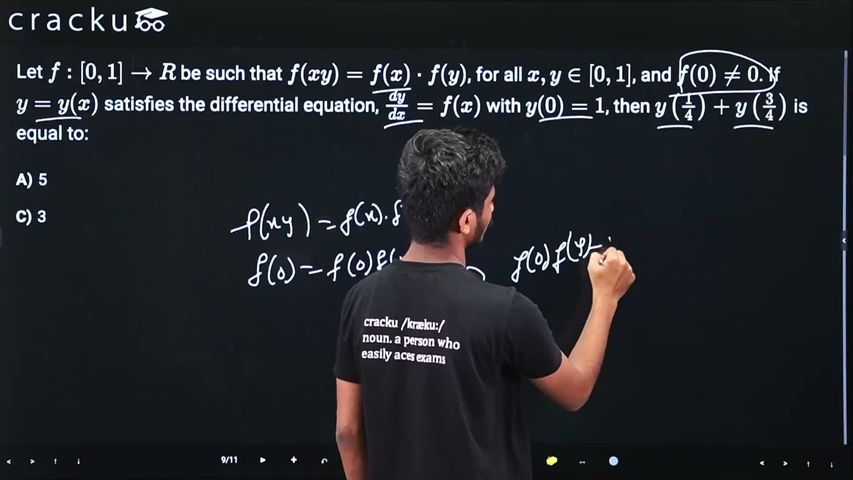
Let $$f: [0,1] \to R$$ be such that $$f(xy) = f(x) \cdot f(y)$$, for all $$x, y \in [0,1]$$, and $$f(0) \neq 0$$. If $$y = y(x)$$ satisfies the differential equation, $$\frac{dy}{dx} = f(x)$$ with $$y(0) = 1$$, then $$y\left(\frac{1}{4}\right) + y\left(\frac{3}{4}\right)$$ is equal to:
We have the functional equation $$f(xy)=f(x)\,f(y)\quad \text{for all }x,y\in[0,1]$$ with the additional information $$f(0)\neq 0.$$
To exploit the given relation, we substitute $$y=0.$$ This choice gives $$xy=0$$ for every $$x\in[0,1],$$ so
$$f(0)=f(x\cdot 0)=f(x)\,f(0).$$
Because $$f(0)\neq 0,$$ we may divide both sides by $$f(0),$$ obtaining
$$\frac{f(0)}{f(0)}=\frac{f(x)\,f(0)}{f(0)}\quad\Longrightarrow\quad 1=f(x)\quad\text{for every }x\in[0,1].$$
Hence $$f(x)=1$$ is the only function satisfying the conditions.
Now we turn to the differential equation. Substituting the just-found value of $$f(x),$$ we get
$$\frac{dy}{dx}=f(x)=1.$$
We integrate both sides with respect to $$x.$$ Using the basic antiderivative rule $$\int 1\,dx = x + C,$$ we find
$$y=x+C,$$
where $$C$$ is the constant of integration. The initial condition $$y(0)=1$$ allows us to determine $$C$$:
$$1=y(0)=0+C\quad\Longrightarrow\quad C=1.$$
Therefore the explicit solution is
$$y(x)=x+1.$$
We now evaluate this function at the required points.
For $$x=\dfrac14:$$
$$y\!\left(\frac14\right)=\frac14+1=\frac54.$$
For $$x=\dfrac34:$$
$$y\!\left(\frac34\right)=\frac34+1=\frac74.$$
Adding the two values, we have
$$y\!\left(\frac14\right)+y\!\left(\frac34\right)=\frac54+\frac74=\frac{12}{4}=3.$$
Hence, the correct answer is Option C.
Was this solution helpful?
Click on the Email ☝️ to Watch the Video Solution
Create a FREE account and get:
_1.webp)

Educational materials for JEE preparation

Ask our AI anything

AI can make mistakes. Please verify important information.
AI can make mistakes. Please verify important information.


