
Join Our JEE Preparation Group
Prep with like-minded aspirants; Get access to free daily tests and study material.
Sign in
Please select an account to continue using cracku.in
↓ →
Join Our JEE Preparation Group
Prep with like-minded aspirants; Get access to free daily tests and study material.
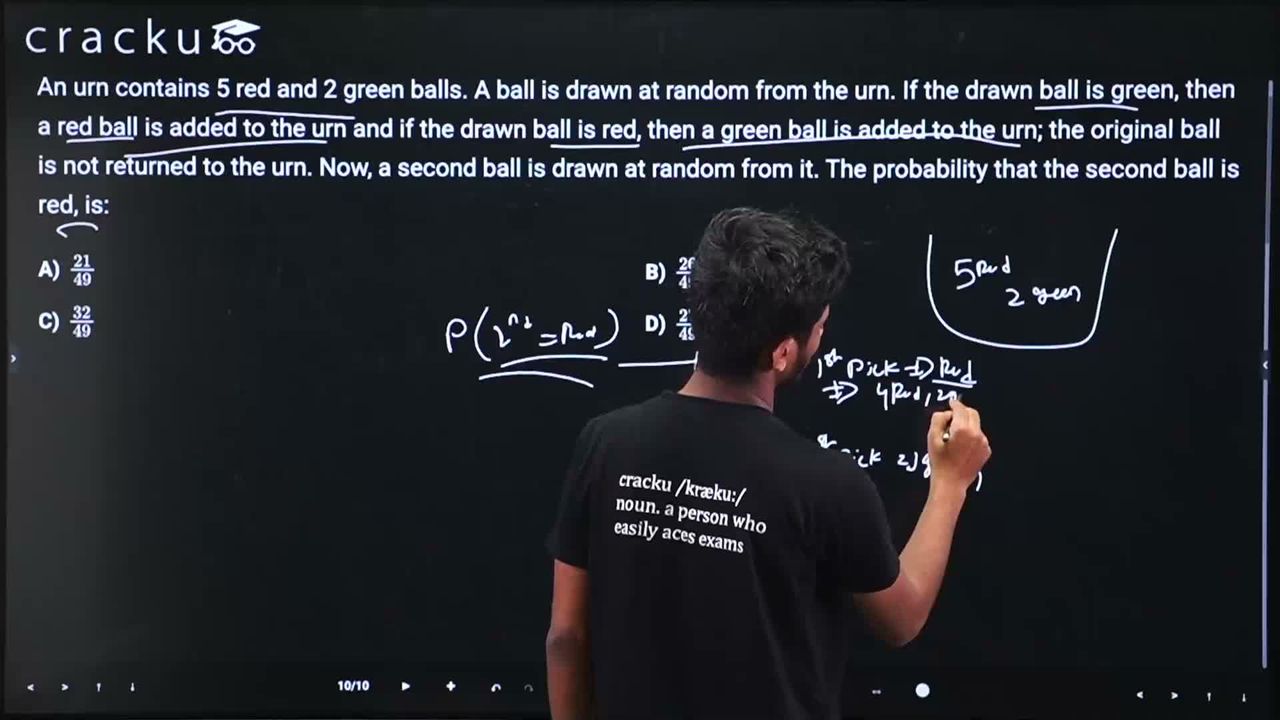
An urn contains 5 red and 2 green balls. A ball is drawn at random from the urn. If the drawn ball is green, then a red ball is added to the urn and if the drawn ball is red, then a green ball is added to the urn; the original ball is not returned to the urn. Now, a second ball is drawn at random from it. The probability that the second ball is red, is:
First we note the contents of the urn at the beginning. There are $$5$$ red balls and $$2$$ green balls, so in all $$7$$ balls.
We name the events so that the later algebra will be clear:
$$R_1 : \text{``the first ball drawn is red''}$$
$$G_1 : \text{``the first ball drawn is green''}$$
$$R_2 : \text{``the second ball drawn is red''}$$
We are required to find the probability $$P(R_2)$$, that is, the probability that the second ball is red.
According to the Law of Total Probability (which states $$P(B)=P(A_1)P(B|A_1)+P(A_2)P(B|A_2)+\dots$$ for a complete set of events $$A_i$$), we can write
$$ P(R_2)=P(R_1)\,P(R_2|R_1)+P(G_1)\,P(R_2|G_1). $$
So we shall calculate each factor step by step.
First-draw probabilities:
$$ P(R_1)=\frac{5}{7}, \qquad P(G_1)=\frac{2}{7}. $$
Now we handle the composition changes that happen after the first draw.
Case 1: The first ball is red ($$R_1$$). A red ball is removed, and a green ball is added. So the urn now contains:
Red balls: $$5-1=4$$
Green balls: $$2+1=3$$
Total balls remain $$7$$ (because one was taken out and one was put in).
Hence, given $$R_1$$, the conditional probability that the second ball is red is
$$ P(R_2|R_1)=\frac{4}{7}. $$
Case 2: The first ball is green ($$G_1$$). A green ball is removed, and a red ball is added. So the urn now contains:
Red balls: $$5+1=6$$
Green balls: $$2-1=1$$
Total balls again $$7$$.
Hence, given $$G_1$$, the conditional probability that the second ball is red is
$$ P(R_2|G_1)=\frac{6}{7}. $$
We now substitute all these numbers into the total-probability expression:
$$ P(R_2)=\frac{5}{7}\times\frac{4}{7}+\frac{2}{7}\times\frac{6}{7}. $$
We multiply term by term:
$$ \frac{5}{7}\times\frac{4}{7}=\frac{20}{49},\qquad \frac{2}{7}\times\frac{6}{7}=\frac{12}{49}. $$
Adding the two fractions (same denominator $$49$$) gives
$$ P(R_2)=\frac{20}{49}+\frac{12}{49}=\frac{32}{49}. $$
Therefore the probability that the second ball is red equals $$\dfrac{32}{49}$$.
Hence, the correct answer is Option C.
Was this solution helpful?
Click on the Email ☝️ to Watch the Video Solution
Create a FREE account and get:
_1.webp)

Educational materials for JEE preparation

Ask our AI anything

AI can make mistakes. Please verify important information.
AI can make mistakes. Please verify important information.


