
Join Our JEE Preparation Group
Prep with like-minded aspirants; Get access to free daily tests and study material.
Sign in
Please select an account to continue using cracku.in
↓ →
Join Our JEE Preparation Group
Prep with like-minded aspirants; Get access to free daily tests and study material.
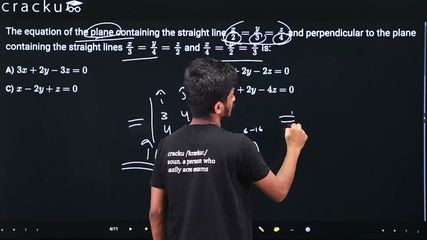
The equation of the plane containing the straight line $$\frac{x}{2} = \frac{y}{3} = \frac{z}{4}$$ and perpendicular to the plane containing the straight lines $$\frac{x}{3} = \frac{y}{4} = \frac{z}{2}$$ and $$\frac{x}{4} = \frac{y}{2} = \frac{z}{3}$$ is:
We start with the straight line $$\dfrac{x}{2}=\dfrac{y}{3}=\dfrac{z}{4}$$.
Putting the common ratio equal to a parameter, say $$\lambda$$, we obtain the parametric form
$$x = 2\lambda,\; y = 3\lambda,\; z = 4\lambda.$$
Hence the direction-ratio (d.r.) vector of this line is
$$\vec d_1 = (2,\,3,\,4).$$
Because the line passes through the origin, any plane that contains this line must also pass through the origin.
Next, consider the two lines
$$\dfrac{x}{3}=\dfrac{y}{4}=\dfrac{z}{2} \qquad\text{and}\qquad \dfrac{x}{4}=\dfrac{y}{2}=\dfrac{z}{3}.$$
Writing them in parametric form, we let
$$\dfrac{x}{3}=\dfrac{y}{4}=\dfrac{z}{2}= \mu \;\;\Longrightarrow\;\; x = 3\mu,\; y = 4\mu,\; z = 2\mu,$$
so the direction vector of the first line is
$$\vec a = (3,\,4,\,2).$$
Similarly, putting
$$\dfrac{x}{4}=\dfrac{y}{2}=\dfrac{z}{3}= \nu \;\;\Longrightarrow\;\; x = 4\nu,\; y = 2\nu,\; z = 3\nu,$$
we obtain the direction vector of the second line as
$$\vec b = (4,\,2,\,3).$$
These two lines lie in a common plane; a normal vector to that plane can be found by the cross-product of their direction vectors.
Using the formula $$\vec n_2 = \vec a \times \vec b,$$ we compute
$$ \vec n_2 = \begin{vmatrix} \mathbf i & \mathbf j & \mathbf k\\[2pt] 3 & 4 & 2\\ 4 & 2 & 3 \end{vmatrix} = \mathbf i\,(4\cdot3-2\cdot2)\;-\; \mathbf j\,(3\cdot3-2\cdot4)\;+\; \mathbf k\,(3\cdot2-4\cdot4) = (8,\,-1,\,-10). $$
Thus $$\vec n_2=(8,\,-1,\,-10)$$ is a normal to the plane containing the two given lines.
We now want a new plane that satisfies two conditions:
(i) it contains the first line, so its normal $$\vec n_1$$ must be perpendicular to $$\vec d_1$$, i.e. $$\vec n_1\cdot\vec d_1=0$$;
(ii) it is perpendicular to the plane whose normal is $$\vec n_2$$, so $$\vec n_1$$ must also be perpendicular to $$\vec n_2$$, i.e. $$\vec n_1\cdot\vec n_2=0.$$
A vector perpendicular to both $$\vec d_1$$ and $$\vec n_2$$ is given by their cross-product.
Hence we take
$$ \vec n_1 = \vec d_1 \times \vec n_2 = \begin{vmatrix} \mathbf i & \mathbf j & \mathbf k\\[2pt] 2 & 3 & 4\\ 8 & -1 & -10 \end{vmatrix} = \mathbf i\,(3\cdot(-10) - 4\cdot(-1)) - \mathbf j\,(2\cdot(-10) - 4\cdot8) + \mathbf k\,(2\cdot(-1) - 3\cdot8) $$
$$ = \mathbf i\,(-30+4)\;-\;\mathbf j\,(-20-32)\;+\;\mathbf k\,(-2-24) = \mathbf i\,(-26)\;+\;\mathbf j\,(52)\;+\;\mathbf k\,(-26). $$
Thus $$\vec n_1=(-26,\,52,\,-26).$$ Dividing by $$-26$$ for simplicity, an equivalent normal vector is
$$\vec n_1=(1,\,-2,\,1).$$
Because the required plane passes through the origin, its Cartesian equation is obtained from
$$\vec n_1\cdot(x,\,y,\,z)=0.$$
Therefore
$$1\cdot x + (-2)\cdot y + 1\cdot z = 0 \;\;\Longrightarrow\;\; x - 2y + z = 0.$$
Comparing with the given options, this matches Option C.
Hence, the correct answer is Option C.
Was this solution helpful?
Click on the Email ☝️ to Watch the Video Solution
Create a FREE account and get:
_1.webp)

Educational materials for JEE preparation

Ask our AI anything

AI can make mistakes. Please verify important information.
AI can make mistakes. Please verify important information.


