
Join Our JEE Preparation Group
Prep with like-minded aspirants; Get access to free daily tests and study material.
Sign in
Please select an account to continue using cracku.in
↓ →
Join Our JEE Preparation Group
Prep with like-minded aspirants; Get access to free daily tests and study material.
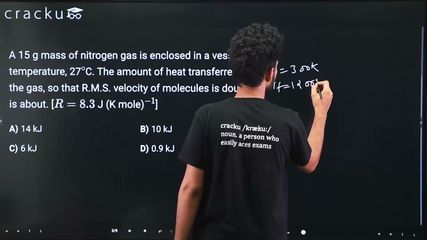
A 15 g mass of nitrogen gas is enclosed in a vessel at a temperature, 27$$^{\circ}$$C. The amount of heat transferred to the gas, so that R.M.S. velocity of molecules is doubled, is about. [$$R = 8.3$$ J (K mole)$$^{-1}$$]
We start with the well-known relation for the root-mean-square (r.m.s.) speed of an ideal gas,
$$v_{\text{rms}}=\sqrt{\dfrac{3RT}{M}},$$
where $$R$$ is the universal gas constant, $$T$$ is the absolute temperature, and $$M$$ is the molar mass of the gas.
The r.m.s. speed is to be doubled. Therefore, if the initial speed is $$v_{\text{rms,1}}$$ at temperature $$T_1$$ and the final speed is $$v_{\text{rms,2}}=2v_{\text{rms,1}}$$ at temperature $$T_2$$, we write
$$\dfrac{v_{\text{rms,2}}}{v_{\text{rms,1}}}=2=\sqrt{\dfrac{T_2}{T_1}}.$$
Squaring both sides,
$$4=\dfrac{T_2}{T_1}\quad\Longrightarrow\quad T_2=4T_1.$$
The gas is initially at $$27^{\circ}\text{C}=27+273=300\ \text{K}$$, so
$$T_2=4\times 300\ \text{K}=1200\ \text{K}.$$
Next, we calculate the number of moles of nitrogen. The mass is 15 g and the molar mass of $$\mathrm{N_2}$$ is 28 g mol−1, hence
$$n=\dfrac{m}{M}=\dfrac{15\ \text{g}}{28\ \text{g mol}^{-1}}=0.5357\ \text{mol}.$$
The vessel is rigid, so the heating takes place at constant volume. For a diatomic gas in the temperature range considered, the molar heat capacity at constant volume is
$$C_V=\dfrac{5}{2}R.$$
Stating the formula for heat supplied at constant volume,
$$Q=nC_V\Delta T,$$
where $$\Delta T=T_2-T_1=1200\ \text{K}-300\ \text{K}=900\ \text{K}.$$
Substituting all numerical values,
$$\begin{aligned} Q&=n\left(\dfrac{5}{2}R\right)\Delta T\\[4pt] &=0.5357\ \text{mol}\times\left(\dfrac{5}{2}\times 8.3\ \text{J mol}^{-1}\text{K}^{-1}\right)\times 900\ \text{K}. \end{aligned}$$
First evaluate the heat capacity factor:
$$\dfrac{5}{2}\times 8.3=20.75\ \text{J mol}^{-1}\text{K}^{-1}.$$
Then multiply by the moles:
$$0.5357\times 20.75=11.12\ \text{J K}^{-1}.$$
Finally multiply by $$\Delta T$$:
$$Q=11.12\ \text{J K}^{-1}\times 900\ \text{K}=10,008\ \text{J}\approx 1.0\times 10^{4}\ \text{J}.$$
Expressing this in kilojoules,
$$Q\approx 10\ \text{kJ}.$$
Hence, the correct answer is Option B.
Was this solution helpful?
Click on the Email ☝️ to Watch the Video Solution
Create a FREE account and get:
_1.webp)

Educational materials for JEE preparation

Ask our AI anything

AI can make mistakes. Please verify important information.
AI can make mistakes. Please verify important information.


