Join Our JEE Preparation Group
Prep with like-minded aspirants; Get access to free daily tests and study material.
Sign in
Please select an account to continue using cracku.in
↓ →
Join Our JEE Preparation Group
Prep with like-minded aspirants; Get access to free daily tests and study material.
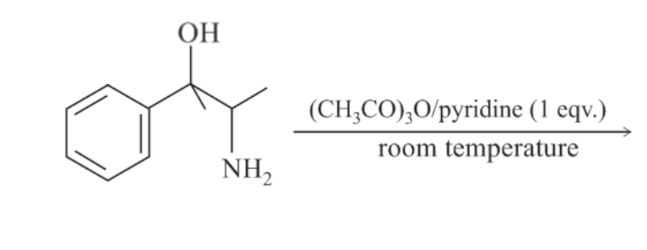
We need to determine the major product formed when the given amino alcohol intermediate reacts with acetic anhydride ($$\text{(CH}_3\text{CO)}_2\text{O}$$) in the presence of one equivalent of pyridine at room temperature.
Nucleophilicity Comparison:
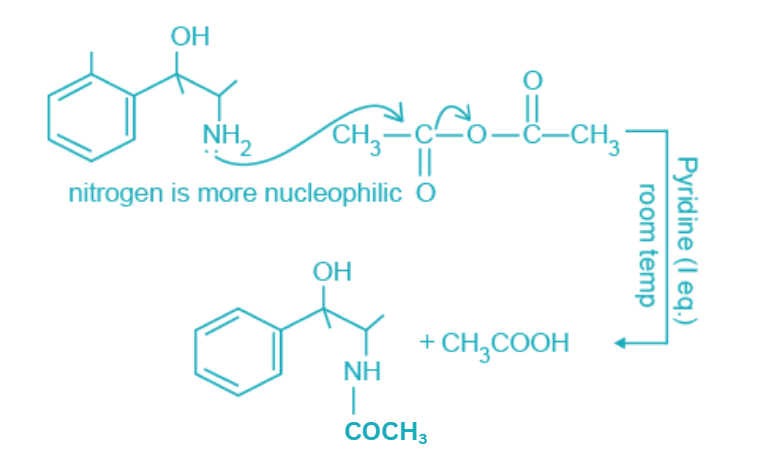
The substrate contains two distinct nucleophilic functional groups: a secondary alcohol group ($$\text{--OH}$$) and a primary amine group ($$\text{--NH}_2$$). Because nitrogen is significantly less electronegative than oxygen, its lone pair is held less tightly and is much more available for bonding. Consequently, the amino nitrogen is a far stronger nucleophile than the hydroxyl oxygen:
$$\text{Nucleophilicity: --NH}_2 > \text{--OH}$$Selective N-Acetylation:
Under mild conditions (room temperature) and limited reagent quantities (1 equivalent of pyridine), the more nucleophilic amine group selectively attacks one of the electrophilic carbonyl centers of the acetic anhydride molecule. This undergoes a nucleophilic acyl substitution, displacing an acetate leaving group:
$$\text{R--NH}_2 + \text{(CH}_3\text{CO)}_2\text{O} \xrightarrow{\text{Pyridine}} \text{R--NHCOCH}_3 + \text{CH}_3\text{COOH}$$The secondary alcohol group ($$\text{--OH}$$) remains completely unreacted and intact throughout this selective transformation.
The chemoselective reaction smoothly yields the N-acetylated amide derivative while leaving the secondary hydroxyl group untouched.
Answer: Option B
Was this solution helpful?
Click on the Email ☝️ to Watch the Video Solution
Create a FREE account and get:
_1.webp)

Educational materials for JEE preparation

Ask our AI anything

AI can make mistakes. Please verify important information.
AI can make mistakes. Please verify important information.