
Join Our JEE Preparation Group
Prep with like-minded aspirants; Get access to free daily tests and study material.
Sign in
Please select an account to continue using cracku.in
↓ →
Join Our JEE Preparation Group
Prep with like-minded aspirants; Get access to free daily tests and study material.
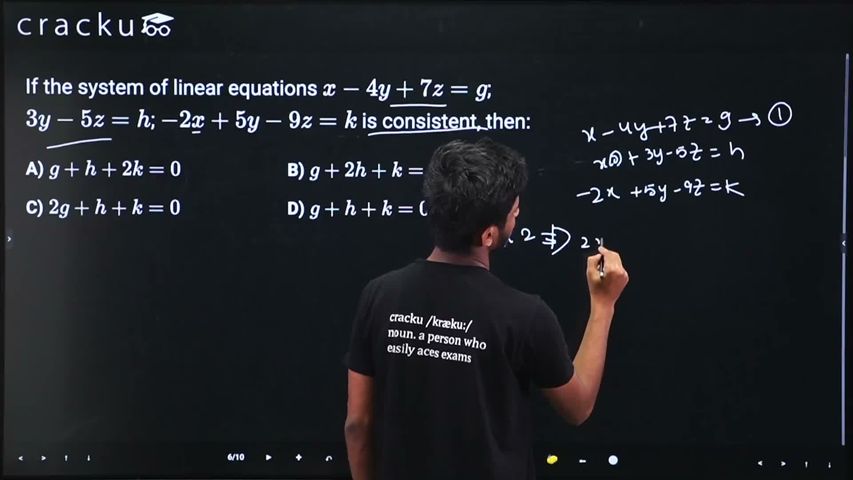
If the system of linear equations $$x - 4y + 7z = g$$; $$3y - 5z = h$$; $$-2x + 5y - 9z = k$$ is consistent, then:
We have the system
$$x - 4y + 7z = g \qquad (1)$$
$$3y - 5z = h \qquad (2)$$
$$-2x + 5y - 9z = k \qquad (3)$$
For the system to be consistent, every solution of the first two equations must also satisfy the third. Therefore we first solve (1) and (2) for $$x$$ and $$y$$ in terms of a free variable (which we choose as $$z$$) and the constants $$g,h$$.
From equation (2) we isolate $$y$$:
$$3y - 5z = h$$
$$\Rightarrow\; 3y = h + 5z$$
$$\Rightarrow\; y = \dfrac{h + 5z}{3} \qquad (4)$$
Next, from equation (1) we isolate $$x$$:
$$x - 4y + 7z = g$$
$$\Rightarrow\; x = g + 4y - 7z$$
Substituting the value of $$y$$ from (4):
$$x = g + 4\!\left(\dfrac{h + 5z}{3}\right) - 7z$$
Bring everything over a common denominator of $$3$$ (so that every term contains the same denominator):
$$x = g + \dfrac{4h + 20z}{3} - \dfrac{21z}{3}$$
Combine the $$z$$ terms in the numerator:
$$x = g + \dfrac{4h + 20z - 21z}{3}$$
$$\Rightarrow\; x = g + \dfrac{4h - z}{3} \qquad (5)$$
Now we substitute the expressions (4) and (5) for $$y$$ and $$x$$ into equation (3). If the system is consistent, that substitution must satisfy (3) for every choice of the free variable $$z$$.
Equation (3) is
$$-2x + 5y - 9z = k$$
Insert (5) for $$x$$ and (4) for $$y$$:
$$-2\!\left[g + \dfrac{4h - z}{3}\right] + 5\!\left(\dfrac{h + 5z}{3}\right) - 9z = k$$
Let us open the brackets step by step. First, the term $$-2x$$:
$$-2x = -2g - 2\!\left(\dfrac{4h - z}{3}\right) = -2g - \dfrac{8h - 2z}{3}$$
Second, the term $$5y$$:
$$5y = 5\!\left(\dfrac{h + 5z}{3}\right) = \dfrac{5h + 25z}{3}$$
Now we write the entire left‐hand side of (3) over the common denominator $$3$$. We keep the integer term $$-2g$$ separate for clarity:
Left side $$= -2g + \dfrac{-\,\!(8h - 2z) + (5h + 25z)}{3} - 9z$$
Convert the final term $$-9z$$ to the same denominator (multiply numerator and denominator by $$3$$):
$$-9z = -\dfrac{27z}{3}$$
So the complete numerator becomes
$$[-(8h - 2z) + (5h + 25z) - 27z]$$
Open the brackets carefully:
$$-(8h - 2z) = -8h + 2z$$
Add $$5h + 25z$$:
$$-8h + 2z + 5h + 25z = -3h + 27z$$
Finally, subtract $$27z$$:
$$-3h + 27z - 27z = -3h$$
Thus the entire fraction reduces to
$$\dfrac{-3h}{3} = -h$$
Putting this together with the integer term $$-2g$$, the left side of equation (3) simplifies completely to
$$-2g - h$$
For consistency we equate this to the right side of (3):
$$-2g - h = k$$
Move every term to one side to form a single relation among $$g,h,k$$:
$$-2g - h - k = 0$$
Multiply through by $$-1$$ to write it in a more familiar positive form:
$$2g + h + k = 0$$
This is exactly the condition listed in Option C.
Hence, the correct answer is Option C.
Was this solution helpful?
Click on the Email ☝️ to Watch the Video Solution
Create a FREE account and get:
_1.webp)

Educational materials for JEE preparation

Ask our AI anything

AI can make mistakes. Please verify important information.
AI can make mistakes. Please verify important information.


