
Join Our JEE Preparation Group
Prep with like-minded aspirants; Get access to free daily tests and study material.
Sign in
Please select an account to continue using cracku.in
↓ →
Join Our JEE Preparation Group
Prep with like-minded aspirants; Get access to free daily tests and study material.
If $$A = \begin{bmatrix} e^t & e^{-t}\cos t & e^{-t}\sin t \\ e^t & -e^{-t}\cos t - e^{-t}\sin t & -e^{-t}\sin t + e^{-t}\cos t \\ e^t & 2e^{-t}\sin t & -2e^{-t}\cos t \end{bmatrix}$$, then $$A$$ is:
We have the square matrix
$$A=\begin{bmatrix} e^{t} & e^{-t}\cos t & e^{-t}\sin t\\[4pt] e^{t} & -e^{-t}\cos t-e^{-t}\sin t & -e^{-t}\sin t+e^{-t}\cos t\\[4pt] e^{t} & 2e^{-t}\sin t & -2e^{-t}\cos t \end{bmatrix}.$$
A matrix is invertible exactly when its determinant is non-zero. Hence we compute $$\det(A).$$
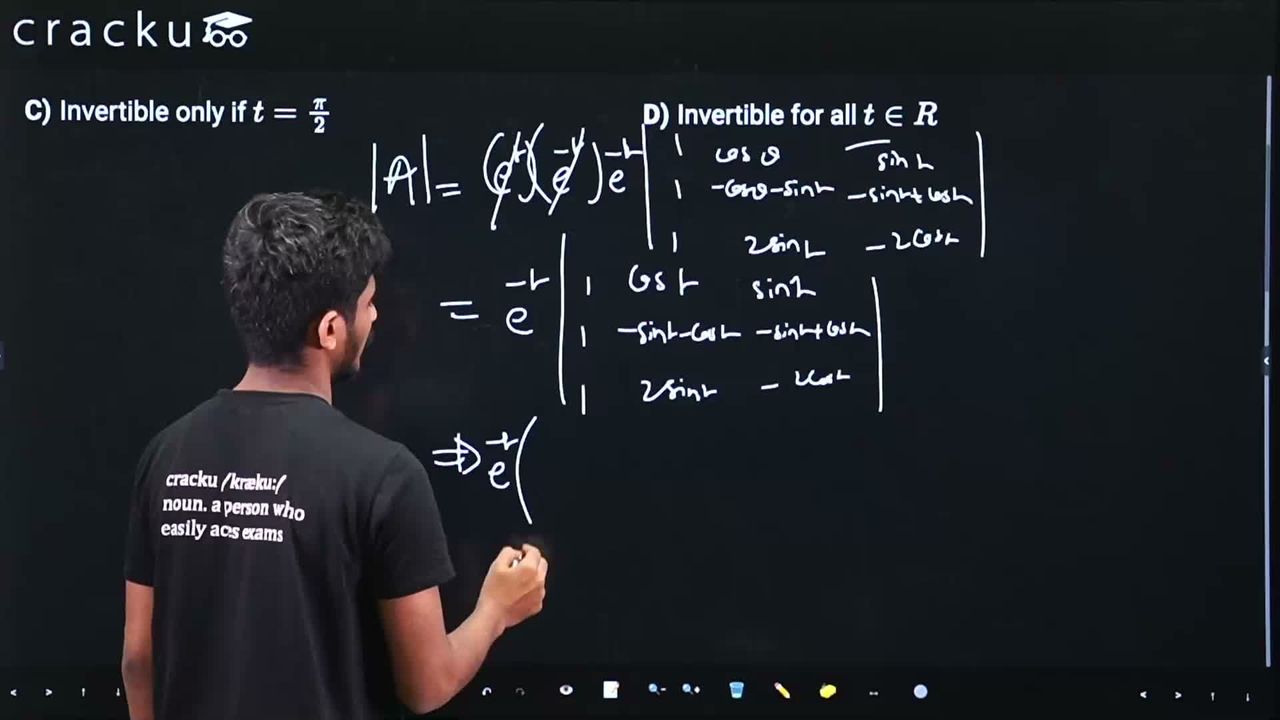
First, in every column we take out the common exponential factor:
Column 1 has a common factor $$e^{t},$$ Column 2 has a common factor $$e^{-t},$$ Column 3 has a common factor $$e^{-t}.$$
The rule “pulling a scalar $$k$$ out of a column multiplies the determinant by $$k$$” gives
$$\det(A)=e^{t}\,e^{-t}\,e^{-t}\;\det\!\begin{bmatrix} 1 & \cos t & \sin t\\[4pt] 1 & -\cos t-\sin t & -\sin t+\cos t\\[4pt] 1 & 2\sin t & -2\cos t \end{bmatrix}.$$
Simplifying the scalar product, $$e^{t}e^{-t}e^{-t}=e^{-t},$$ so
$$ \det(A)=e^{-t}\,\det(B), $$ where
$$B=\begin{bmatrix} 1 & \cos t & \sin t\\[4pt] 1 & -\cos t-\sin t & -\sin t+\cos t\\[4pt] 1 & 2\sin t & -2\cos t \end{bmatrix}.$$
Because $$e^{-t}\neq 0$$ for every real $$t,$$ the sign of $$\det(A)$$ is the same as that of $$\det(B).$$ Now we find $$\det(B).$$
Subtracting the first row from the second and third (a row operation that does not change the determinant) gives
$$\det(B)=\det\!\begin{bmatrix} 1 & \cos t & \sin t\\[4pt] 0 & (-\cos t-\sin t)-\cos t & (-\sin t+\cos t)-\sin t\\[4pt] 0 & 2\sin t-\cos t & -2\cos t-\sin t \end{bmatrix}.$$
Thus
$$B=\begin{bmatrix} 1 & \cos t & \sin t\\[4pt] 0 & -2\cos t-\sin t & \cos t-2\sin t\\[4pt] 0 & 2\sin t-\cos t & -2\cos t-\sin t \end{bmatrix}.$$
Expanding the determinant down the first column (using the formula “minor times cofactor,” and noting that the sign is $$+$$ because the element is in position (1,1)):
$$\det(B)=1\cdot \det\!\begin{bmatrix} -2\cos t-\sin t & \cos t-2\sin t\\[4pt] 2\sin t-\cos t & -2\cos t-\sin t \end{bmatrix}.$$
For the 2 × 2 determinant we use $$\det\!\begin{bmatrix}p&q\\r&s\end{bmatrix}=ps-qr:$$
$$\det(B)=(-2\cos t-\sin t)(-2\cos t-\sin t)\,- (\cos t-2\sin t)(2\sin t-\cos t).$$
Introduce the abbreviations
$$ a=-2\cos t-\sin t,\qquad b=\cos t-2\sin t. $$
Notice that $$2\sin t-\cos t=-b.$$ Therefore
$$ \det(B)=a^{2}-b(-b)=a^{2}+b^{2}. $$
The expression $$a^{2}+b^{2}$$ is a sum of two squares, which is never negative, and it equals zero only if both $$a=0$$ and $$b=0.$
Setting $$a=0$$ gives $$-2\cos t-\sin t=0\;\Longrightarrow\;\tan t=-2.$$ Setting $$b=0$$ gives $$\cos t-2\sin t=0\;\Longrightarrow\;\tan t=\dfrac12.$$
Because $$\tan t$$ cannot be simultaneously $$-2$$ and $$\dfrac12,$$ the pair of equations has no common solution. Hence $$a^{2}+b^{2}>0$$ for all real $$t,$$ so
$$ \det(B)\;>\;0\quad\text{for every real }t. $$
Finally, since $$\det(A)=e^{-t}\det(B)$$ and neither factor is ever zero, we have
$$ \det(A)\neq 0\quad\text{for every real }t. $$
Thus the matrix $$A$$ is invertible for all real values of $$t.$$
Hence, the correct answer is Option D.
Was this solution helpful?
Click on the Email ☝️ to Watch the Video Solution
Create a FREE account and get:
_1.webp)

Educational materials for JEE preparation

Ask our AI anything

AI can make mistakes. Please verify important information.
AI can make mistakes. Please verify important information.


