
Join Our JEE Preparation Group
Prep with like-minded aspirants; Get access to free daily tests and study material.
Sign in
Please select an account to continue using cracku.in
↓ →
Join Our JEE Preparation Group
Prep with like-minded aspirants; Get access to free daily tests and study material.
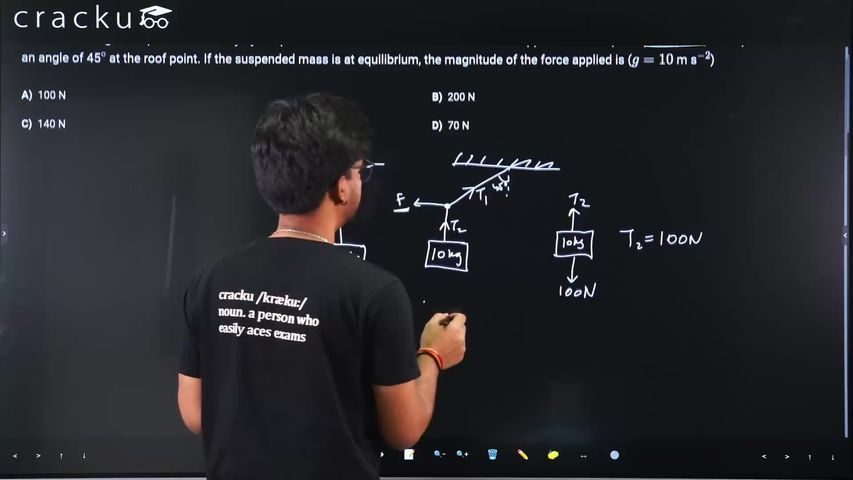
A mass of 10 kg is suspended vertically by a rope from the roof. When a horizontal force is applied on the rope at some point, the rope deviated at an angle of 45$$^{\circ}$$ at the roof point. If the suspended mass is at equilibrium, the magnitude of the force applied is ($$g = 10$$ m s$$^{-2}$$)
Let the mass be $$m = 10 \text{ kg}$$. Its weight acts vertically downward and is given by the well-known relation $$W = mg$$.
Substituting $$g = 10 \text{ m s}^{-2}$$, we get
$$W = m g = 10 \times 10 = 100 \text{ N}.$$
The horizontal pull applied somewhere on the rope makes the upper part of the rope tilt so that, at the roof, the rope now forms an angle $$\theta = 45^{\circ}$$ with the vertical. The whole system is stated to be in equilibrium; therefore the net force on the suspended mass is zero.
The only forces acting on the mass itself are
(i) its weight $$W = 100 \text{ N}$$ downward, and
(ii) the tension in the rope, $$T$$, directed along the rope, i.e. at $$45^{\circ}$$ to the vertical.
We resolve the tension into mutually perpendicular components, remembering the standard trigonometric relations
$$T_{\text{vertical}} = T \cos\theta, \qquad T_{\text{horizontal}} = T \sin\theta.$$
Because the mass neither rises nor falls, the vertical components must balance:
$$T\cos\theta = W.$$
Substituting $$\theta = 45^{\circ}$$ and $$W = 100 \text{ N}$$, we have
$$T \cos45^{\circ} = 100.$$
Using $$\cos45^{\circ} = \dfrac{\sqrt2}{2},$$ we obtain
$$T \left(\dfrac{\sqrt2}{2}\right) = 100 \;\;\Longrightarrow\;\; T = 100 \times \dfrac{2}{\sqrt2} = 100\sqrt2 \text{ N}.$$
Now we look at the horizontal balance. In equilibrium the horizontal component of the tension must be cancelled by the externally applied horizontal force, which we call $$F$$. Hence
$$F = T\sin\theta.$$
Again inserting $$\theta = 45^{\circ}$$ and $$T = 100\sqrt2 \text{ N},$$ we write
$$F = (100\sqrt2)\sin45^{\circ} = (100\sqrt2)\left(\dfrac{\sqrt2}{2}\right).$$
Simplifying the product of the radicals,
$$F = 100 \left(\dfrac{\sqrt2 \times \sqrt2}{2}\right) = 100 \left(\dfrac{2}{2}\right) = 100 \text{ N}.$$
Hence, the correct answer is Option A.
Was this solution helpful?
Click on the Email ☝️ to Watch the Video Solution
Create a FREE account and get:
_1.webp)

Educational materials for JEE preparation

Ask our AI anything

AI can make mistakes. Please verify important information.
AI can make mistakes. Please verify important information.


