
Join Our JEE Preparation Group
Prep with like-minded aspirants; Get access to free daily tests and study material.
Sign in
Please select an account to continue using cracku.in
↓ →
Join Our JEE Preparation Group
Prep with like-minded aspirants; Get access to free daily tests and study material.
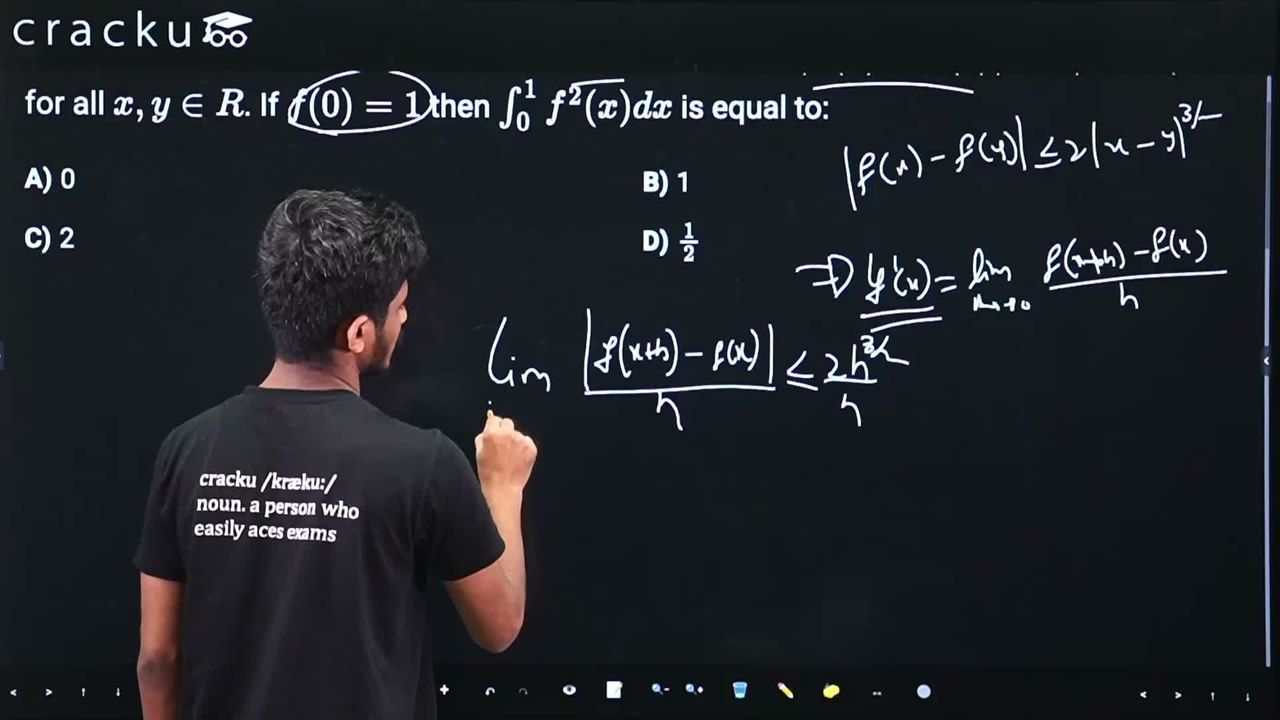
Let $$f$$ be a differentiable function from $$R$$ to $$R$$ such that $$|f(x) - f(y)| \leq 2|x - y|^{3/2}$$, for all $$x, y \in R$$. If $$f(0) = 1$$ then $$\int_0^1 f^2(x)dx$$ is equal to:
We are told that the real-valued function $$f$$ is differentiable on the whole real line and that for every pair of real numbers $$x$$ and $$y$$ the following Hölder-type estimate is true
$$|\,f(x)-f(y)\,|\;\le 2\,|x-y|^{3/2}.$$
Because $$f$$ is differentiable, we are free to look at the derivative defined by the limit of the difference quotient. We first rewrite the given inequality so that the difference of function values is divided by the difference of the arguments. Fix an arbitrary real number $$a$$ and put $$h$$ in place of $$x-a$$. Then $$x=a+h$$, and the inequality becomes
$$|\,f(a+h)-f(a)\,|\;\le 2\,|h|^{3/2}.$$
Dividing both sides by $$|h|$$ (possible for every non-zero $$h$$) we find
$$\Bigl|\dfrac{f(a+h)-f(a)}{h}\Bigr|\;\le 2\,|h|^{1/2}.$$
Now we let $$h \to 0$$. Since $$|h|^{1/2}\to 0$$, the right-hand side tends to $$0$$. Because the absolute value of the difference quotient is squeezed to $$0$$, the limit itself must be $$0$$. That limit is exactly the derivative $$f'(a)$$. Hence
$$f'(a)=0\qquad\text{for every }a\in\mathbb R.$$
So the derivative of $$f$$ is identically zero on the real line. From elementary calculus we know the following fact (Mean Value Theorem): if a differentiable function has zero derivative everywhere on an interval, then the function is constant on that interval. As our interval is all of $$\mathbb R$$, we conclude that
$$f(x)=C\qquad\text{for all }x\in\mathbb R,$$
where $$C$$ is a fixed real constant. The value of this constant is determined from the given datum $$f(0)=1$$, therefore
$$f(x)=1\qquad\text{for all }x\in\mathbb R.$$
With the explicit form of the function in hand, evaluating the required definite integral is immediate:
$$\int_{0}^{1}f^{2}(x)\,dx \;=\; \int_{0}^{1}1^{2}\,dx \;=\; \int_{0}^{1}1\,dx \;=\; \bigl[x\bigr]_{0}^{1} \;=\; 1-0 \;=\; 1.$$
Hence, the correct answer is Option B.
Was this solution helpful?
Click on the Email ☝️ to Watch the Video Solution
Create a FREE account and get:
_1.webp)

Educational materials for JEE preparation

Ask our AI anything

AI can make mistakes. Please verify important information.
AI can make mistakes. Please verify important information.


