
Join Our JEE Preparation Group
Prep with like-minded aspirants; Get access to free daily tests and study material.
Sign in
Please select an account to continue using cracku.in
↓ →
Join Our JEE Preparation Group
Prep with like-minded aspirants; Get access to free daily tests and study material.
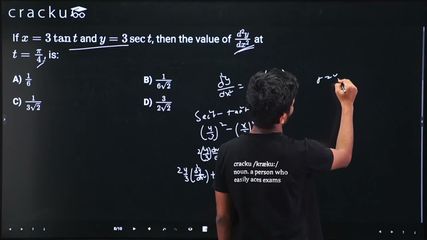
If $$x = 3\tan t$$ and $$y = 3\sec t$$, then the value of $$\frac{d^2y}{dx^2}$$ at $$t = \frac{\pi}{4}$$, is:
We are given the parametric relations $$x = 3\tan t \quad \text{and} \quad y = 3\sec t.$$ Our goal is to find the second derivative $$\dfrac{d^{2}y}{dx^{2}}$$ at the particular value $$t = \dfrac{\pi}{4}.$$
For curves expressed parametrically, the first derivative with respect to $$x$$ is obtained through the chain rule as
$$\frac{dy}{dx} \;=\; \frac{\dfrac{dy}{dt}}{\dfrac{dx}{dt}}.$$
We therefore begin by differentiating $$x$$ and $$y$$ with respect to the parameter $$t$$.
Starting with $$x = 3\tan t$$, we use the standard derivative $$\dfrac{d}{dt}(\tan t) = \sec^{2}t$$. Hence
$$\frac{dx}{dt} \;=\; 3\sec^{2}t.$$
Next, for $$y = 3\sec t$$, we recall the derivative $$\dfrac{d}{dt}(\sec t) = \sec t\tan t$$. Thus
$$\frac{dy}{dt} \;=\; 3\sec t \tan t.$$
Substituting these two results into the first-derivative formula gives
$$\frac{dy}{dx} \;=\; \frac{3\sec t \tan t}{3\sec^{2}t} \;=\; \frac{\sec t \tan t}{\sec^{2}t} \;=\; \tan t \cdot \frac{\sec t}{\sec^{2}t} \;=\; \tan t \cdot \cos t \;=\; \sin t.$$
We now have the simple expression $$\dfrac{dy}{dx} = \sin t.$$
To obtain the second derivative, we first differentiate $$\dfrac{dy}{dx}$$ with respect to $$t$$:
$$\frac{d}{dt}\!\left(\frac{dy}{dx}\right) \;=\; \frac{d}{dt}(\sin t) \;=\; \cos t.$$
The standard formula for the second derivative in parametric form is
$$\frac{d^{2}y}{dx^{2}} \;=\; \frac{\dfrac{d}{dt}\!\left(\dfrac{dy}{dx}\right)} {\dfrac{dx}{dt}}.$$
Substituting the values we have already obtained, we write
$$\frac{d^{2}y}{dx^{2}} \;=\; \frac{\cos t}{3\sec^{2}t} \;=\; \cos t \cdot \frac{\cos^{2}t}{3} \;=\; \frac{\cos^{3}t}{3}.$$
We now evaluate this at the specified parameter value $$t=\dfrac{\pi}{4}$$. For $$t = \dfrac{\pi}{4}$$ we know $$\cos\!\left(\dfrac{\pi}{4}\right)=\dfrac{1}{\sqrt2}$$. Therefore,
$$\cos^{3}\!\left(\frac{\pi}{4}\right) \;=\; \left(\frac{1}{\sqrt2}\right)^{3} \;=\; \frac{1}{2\sqrt2}.$$
Putting this into the expression for the second derivative, we obtain
$$\frac{d^{2}y}{dx^{2}}\Bigg|_{\,t=\frac{\pi}{4}} \;=\; \frac{1}{3} \cdot \frac{1}{2\sqrt2} \;=\; \frac{1}{6\sqrt2}.$$
Hence, the correct answer is Option B.
Was this solution helpful?
Click on the Email ☝️ to Watch the Video Solution
Create a FREE account and get:
_1.webp)

Educational materials for JEE preparation

Ask our AI anything

AI can make mistakes. Please verify important information.
AI can make mistakes. Please verify important information.


