
Join Our JEE Preparation Group
Prep with like-minded aspirants; Get access to free daily tests and study material.
Sign in
Please select an account to continue using cracku.in
↓ →
Join Our JEE Preparation Group
Prep with like-minded aspirants; Get access to free daily tests and study material.
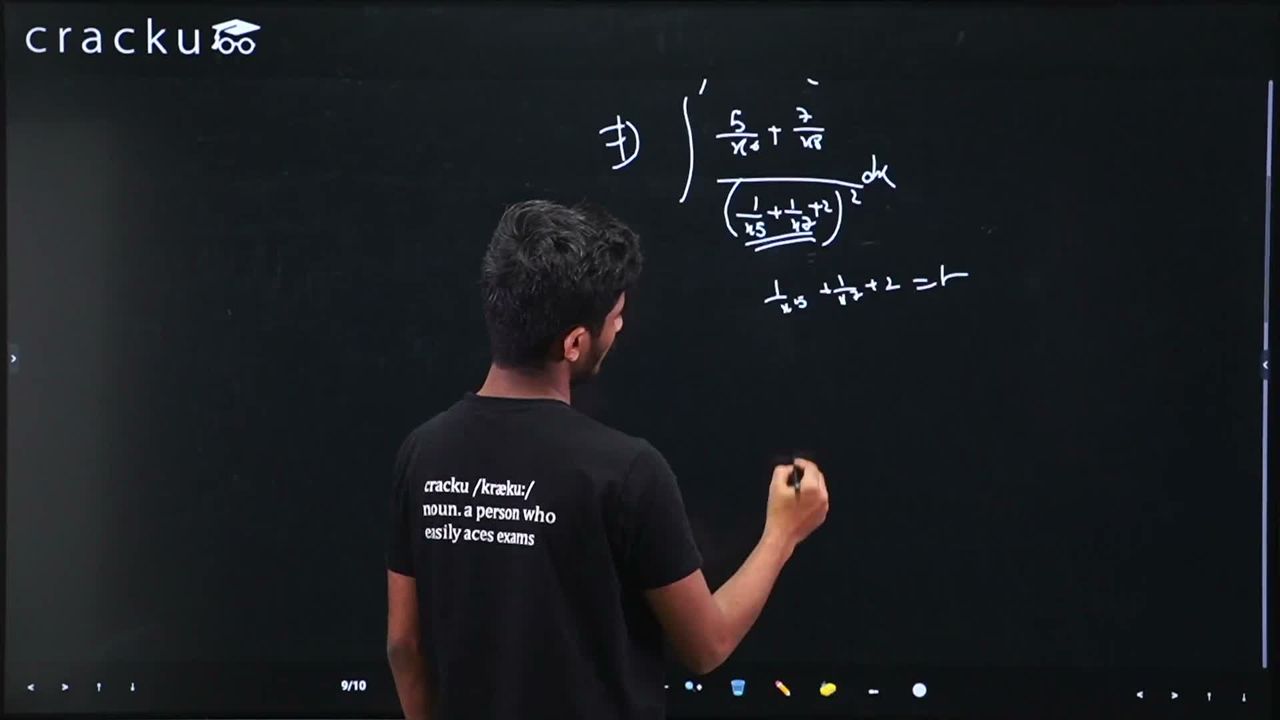
If $$f(x) = \int \frac{(5x^8 + 7x^6)}{(x^2 + 1 + 2x^7)^2}dx$$, $$(x \geq 0)$$, and $$f(0) = 0$$, then the value of $$f(1)$$ is:
We have to evaluate $$f(1)$$ when
$$f(x)=\int \dfrac{5x^{8}+7x^{6}}{(x^{2}+1+2x^{7})^{2}}\;dx,\qquad x\ge 0,$$
with the initial condition $$f(0)=0.$$
The integrand looks like the derivative of a quotient. We therefore search for a function of the form
$$\dfrac{u(x)}{v(x)}$$
whose derivative gives exactly
$$\dfrac{5x^{8}+7x^{6}}{(x^{2}+1+2x^{7})^{2}}.$$
Observe that the denominator of the integrand is $$(x^{2}+1+2x^{7})^{2},$$ so it is natural to try
$$v(x)=x^{2}+1+2x^{7}\quad\text{and}\quad u(x)=x^{7}.$$
First, we compute $$v'(x).$$
Since $$v(x)=x^{2}+1+2x^{7},$$ we get
$$v'(x)=\dfrac{d}{dx}(x^{2})+\dfrac{d}{dx}(1)+\dfrac{d}{dx}(2x^{7}) =2x+14x^{6}.$$
Next, we recall the quotient‐rule formula:
$$\dfrac{d}{dx}\!\left(\dfrac{u}{v}\right) =\dfrac{u'\,v-u\,v'}{v^{2}}.$$
Apply the formula to $$\dfrac{x^{7}}{x^{2}+1+2x^{7}}:$$
• Compute $$u'(x):$$ since $$u(x)=x^{7},$$ we have $$u'(x)=7x^{6}.$$
• Plug $$u,\,u',\,v,\,v'$$ into the quotient rule:
$$\dfrac{d}{dx}\!\left(\dfrac{x^{7}}{x^{2}+1+2x^{7}}\right) =\dfrac{7x^{6}(x^{2}+1+2x^{7})-x^{7}(2x+14x^{6})}{(x^{2}+1+2x^{7})^{2}}.$$
Now we expand the numerator carefully.
First term:
$$7x^{6}(x^{2}+1+2x^{7})
=7x^{6}\cdot x^{2}+7x^{6}\cdot1+7x^{6}\cdot2x^{7}
=7x^{8}+7x^{6}+14x^{13}.$$
Second term:
$$x^{7}(2x+14x^{6})
=x^{7}\cdot2x+x^{7}\cdot14x^{6}
=2x^{8}+14x^{13}.$$
Subtracting the second term from the first (as dictated by the quotient rule) gives
$$\bigl(7x^{8}+7x^{6}+14x^{13}\bigr)-\bigl(2x^{8}+14x^{13}\bigr) =7x^{8}-2x^{8}+7x^{6}+14x^{13}-14x^{13} =5x^{8}+7x^{6}.$$
Thus we have derived
$$\dfrac{d}{dx}\!\left(\dfrac{x^{7}}{x^{2}+1+2x^{7}}\right) =\dfrac{5x^{8}+7x^{6}}{(x^{2}+1+2x^{7})^{2}},$$
which matches the integrand exactly. Therefore
$$\int \dfrac{5x^{8}+7x^{6}}{(x^{2}+1+2x^{7})^{2}}\;dx =\dfrac{x^{7}}{x^{2}+1+2x^{7}}+C,$$
where $$C$$ is the constant of integration.
Given $$f(0)=0,$$ we substitute $$x=0$$ to determine $$C$$:
$$f(0)=\dfrac{0^{7}}{0^{2}+1+2\cdot0^{7}}+C =\dfrac{0}{1}+C =C.$$
But $$f(0)=0,$$ so $$C=0.$$ Hence
$$f(x)=\dfrac{x^{7}}{x^{2}+1+2x^{7}}.$$
Now we need $$f(1).$$ Substituting $$x=1$$ gives
$$f(1)=\dfrac{1^{7}}{1^{2}+1+2\cdot1^{7}} =\dfrac{1}{1+1+2} =\dfrac{1}{4}.$$
Hence, the correct answer is Option C.
Was this solution helpful?
Click on the Email ☝️ to Watch the Video Solution
Create a FREE account and get:
_1.webp)

Educational materials for JEE preparation

Ask our AI anything

AI can make mistakes. Please verify important information.
AI can make mistakes. Please verify important information.


