
Join Our JEE Preparation Group
Prep with like-minded aspirants; Get access to free daily tests and study material.
Sign in
Please select an account to continue using cracku.in
↓ →
Join Our JEE Preparation Group
Prep with like-minded aspirants; Get access to free daily tests and study material.
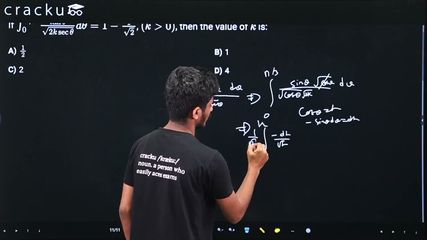
If $$\int_0^{\pi/3} \frac{\tan\theta}{\sqrt{2k\sec\theta}} d\theta = 1 - \frac{1}{\sqrt{2}}$$, $$(k \gt 0)$$, then the value of $$k$$ is:
We begin with the given integral
$$\int_{0}^{\pi/3} \frac{\tan\theta}{\sqrt{2k\sec\theta}}\;d\theta = 1-\frac1{\sqrt2}, \qquad (k\gt 0).$$
First we rewrite the integrand in terms of $$\sin\theta$$ and $$\cos\theta$$. We have the identities $$\tan\theta=\frac{\sin\theta}{\cos\theta},\qquad\sec\theta=\frac1{\cos\theta}.$$ Substituting these,
$$\frac{\tan\theta}{\sqrt{2k\sec\theta}} \;=\; \frac{\dfrac{\sin\theta}{\cos\theta}} {\sqrt{2k\left(\dfrac1{\cos\theta}\right)}} \;=\; \frac{\dfrac{\sin\theta}{\cos\theta}} {\dfrac{\sqrt{2k}}{\sqrt{\cos\theta}}} \;=\; \frac{\sin\theta}{\sqrt{2k}}\, \frac{\sqrt{\cos\theta}}{\cos\theta} \;=\; \frac{\sin\theta}{\sqrt{2k}\,\sqrt{\cos\theta}}.$$
So the integral becomes
$$\int_{0}^{\pi/3} \frac{\tan\theta}{\sqrt{2k\sec\theta}}\;d\theta \;=\; \frac1{\sqrt{2k}} \int_{0}^{\pi/3} \sin\theta\,(\cos\theta)^{-1/2}\;d\theta.$$
Let us denote the inner integral by $$I$$:
$$I = \int_{0}^{\pi/3} \sin\theta\,(\cos\theta)^{-1/2}\;d\theta.$$
To evaluate $$I$$ we use the substitution $$u=\cos\theta$$. Then $$du=-\sin\theta\,d\theta \;\Longrightarrow\; \sin\theta\,d\theta=-du.$$ When $$\theta=0$$, $$u=\cos0=1$$; when $$\theta=\pi/3$$, $$u=\cos(\pi/3)=\tfrac12$$. Hence
$$I =\int_{u=1}^{1/2} (-u^{-1/2})\,du =\int_{1/2}^{1} u^{-1/2}\,du,$$ where we have reversed the limits to remove the minus sign.
We now recall the elementary power-rule for integration: $$\int u^{n}\,du=\frac{u^{\,n+1}}{n+1}+C\quad(n\neq-1).$$ With $$n=-\tfrac12$$, we get
$$\int u^{-1/2}\,du = \frac{u^{1/2}}{1/2} = 2u^{1/2}.$$
Applying the limits,
$$I = 2\bigl(u^{1/2}\bigr)\Big|_{1/2}^{1} = 2\left(\sqrt1-\sqrt{\tfrac12}\right) = 2\left(1-\frac1{\sqrt2}\right).$$
Returning to the original integral, we now have
$$\int_{0}^{\pi/3} \frac{\tan\theta}{\sqrt{2k\sec\theta}}\;d\theta = \frac1{\sqrt{2k}} \; I = \frac1{\sqrt{2k}}\; 2\left(1-\frac1{\sqrt2}\right) = \frac{2\left(1-\dfrac1{\sqrt2}\right)}{\sqrt{2k}}.$$
The question tells us that this equals $$1-\frac1{\sqrt2},$$ so we equate:
$$\frac{2\left(1-\dfrac1{\sqrt2}\right)}{\sqrt{2k}} = 1-\frac1{\sqrt2}.$$
The common factor $$(1-\dfrac1{\sqrt2})$$ appears on both sides and is non-zero, so we cancel it to get
$$\frac{2}{\sqrt{2k}} = 1.$$
Multiplying both sides by $$\sqrt{2k}$$ gives $$2=\sqrt{2k},$$ and squaring both sides yields $$4 = 2k.$$ Finally, dividing by $$2$$ we find
$$k = 2.$$
Hence, the correct answer is Option C.
Was this solution helpful?
Click on the Email ☝️ to Watch the Video Solution
Create a FREE account and get:
_1.webp)

Educational materials for JEE preparation

Ask our AI anything

AI can make mistakes. Please verify important information.
AI can make mistakes. Please verify important information.


