
Join Our JEE Preparation Group
Prep with like-minded aspirants; Get access to free daily tests and study material.
Sign in
Please select an account to continue using cracku.in
↓ →
Join Our JEE Preparation Group
Prep with like-minded aspirants; Get access to free daily tests and study material.
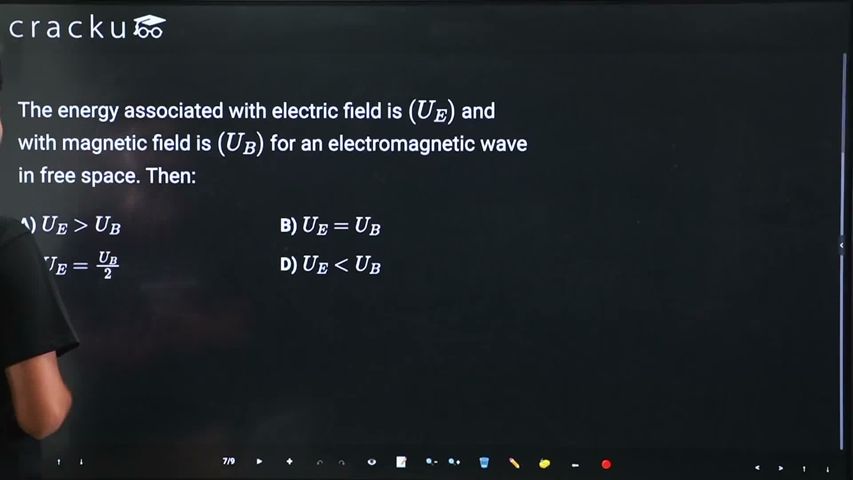
The energy associated with electric field is $$(U_E)$$ and with magnetic field is $$(U_B)$$ for an electromagnetic wave in free space. Then:
The energy stored per unit volume (energy density) in an electric field of magnitude $$E$$ in free space is given by the well-known electrostatic formula
$$u_E \;=\;\dfrac{1}{2}\,\varepsilon_0\,E^{\,2},$$
where $$\varepsilon_0$$ is the permittivity of free space.
In exactly the same way, the energy density in a magnetic field of magnitude $$B$$ is obtained from magnetostatics as
$$u_B \;=\;\dfrac{1}{2\mu_0}\,B^{\,2},$$
with $$\mu_0$$ being the permeability of free space.
For a plane electromagnetic wave travelling in free space, the magnitudes of its electric and magnetic fields are not independent; they obey the intrinsic relation
$$E \;=\;c\,B,$$
where $$c$$ is the speed of light in vacuum. We shall now exploit this relation to compare $$u_E$$ and $$u_B$$.
First, solve the above relation for $$B$$:
$$B \;=\;\dfrac{E}{c}.$$
We substitute this expression for $$B$$ into $$u_B$$:
$$u_B \;=\;\dfrac{1}{2\mu_0}\,\Bigl(\dfrac{E}{c}\Bigr)^{\!2} \;=\;\dfrac{1}{2\mu_0}\,\dfrac{E^{\,2}}{c^{\,2}}.$$
Now, recall the defining equation that links the electromagnetic constants with the speed of light,
$$c^{\,2} \;=\;\dfrac{1}{\mu_0\,\varepsilon_0}.$$
Therefore, its reciprocal is
$$\dfrac{1}{c^{\,2}} \;=\;\mu_0\,\varepsilon_0.$$
Substituting $$1/c^{\,2} = \mu_0\varepsilon_0$$ into the expression for $$u_B$$ gives
$$u_B \;=\;\dfrac{1}{2\mu_0}\,E^{\,2}\,(\mu_0\varepsilon_0) \;=\;\dfrac{1}{2}\,\varepsilon_0\,E^{\,2}.$$
But this is precisely the expression we obtained earlier for $$u_E$$. Hence,
$$u_E \;=\;u_B.$$
The energy carried by an electromagnetic wave in free space is therefore shared equally between its electric and magnetic fields.
Hence, the correct answer is Option B.
Was this solution helpful?
Click on the Email ☝️ to Watch the Video Solution
Create a FREE account and get:
_1.webp)

Educational materials for JEE preparation

Ask our AI anything

AI can make mistakes. Please verify important information.
AI can make mistakes. Please verify important information.


