
Join Our JEE Preparation Group
Prep with like-minded aspirants; Get access to free daily tests and study material.
Sign in
Please select an account to continue using cracku.in
↓ →
Join Our JEE Preparation Group
Prep with like-minded aspirants; Get access to free daily tests and study material.
The products formed in the reaction of cumene with $$O_2$$ followed by treatment with dil HCl are:
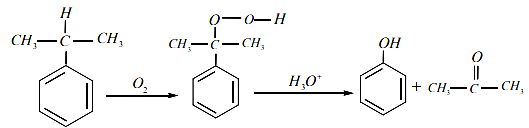
Step 1: Radical Oxidation to Cumene Hydroperoxide
When cumene is reacted with oxygen ($$\text{O}_2$$) in the presence of air, a free-radical oxidation process occurs selectively at the highly reactive tertiary benzylic carbon atom. This leads to the formation of cumene hydroperoxide as a stable intermediate:
$$\text{C}_6\text{H}_5\text{--CH(CH}_3)_2 + \text{O}_2 \rightarrow \text{C}_6\text{H}_5\text{--C(CH}_3)_2\text{--O--O--H}$$Step 2: Acid-Catalyzed Cleavage (Hock Rearrangement)
Subsequent treatment of cumene hydroperoxide with dilute hydrochloric acid ($$\text{dil. HCl}$$ or $$\text{H}^\oplus$$) protonates the terminal oxygen atom. This triggers a simultaneous 1,2-phenyl migration to the electron-deficient oxygen atom with the loss of a water molecule.
The resulting oxacarbocation intermediate is then attacked by water, undergoing proton transfer and bond cleavage to yield two highly valuable chemical industrial products: Phenol and Acetone (propan-2-one).
$$\text{C}_6\text{H}_5\text{--C(CH}_3)_2\text{--O--O--H} \xrightarrow{\text{H}^\oplus, \, \text{H}_2\text{O}} \text{C}_6\text{H}_5\text{OH} + \text{CH}_3\text{--CO--CH}_3$$The industrial preparation of phenol from cumene cleanly delivers phenol as the principal product along with acetone as a commercially significant co-product.
Answer: Option C — Phenol and Acetone
Was this solution helpful?
Click on the Email ☝️ to Watch the Video Solution
Create a FREE account and get:
_1.webp)

Educational materials for JEE preparation

Ask our AI anything

AI can make mistakes. Please verify important information.
AI can make mistakes. Please verify important information.


