
Join Our JEE Preparation Group
Prep with like-minded aspirants; Get access to free daily tests and study material.
Sign in
Please select an account to continue using cracku.in
↓ →
Join Our JEE Preparation Group
Prep with like-minded aspirants; Get access to free daily tests and study material.
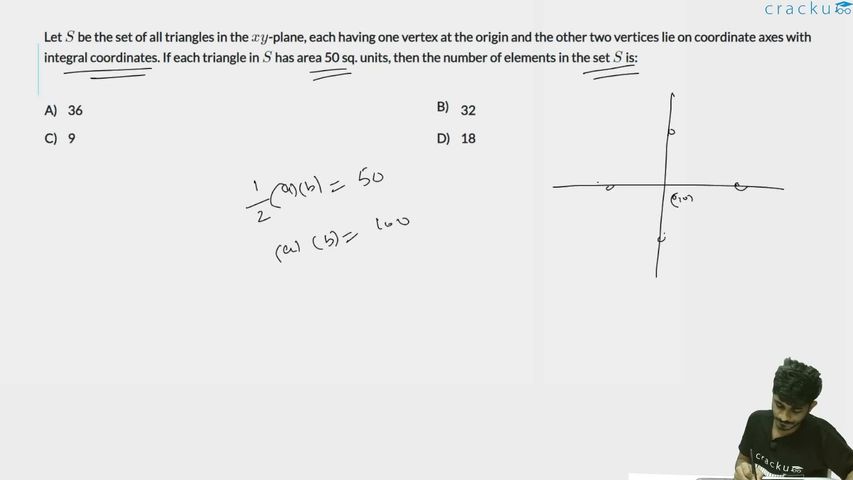
Let $$S$$ be the set of all triangles in the $$xy$$-plane, each having one vertex at the origin and the other two vertices lie on coordinate axes with integral coordinates. If each triangle in $$S$$ has area 50 sq. units, then the number of elements in the set $$S$$ is:
Let the point on the x-axis be $$P(a,0)$$ and the point on the y-axis be $$Q(0,b)$$, where $$a$$ and $$b$$ are non-zero integers (they may be positive or negative).
Because $$OP$$ lies on the x-axis and $$OQ$$ lies on the y-axis, the angle at the origin is a right angle. For a right-angled triangle whose perpendicular sides have lengths $$|a|$$ and $$|b|$$, we first state the familiar area formula:
$$\text{Area}=\dfrac12 \times (\text{base}) \times (\text{height}).$$
Using $$|a|$$ as the base and $$|b|$$ as the height, we have
$$\text{Area}=\dfrac12\,|a|\,|b|.$$
The question tells us this area equals $$50$$, so
$$\dfrac12\,|a|\,|b| = 50 \quad\Longrightarrow\quad |a|\,|b| = 100.$$
Now we must find all ordered pairs of positive integers $$(|a|,|b|)$$ whose product is $$100$$. We factorise $$100$$:
$$100 = 2^2 \cdot 5^2.$$
For a number $$n=p_1^{\alpha_1}\,p_2^{\alpha_2}\dots$$, the total number of positive divisors is $$(\alpha_1+1)(\alpha_2+1)\dots$$. Therefore $$100$$ has $$(2+1)(2+1)=9$$ positive divisors.
Choosing any positive divisor $$d$$ as $$|a|$$ determines $$|b|$$ uniquely as $$\dfrac{100}{d}$$, so there are exactly $$9$$ ordered pairs $$(|a|,|b|)$$ satisfying $$|a||b|=100$$.
Next we remember that $$a$$ and $$b$$ themselves can be either positive or negative independently. For each absolute-value pair we thus have the four possibilities
$$(|a|,|b|)\;\rightarrow\;(+|a|,+|b|),\;(+|a|,-|b|),\;(-|a|,+|b|),\;(-|a|,-|b|).$$
These four sign choices place the points $$P$$ and $$Q$$ on the positive or negative parts of their respective axes, giving four distinct triangles.
Therefore, the total number of triangles is
$$9 \times 4 = 36.$$
Hence, the correct answer is Option A.
Was this solution helpful?
Click on the Email ☝️ to Watch the Video Solution
Create a FREE account and get:
_1.webp)

Educational materials for JEE preparation

Ask our AI anything

AI can make mistakes. Please verify important information.
AI can make mistakes. Please verify important information.


