
Join Our JEE Preparation Group
Prep with like-minded aspirants; Get access to free daily tests and study material.
Sign in
Please select an account to continue using cracku.in
↓ →
Join Our JEE Preparation Group
Prep with like-minded aspirants; Get access to free daily tests and study material.
The correct match between Item I and Item II is:
Item I Item II
(A) Benzaldehyde (P) Mobile phase
(B) Alumina (Q) Adsorbent
(C) Acetonitrile (R) Adsorbate
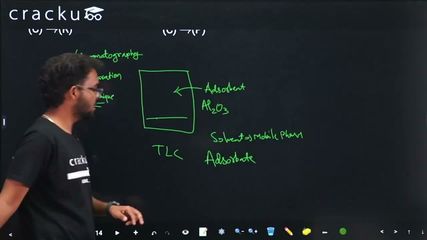
First, let us recall some basic terminology used in chromatographic techniques. The substance that forms the stationary surface on which separation occurs is called the adsorbent. The solvent or mixture of solvents that moves through this stationary phase is known as the mobile phase. Any compound that is being separated or analysed and therefore gets held, at least temporarily, on the stationary phase is referred to as the adsorbate.
With these definitions in mind, we identify which substance of Item I plays which role mentioned in Item II.
We have benzaldehyde, $$\mathrm{C_6H_5CHO}$$. This is an organic compound that one would normally inject or spot on the chromatographic plate or load into the column to be separated from other components. Thus benzaldehyde itself is the species that gets adsorbed on the surface of the stationary phase. Because the substance being separated is, by definition, the adsorbate, we can say
$$\text{Benzaldehyde} \; \longrightarrow \; \text{Adsorbate}.$$
Hence, benzaldehyde of Item I matches with $$\text{Item II : R (Adsorbate)}$$.
Now we look at alumina, chemically written as $$\mathrm{Al_2O_3}$$. In chromatographic practice, finely powdered alumina is commonly packed in columns or coated on plates to provide the surface to which different molecules can adhere with different strengths. The solid that provides this surface is precisely what is known as the adsorbent. Therefore,
$$\text{Alumina} \; \longrightarrow \; \text{Adsorbent}.$$
So alumina of Item I associates with $$\text{Item II : Q (Adsorbent)}$$.
Finally, we examine acetonitrile, $$\mathrm{CH_3CN}$$. It is a polar aprotic solvent widely employed as the flowing liquid in high-performance liquid chromatography (HPLC) and other chromatographic systems. Because it is the liquid that moves through the stationary phase carrying the sample along, acetonitrile functions as the mobile phase. Therefore,
$$\text{Acetonitrile} \; \longrightarrow \; \text{Mobile phase}.$$
This gives the match of acetonitrile with $$\text{Item II : P (Mobile phase)}$$.
Collecting all three pairings obtained above, we have
$$\begin{aligned} (A)&\; \text{Benzaldehyde} &\rightarrow&\; (R)\\ (B)&\; \text{Alumina} &\rightarrow&\; (Q)\\ (C)&\; \text{Acetonitrile} &\rightarrow&\; (P) \end{aligned}$$
Comparing this ordered list with the options provided, we see that it coincides exactly with Option B.
Hence, the correct answer is Option B.
Was this solution helpful?
Click on the Email ☝️ to Watch the Video Solution
Create a FREE account and get:
_1.webp)

Educational materials for JEE preparation

Ask our AI anything

AI can make mistakes. Please verify important information.
AI can make mistakes. Please verify important information.


