
Join Our JEE Preparation Group
Prep with like-minded aspirants; Get access to free daily tests and study material.
Sign in
Please select an account to continue using cracku.in
↓ →
Join Our JEE Preparation Group
Prep with like-minded aspirants; Get access to free daily tests and study material.
In the given circuit the internal resistance of the 18V cell is negligible. If $$R_1 = 400$$ $$\Omega$$, $$R_3 = 100$$ $$\Omega$$ and $$R_4 = 500$$ $$\Omega$$ and the reading of an ideal voltmeter across $$R_4$$ is 5 V, then the value of $$R_2$$ will be:
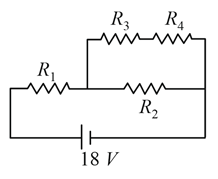
Current flowing through $$R_4$$ (and the $$R_3\text{-}R_4$$ series branch): $$I_{34} = \frac{V_4}{R_4} = \frac{5}{500} = 0.01\text{ A}$$
Total voltage drop across the upper branch ($$R_3 + R_4$$): $$V_{34} = I_{34}(R_3 + R_4) = 0.01(100 + 500) = 0.01 \times 600 = 6\text{ V}$$
Since the branch ($$R_3 + R_4$$) is in parallel with $$R_2$$, the voltage across this parallel network is:
$$V_{\text{parallel}} = V_{34} = 6\text{ V}$$
Voltage drop across $$R_1$$ using Kirchhoff's Voltage Law: $$V_1 = V - V_{\text{parallel}} = 18 - 6 = 12\text{ V}$$
Total circuit current passing through $$R_1$$: $$I_{\text{total}} = \frac{V_1}{R_1} = \frac{12}{400} = 0.03\text{ A}$$
Current flowing through $$R_2$$: $$I_2 = I_{\text{total}} - I_{34} = 0.03 - 0.01 = 0.02\text{ A}$$
Calculating the value of $$R_2$$: $$R_2 = \frac{V_{\text{parallel}}}{I_2} = \frac{6}{0.02} = 300\ \Omega$$
Was this solution helpful?
Create a FREE account and get:
_1.webp)

Educational materials for JEE preparation

Ask our AI anything

AI can make mistakes. Please verify important information.
AI can make mistakes. Please verify important information.


